

Study in Europe

Don't know what to do?
Get Free Counseling
Study in Europe from the UAE: Top Countries, Requirements, Cost & Application
For students in the UAE, studying in Europe is a great opportunity to receive a quality education, experience different cultures and build a successful career. Europe offers many universities with affordable tuition fees, scholarships and a wide range of courses for international students. Students from the UAE can choose from popular study destinations such as Germany, France, Czech Republic, Italy, Poland and Hungary. Each country offers different admission requirements, tuition fees, visa options and work opportunities.
International Student Statistics in Europe
- Germany: Around 516,820 students from other countries were studying at German universities in the 2025/26 winter semester.
- France: Around 443,500 foreign students were studying at French colleges and universities in the 2024/25 academic year.
- Popular Destinations: Germany and France are popular choices for international students because of their universities, courses and job opportunities.
- Study Opportunities: Students can choose from bachelor's, master's and PhD programmes in many European countries.
Note: The figures use different counting methods, so they cannot be directly compared.
*Looking to study abroad? Talk to experts at Y-Axis to guide you with the steps.
Why Study in Europe from the UAE?
Europe is a popular choice for students from the UAE because it offers quality education, different cultures and good career opportunities. Here are some key reasons to study in Europe:
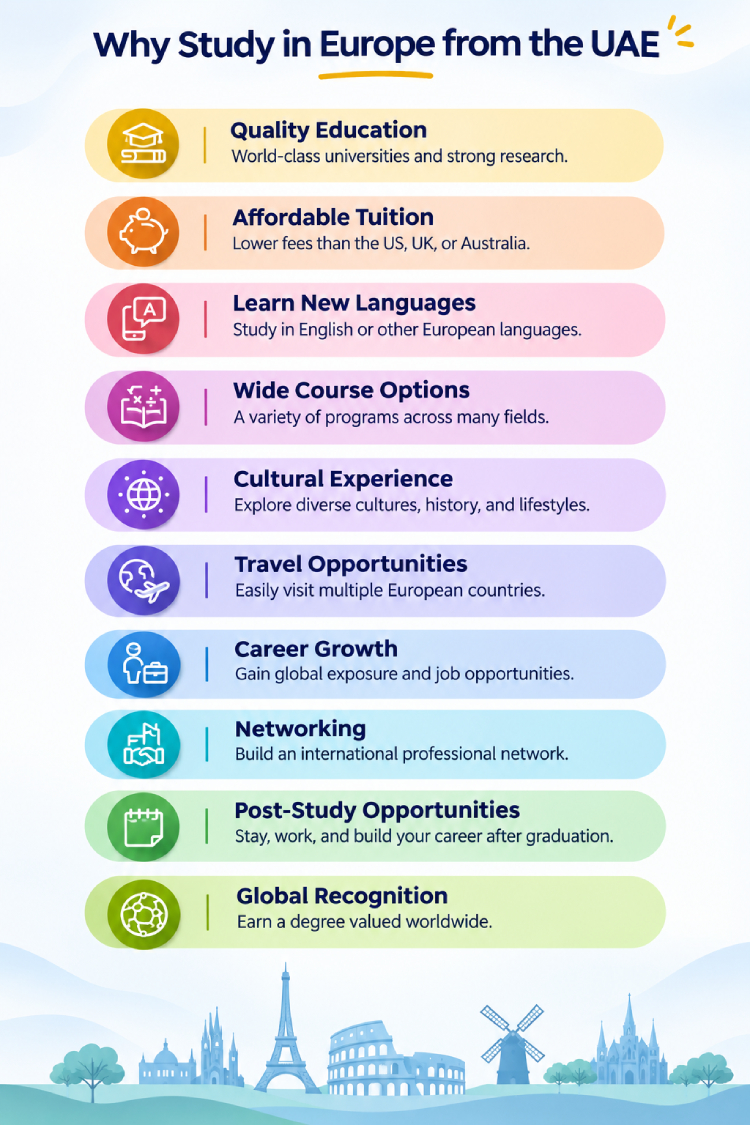
- Quality Education: European universities are known for their high education standards, research facilities and practical learning.
- Affordable Tuition Fees: Many public universities offer lower tuition fees than universities in other popular study destinations. Some countries also provide low-cost or tuition-free options for eligible courses.
- English-Taught Courses: Students can choose from many English-taught bachelor's and master's programmes across Europe.
- Wide Course Options: European universities offer courses in business, engineering, medicine, IT, science, arts and many other fields.
- Cultural Experience: Students can experience different cultures, languages, food and lifestyles while studying abroad.
- Travel Opportunities: A valid Schengen visa or residence permit may allow eligible students to travel to other Schengen countries for short visits, subject to the travel rules.
- Part-Time Work Options: Many European countries allow international students to work while studying, but the permitted hours and conditions vary by country.
- Career Opportunities: Students can access internships, work placements and job opportunities during or after their studies, depending on local rules.
- Post-Study Stay Options: Several European countries offer options for eligible graduates to stay and look for work or start a business after completing their studies.
- International Exposure: Studying in Europe helps students build global connections, gain new skills and prepare for international careers.
Top Countries to Study in Europe for UAE Students
Europe offers UAE students quality education, affordable study options and good career opportunities. Here are some popular countries to consider:
| Country | Key highlights | Approx. tuition fees per year | Student work rights |
|---|---|---|---|
| Germany | Low-cost education; strong in engineering and technology. | Mostly free; around €300 semester contribution. | 140 full days or 280 half days per year. |
| France | Popular for business, fashion, arts and science. | €2,902 bachelor's; €3,950 master's at affected public universities. | 964 hours per year. |
| Netherlands | Many English-taught courses and modern teaching. | €9,000–€20,000 bachelor's; €12,000–€30,000 master's. | 16 hours per week during term. |
| Italy | Known for design, architecture and fashion. | €900–€4,000. | 20 hours per week. |
| Spain | Good student life and cultural experience. | €700–€3,500. | Up to 30 hours per week. |
| Sweden | Strong in research, technology and innovation. | Varies by university and course. | Generally 15 hours per week for new permits from June 2026. |
| Ireland | English-speaking country with strong tech and business sectors. | Varies by course; often €10,300 or more. | 20 hours per week during term; 40 during holidays. |
| Finland | Quality education and modern facilities. | €9,000–€20,000. | Up to 30 hours per week on average. |
Top Universities in Europe for UAE Students
Europe is home to many world-renowned universities offering quality education, research opportunities and a wide range of courses. Students from the UAE can choose from top institutions in countries such as the UK, Germany, France, Switzerland and the Netherlands. Here are some of the top European universities based on the QS World University Rankings 2027.
| University name | QS World Rank 2027 | Country |
|---|---|---|
| Imperial College London | 2 | United Kingdom |
| University of Oxford | 4 | United Kingdom |
| University of Cambridge | 6 | United Kingdom |
| ETH Zurich | 8 (Joint) | Switzerland |
| University College London (UCL) | 8 (Joint) | United Kingdom |
| EPFL – École Polytechnique Fédérale de Lausanne | 22 (Joint) | Switzerland |
| Technical University of Munich | 25 | Germany |
| Université PSL | 34 | France |
| University of Edinburgh | 35 | United Kingdom |
| King's College London | 37 | United Kingdom |
| University of Manchester | 40 (Joint) | United Kingdom |
| Institut Polytechnique de Paris | 43 (Joint) | France |
| Delft University of Technology | 48 | Netherlands |
| University of Amsterdam | 53 | Netherlands |
| KU Leuven | 60 | Belgium |
| Politecnico di Milano | 98 | Italy |
| Lund University | 72 | Sweden |
| University of Copenhagen | 101 | Denmark |
| University of Barcelona | 160 | Spain |
| Trinity College Dublin | 75 | Ireland |
Popular Courses to Study in Europe
Europe is home to some of the world's most prestigious universities, offering internationally recognized degrees, excellent academic facilities, experienced faculty, and diverse career opportunities. Students can choose from a wide range of programs across engineering, business, computer science, medicine, and creative arts. The table below highlights the top courses in europe and their top universites.
| Field | Top 5 Universities in Europe | Popular Programs |
|---|---|---|
| Engineering & Technology | ETH Zurich (Switzerland), TU Munich (Germany), EPFL Lausanne (Switzerland), TU Delft (Netherlands), Politecnico di Milano (Italy) | Mechanical Engineering, Electrical Engineering, Robotics, AI, Civil Engineering |
| Business & Management | INSEAD (France), HEC Paris (France), London Business School (UK), Bocconi University (Italy), Erasmus University Rotterdam (Netherlands) | MBA, Finance, Marketing, International Business, Strategy |
| Computer Science & IT | University of Oxford (UK), ETH Zurich (Switzerland), University of Cambridge (UK), EPFL Lausanne (Switzerland), TU Munich (Germany) | Software Engineering, AI, Cybersecurity, Data Science |
| Medicine & Health Sciences | Karolinska Institute (Sweden), LMU Munich (Germany), University of Oxford (UK), University of Cambridge (UK), University of Milan (Italy) | Medicine, Public Health, Dentistry, Biomedicine |
| Arts, Design & Architecture | Politecnico di Milano (Italy), University of the Arts London (UK), Aalto University (Finland), Royal College of Art (UK), Design Academy Eindhoven (Netherlands) | Fashion Design, Interior Design, Architecture, Visual Arts |
What is a Europe Student Visa?
A European student visa allows international students from countries outside the EU, such as India and the UAE, to travel to and stay in a European country for their studies. Students who want to study in Europe may need a short-stay visa or a long-stay visa, depending on the length of their course and the country they choose.
A Type C visa is generally for short courses lasting up to 90 days, such as language courses, summer schools, or exchange programs. A Type D visa is generally for students planning to study for more than 90 days, such as bachelor's, master's, or PhD programs. Students staying for a longer period may also need to apply for a student residence permit after arriving in the country. In many European countries, international students are allowed to work part-time while studying, but the working hours and rules depend on the country.
Types of Europe Student Visas
Before applying to study in Europe, students should understand the different types of visas and permits available. The visa required depends on the duration of the course and the country where the student plans to study.
The following table explains the main types of student visas and their features.
| Visa Type | Duration | Purpose | Key Features |
|---|---|---|---|
| Type C Visa | Short stay (up to 90 days) | Language courses, exchange programs, and summer schools | Allows travel within the Schengen Area. Generally does not allow students to work. |
| Type D Visa | Long stay (more than 90 days) | Full-time university studies, including bachelor's, master's, and PhD programs | Allows students to stay for longer studies. May allow part-time work depending on the country. |
| Student Residence Permit | Depends on the country and course duration | Long-term stay for international students | Allows students to legally live in the country during their studies. Usually needs to be renewed when required. |
Who Can Apply for a Europe Student Visa from the UAE?
Citizens and residents of the UAE who have been admitted to a recognized European school are eligible to apply for a European student visa. A valid passport is needed, and applicants must fulfill the entry and financial criteria of their destination country. Students below the age of 18 might need to provide parental consent forms and guardianship records. Applicants for any course, whether short-term or full-time have to provide evidence of study purpose, lodging, and adequate funds for tuition and living costs throughout their stay in Europe.
Eligibility Criteria for a European Student Visa
To study in Europe, you must provide the following documents given below:
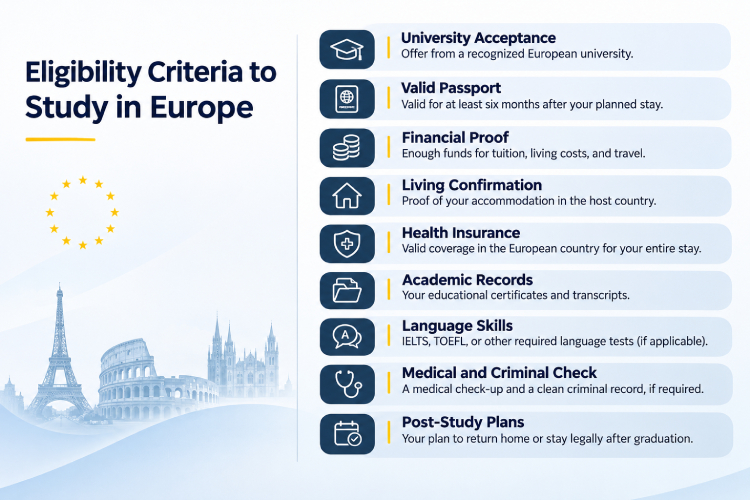
- Acceptance from a recognized European university.
- A passport valid for at least six months after your planned stay.
- Proof that you can pay for tuition, living costs, and travel.
- Confirmation of where you will be living.
- Health insurance that works in the European country for your entire stay.
- Academic records and certificates required by the university.
- Proof of your language skills (like IELTS or TOEFL) if studying in English.
- A medical check-up and a clean criminal record, if asked.
- Plans to return home after studying or to legally stay after you graduate (depending on your visa).
Documents Required to Study in Europe from the UAE
When applying for a European student visa from the UAE, prepare these documents:
- A passport that is valid for at least six months and has at least two blank pages.
- A university acceptance letter or enrollment certificate.
- A completed visa application form for the specific country.
- Recent passport-sized photos that meet the embassy's standards.
- Evidence of enough funds (bank statements, sponsor letter, or scholarship proof).
- Health insurance that works in the country where you will be studying.
- Proof of where you will be staying (university housing confirmation or a rental agreement).
- Transcripts and certificates from your previous schools.
- Language test scores (IELTS, TOEFL, or similar), if needed.
- A travel plan or flight booking (in some situations).
- A receipt for the visa application fee.
- A consent letter from your parents (if you are under 18).
How to Apply for a Student Visa for Europe – Step-by-Step Process
The process to apply for a student visa for Europe is given below.
Step 1: Apply to a European university that is recognized and get your acceptance letter.
Step 2: Collect the needed documents. This includes your passport, evidence of funds, health insurance, and where you plan to stay.
Step 3: Set up a meeting with the embassy, consulate, or visa application center for the country where you plan to study.
Step 4: Go to your scheduled meeting to hand in your documents, provide your biometric information, and pay the fee.
Step 5: Once your application is approved, you will get your passport back that includes your Study in Europe visa.
*Want guidance to apply for Study in Europe? Sign up with Y-Axis for comprehensive support with the process.
Cost of Studying in Europe from the UAE
The cost of studying in Europe depends on the country, university, course, and lifestyle of the student. Public universities in some European countries offer affordable tuition fees, while others charge higher fees for international students. Students should also consider accommodation, food, transport, and other daily expenses when planning their budget.
The table below provides an estimated overview of tuition fees and monthly living costs in popular European study destinations.
| Country | Average Tuition Fees (Public Universities) | Estimated Living Costs/Month |
|---|---|---|
| Germany | €0–€1,500 per year | €800–€1,100 |
| France | €200–€4,000 per year | €800–€1,200 |
| Netherlands | €8,000–€15,000 per year | €900–€1,300 |
| Italy | €1,000–€4,000 per year | €700–€1,100 |
| Spain | €1,000–€3,500 per year | €700–€1,000 |
| Sweden | €8,000–€18,000 per year | €900–€1,200 |
| Finland | €4,000–€13,000 per year | €700–€1,100 |
| Ireland | €10,000–€20,000 per year | €900–€1,400 |
Note: These are approximate costs and may vary depending on the university, course, city, and lifestyle. Tuition fees are indicative estimates for international students.
Europe Student Visa Processing Time
Student visa processing times vary depending on the country, visa type, application volume, and the documents submitted. Students are advised to apply early to avoid delays and complete the visa process before their course begins.
The table below provides an estimated overview of student visa processing times.
| Visa Type | Duration of Stay | Typical Processing Time |
|---|---|---|
| Type C (Short-Stay Visa) | Up to 90 days | 10–15 calendar days |
| Type D (Long-Stay Visa) | More than 90 days | 30–60 calendar days |
| Student Residence Permit | Depends on the country | Additional 2–8 weeks after arrival (estimated) |
Note: Processing times are approximate and differ from country to country. Some applications may take longer due to additional document checks, interviews, or high application volumes.
Scholarships for UAE Students to Study in Europe
Several European countries and universities offer scholarships to international students, including those from the UAE. These scholarships help reduce education costs by covering tuition fees, living expenses, travel, and insurance.
The table below highlights popular scholarships available to eligible international students.
| Scholarship Name | Amount / Value | What It Covers | Eligibility Criteria |
|---|---|---|---|
| Erasmus Mundus Scholarship | Full scholarship with monthly allowance | Tuition, travel, and living expenses | Open to students worldwide with a bachelor's degree and good academic results. |
| DAAD Scholarships (Germany) | €934–€1,300/month (varies) | Living expenses, insurance, and travel | Relevant academic qualification and strong academic performance. |
| Eiffel Excellence Scholarship (France) | €1,200/month (Master's); €2,100/month (PhD) | Monthly allowance, travel, and insurance | Outstanding international students nominated by French universities. |
| NL Scholarship (Netherlands) | €5,000 one-time payment (subject to current scheme) | Partial study expenses | Non-EEA students admitted to participating Dutch universities. |
| Swedish Institute Scholarship | Full tuition + monthly allowance | Tuition, living expenses, and insurance | Eligible international master's students with academic and leadership experience. |
| ETH Zurich Excellence Scholarship (Switzerland) | CHF 12,000/semester + tuition waiver | Living expenses and tuition | Excellent academic record and admission to an ETH master's program. |
| Italian Government Scholarships | Approximately €900/month (subject to current call) | Living expenses and possible tuition exemption | Eligible international students meeting academic and language requirements. |
| University of Geneva Excellence Fellowship | Varies; historically CHF 10,000–15,000/year | Financial support for master's studies | Outstanding students applying for eligible science master's programs. |
Can You Work While Studying in Europe?
Yes, international students can work while studying in many European countries. Students with a valid student visa or residence permit may be allowed to work part-time during their studies and full-time during certain holidays. However, the allowed working hours and permit requirements differ from country to country. Students should follow these rules to avoid visa problems and balance their studies with work. The following table provides an overview of student work rights in popular European destinations.
Work Hours Allowed for International Students in Europe
| Country | Allowed Work Hours (During Studies) | Full-Time During Holidays | Work Permit Required? |
|---|---|---|---|
| Germany | 140 full days or 280 half-days per year | Yes | No separate work permit generally required |
| France | Up to 964 hours per year (approximately 20 hours/week) | Yes, within the annual limit | No, with a valid student residence permit |
| Netherlands | 16 hours/week | Yes, June–August | Yes, employer must apply for a work permit |
| Italy | 20 hours/week (maximum 1,040 hours/year) | Yes | No separate work permit generally required |
| Spain | Up to 30 hours/week | Yes | No separate work permit, subject to student authorization |
| Sweden | No fixed weekly work-hour limit | Yes | No |
| Finland | Average of 30 hours/week | Yes, subject to applicable rules | No separate work permit |
| Ireland | 20 hours/week | 40 hours/week during permitted holidays | No, with valid Stamp 2 permission |
| Norway | 20 hours/week | Yes | No separate work permit, with a valid study permit |
| Switzerland | 15 hours/week (generally after six months) | Yes, subject to authorization | Yes, employer must apply |
Note: Work rules may vary depending on the student's visa, residence permit, and country regulations.
PR and Settlement Options After Studying in Europe
Many European countries offer international graduates opportunities to stay after completing their studies and look for employment. Students who find suitable jobs may later qualify for permanent residency (PR), depending on the country's immigration rules. The following table provides an overview of post-study work opportunities and possible PR pathways.
| Country | Post-Study Work Visa Duration | PR Eligibility Timeline | Key Requirements for PR / Settlement |
|---|---|---|---|
| Germany | 18 months after graduation | Generally 5 years, subject to eligibility | Qualified employment, stable income, language skills, and pension contributions |
| France | 12 months (some master's graduates may qualify for 24 months) | Generally 5 years | Employment, stable income, and French language skills |
| Netherlands | 12-month orientation year visa | Generally 5 years | Continuous legal residence, income requirements, and integration |
| Sweden | 12 months to find a job | Depends on residence and work permit history | Employment, financial stability, and applicable residence requirements |
| Finland | Up to 2 years to look for work or start a business | Depends on the applicable residence route | Continuous residence, income, and other residence permit requirements |
| Ireland | 12 months for bachelor's graduates; up to 24 months for master's and PhD graduates (Stamp 1G) | Generally 5 years of qualifying residence for relevant long-term routes | Eligible employment, qualifying residence, and financial stability |
| Italy | Up to 12 months to look for employment | Generally 5 years | Legal residence, employment, income, and integration requirements |
| Spain | Up to 12 months under the job-search residence option | Generally 5 years | Legal continuous residence, employment, and income requirements |
| Norway | Up to 12 months under a job-seeker permit | Generally 3 years under qualifying work immigration routes | Qualified employment, income, and language requirements where applicable |
| Switzerland | Limited post-study job-search options | Generally 10 years for non-EU/EFTA nationals, subject to exceptions | Employment, integration, language skills, and residence requirements |
Bringing Family While Studying in Europe
Students with long-stay visas or residence permits have the option to apply for family reunification to bring their spouse or children to the country. The requirements depend on the specific country but often include:
- Proof of sufficient funds to support the family
- Health insurance coverage for family members
- Evidence of suitable housing
- Processing times and the rights of family members, such as the ability to work or attend school, differ by country.
How Can Y-Axis Help You?
Y-Axis assists students from the UAE who want to study in Europe by offering complete support, which includes:
- Selecting a university suitable for the student.
- Aiding with applications and documentation.
- Preparing for visa applications and interviews.
- Offering advice on scholarships and funds.
- Coaching and IELTS preparation.
With years of expertise in international education, Y-Axis ensures a smooth and successful transition to Europe for students in the UAE.
Looking for inspiration
Explore what Global Citizens have to say about Y-Axis in shaping their future
Frequently Asked Questions

