


Editors Pick
Latest Article
Top 10 Countries for Physiotherapists to Work Abroad: Salary, Demand & PR Opportunities Compared
Top 10 Countries for Physiotherapists to Work Abroad: Salary, Demand & PR Opportunities Compared
The top 10 countries for Physiotherapists in the UAE to work abroad are Australia, Canada, the United Kingdom, Germany, New Zealand, the United States, Ireland, Switzerland, the Netherlands, and Norway. These countries offer strong job demand, competitive salaries, international recruitment opportunities, work visa options, and pathways to permanent residency or long-term settlement.
Demand for Physiotherapists is expected to grow further as the global physiotherapy services market is projected to reach USD 90.79 billion by 2033. Ageing populations, chronic conditions, sports injuries, and rising rehabilitation needs are expected to create more job opportunities for Physiotherapists across major healthcare markets worldwide.
*Want to work abroad? Sign up with Y-Axis Resume Marketing Services to find right job faster.
Benefits of Working Abroad as a Physiotherapist
Working abroad as a Physiotherapist can offer higher earning potential, employer-sponsored work opportunities, permanent residency pathways, family benefits, and better career growth.
- Higher earning potential: Access competitive salaries and employment benefits.
- Visa sponsorship: Secure employer-supported work visa opportunities.
- PR pathways: Qualify for skilled migration and permanent residency routes.
- Family benefits: Bring family members and access education and healthcare benefits.
- Career growth: Progress into specialist, senior clinical, or management roles.
How to Choose the Right Country for Physiotherapist Jobs Abroad?
Choosing the right country for Physiotherapist jobs abroad depends on salary, job demand, licensing requirements, work visa options, and long-term settlement goals.
- Compare salaries and living costs: Check potential savings after housing, taxes, transport, and daily expenses.
- Check job demand: Focus on countries recruiting Physiotherapists across hospitals, clinics, rehabilitation centres, and aged care.
- Review licensing requirements: Compare registration, qualification recognition, language tests, and assessment processes.
- Assess visa and PR options: Prioritise countries offering work visas, employer sponsorship, and permanent residency pathways.
- Consider family needs: Compare dependant visas, education, healthcare, and long-term settlement benefits.
Top 10 Countries for Physiotherapists to Work Abroad
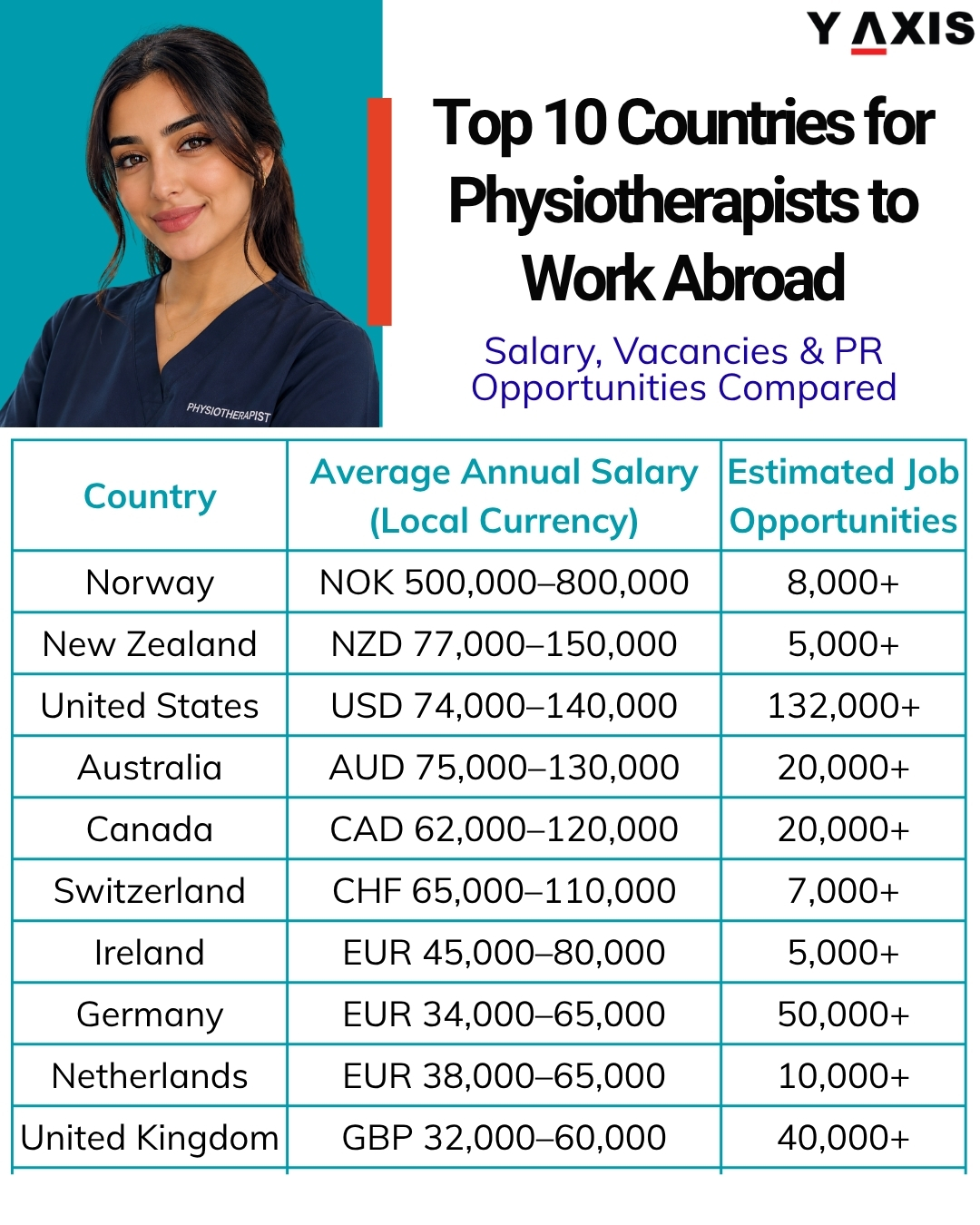
Physiotherapists can find high salaries, growing job demand, work visa options, and pathways to permanent residency in leading destinations abroad. They can earn around AED 370,000 per year in the United States, while Australia, Canada, and the United Kingdom recruit across hospitals, clinics, rehabilitation centres, and aged-care facilities. These countries also offer opportunities to specialise in sports physiotherapy, neurological rehabilitation, paediatric care, and musculoskeletal therapy.
|
Country |
Average Annual Salary |
Estimated Physiotherapist |
|
Australia |
AUD 75,000–130,000 |
20,000+ |
|
Canada |
CAD 62,000–120,000 |
20,000+ |
|
United Kingdom |
GBP 32,000–60,000 |
40,000+ |
|
Germany |
EUR 34,000–65,000 |
50,000+ |
|
New Zealand |
NZD 77,000–150,000 |
5,000+ |
|
United States |
USD 74,000–140,000 |
132,000+ |
|
Ireland |
EUR 45,000–80,000 |
5,000+ |
|
Switzerland |
CHF 65,000–110,000 |
7,000+ |
|
Netherlands |
EUR 38,000–65,000 |
10,000+ |
|
Norway |
NOK 500,000–800,000 |
8,000+ |
*Want to work abroad? Sign up with Y-Axis Resume Marketing Services to find right job faster.
Best Countries for Physiotherapists to Work and Settle Abroad
Physiotherapists have strong opportunities to work and settle abroad in countries with high healthcare demand, competitive salaries, work visa options, and long-term settlement pathways. Australia and Canada offer skilled migration and permanent residency opportunities, while the United States and Switzerland provide high earning potential. Job availability, salary, professional registration requirements, visa options, and long-term settlement prospects are key factors when choosing the right country.
Physiotherapist Jobs in Australia
Australia has a strong job market for Physiotherapists, with demand across public and private hospitals, rehabilitation centres, aged-care facilities, disability services, sports clinics, and community healthcare. Population ageing, expanding aged and disability care, and rising rehabilitation needs are creating long-term job opportunities, particularly in regional areas. Hospitals and healthcare employers recruit overseas Physiotherapists and can provide visa sponsorship for work in Australia, while skilled migration pathways support permanent residency and long-term settlement. Physiotherapists can also build careers in musculoskeletal therapy, neurological rehabilitation, sports physiotherapy, paediatric care, and aged care, with opportunities for clinical specialisation and career progression.
|
Factor |
Details |
|
Physiotherapist Job Market & Estimated Job Opportunities for Next Decade |
Australia’s physiotherapy job market remains strong, with more than 20,000 job opportunities projected over the next decade. Demand is driven by ageing population needs, disability services, rehabilitation care, hospitals, private clinics, and regional healthcare workforce requirements. |
|
Investment in Healthcare, Aged Care & Disability Services |
Australia’s healthcare spending exceeds AUD 270 billion annually, with major investments supporting public hospitals, aged care, disability services, rehabilitation programmes, and allied health workforce growth. The NDIS also supports demand for physiotherapy services through disability and mobility care. |
|
In-Demand Physiotherapy Roles & Skills |
Musculoskeletal Physiotherapists, sports Physiotherapists, neurological rehabilitation specialists, paediatric Physiotherapists, and aged-care Physiotherapists are in demand. Key skills include rehabilitation planning, exercise therapy, mobility assessment, pain management, and patient care. |
|
Work Visa Options for Physiotherapists |
Physiotherapists can apply through the Skills in Demand (SID) Visa (Subclass 482), Skilled Independent Visa (Subclass 189), Skilled Nominated Visa (Subclass 190), and Skilled Work Regional Visa (Subclass 491). |
|
Priority Hiring & Recruitment Pathways |
Healthcare employers, including hospitals, aged-care providers, rehabilitation centres, and private healthcare organisations, recruit overseas Physiotherapists, with regional healthcare roles offering additional opportunities. |
|
PR / Long-Term Residence Opportunities |
Permanent residency pathways include points-based skilled migration visas such as Subclass 189 and 190, employer-sponsored permanent residence through Subclass 186, and regional pathways such as Subclass 491 leading to PR. |
|
Registration & Practice Requirements |
Physiotherapists must complete registration with the Australian Health Practitioner Regulation Agency (AHPRA) before practising in Australia. |
|
Language Requirements |
English proficiency is required for professional registration and clinical practice in Australia. |
|
Eligibility for Dependents |
Skilled visa applicants can include eligible family members, including spouses and dependent children, in their visa applications. |
|
Benefits for Family Members |
Family members may access education opportunities, healthcare benefits, and work rights depending on the visa conditions. |
*Want to Work in Australia? Let Y-Axis guide you through application process.
Physiotherapist Jobs in Canada
Canada has a strong job market for Physiotherapists, with labour shortages reported in some regions and recruitment across hospitals, rehabilitation centres, private clinics, long-term care, and home healthcare. Demand is supported by population ageing and the need for post-surgical, neurological, and mobility rehabilitation. Physiotherapists are included in Canada’s healthcare and social services category under Express Entry, creating a direct route towards permanent residency for candidates selected through the system. Provincial Nominee Programs provide additional settlement pathways, while healthcare employers also recruit internationally for hard-to-fill positions. Canada is especially attractive for Physiotherapists seeking long-term employment and permanent settlement.
|
Factor |
Details |
|
Physiotherapist Job Market & Estimated Job Opportunities for Next Decade |
Canada’s physiotherapy job market remains strong, with more than 20,000 job opportunities projected over the next decade. Demand is driven by ageing population needs, rehabilitation services, long-term care, home healthcare, and workforce requirements across several provinces. |
|
Investment in Healthcare Sector |
Canada has committed nearly CAD 200 billion over 10 years through healthcare agreements with provinces and territories to strengthen healthcare delivery, improve access to services, and support healthcare workforce growth. |
|
In-Demand Physiotherapy Roles & Skills |
Physiotherapists specialising in musculoskeletal care, neurological rehabilitation, sports injuries, geriatric rehabilitation, paediatric care, and post-surgical recovery are in demand. Skills in mobility assessment, exercise therapy, rehabilitation planning, and patient care are highly valued. |
|
Work Visa Options for Physiotherapists |
Physiotherapists can apply through employer-specific work permits, provincial healthcare recruitment pathways, and immigration routes linked to Express Entry and Provincial Nominee Programs (PNPs). |
|
Priority Hiring & Recruitment Pathways |
Provincial healthcare recruitment initiatives, employer hiring programmes, and targeted immigration pathways support the recruitment of Physiotherapists, especially in provinces with healthcare workforce needs. |
|
PR / Long-Term Residence Opportunities |
Physiotherapists can pursue permanent residence through Express Entry and Provincial Nominee Programs, with healthcare occupations receiving priority through category-based selection and provincial healthcare streams. |
|
Registration & Practice Requirements |
Physiotherapists must obtain registration with the regulatory body in the province or territory where they plan to practise before working in Canada. |
|
Language Requirements |
English or French proficiency is required through approved language tests for registration and immigration purposes. |
|
Eligibility for Dependents |
Spouses and dependent children can accompany the primary applicant through eligible immigration pathways. |
|
Benefits for Family Members |
Family members may access education opportunities, healthcare coverage based on provincial rules, and work rights depending on their immigration status. |
*Want to Work in Canada? Let Y-Axis guide you through application process.
Physiotherapist Jobs in the United Kingdom
The United Kingdom offers a large job market for Physiotherapists, led by the NHS, alongside private hospitals, rehabilitation services, community care, and sports clinics. Recruitment is driven by demand for musculoskeletal treatment, post-surgical rehabilitation, neurological care, and services for an ageing population. NHS trusts and approved healthcare employers can sponsor overseas Physiotherapists through the Health and Care Worker visa. The route provides lower visa fees, exemption from the Immigration Health Surcharge, and a pathway to permanent settlement after five years. The NHS pay-band system also provides a structured route from clinical practice into specialist, advanced, and leadership positions.
|
Factor |
Details |
|
Physiotherapist Job Market & Estimated Job Opportunities for Next Decade |
The UK physiotherapy job market remains strong, with more than 40,000 job opportunities projected over the next decade. Demand is driven by recruitment across the NHS, private healthcare, rehabilitation services, community care, and an ageing population requiring mobility and recovery support. |
|
Investment in Healthcare Sector |
The UK invests more than £200 billion annually in the NHS, supporting hospitals, community healthcare, rehabilitation services, workforce development, and healthcare modernisation initiatives that strengthen demand for allied health roles. |
|
In-Demand Physiotherapy Roles & Skills |
Musculoskeletal Physiotherapists, neurological rehabilitation specialists, respiratory Physiotherapists, paediatric Physiotherapists, sports Physiotherapists, and geriatric care specialists are in demand. Skills in rehabilitation planning, exercise therapy, mobility assessment, and patient management are highly valued. |
|
Work Visa Options for Physiotherapists |
Physiotherapists can apply through the Health and Care Worker Visa, Skilled Worker Visa, and employer-sponsored routes with approved healthcare employers. |
|
Priority Hiring & Recruitment Pathways |
NHS trusts, private hospitals, rehabilitation providers, and community healthcare organisations recruit overseas Physiotherapists through international recruitment programmes and approved sponsorship routes. |
|
PR / Long-Term Residence Opportunities |
Physiotherapists can work towards Indefinite Leave to Remain (ILR) after completing the required residence period under eligible visa routes. |
|
Registration & Practice Requirements |
Physiotherapists must register with the Health and Care Professions Council (HCPC) before practising in the UK. |
|
Language Requirements |
English proficiency is required for HCPC registration through approved tests such as IELTS or recognised English qualifications. |
|
Eligibility for Dependents |
Spouses and dependent children can accompany the primary applicant under eligible visa routes. |
|
Benefits for Family Members |
Family members may access education opportunities, healthcare services through the NHS subject to visa conditions, and work rights where permitted. |
* Want to Work in the UK? Let Y-Axis guide you through the steps.
Physiotherapist Jobs in Germany
Germany has a large physiotherapy market built around rehabilitation and outpatient care, with many jobs outside traditional hospital settings. Physiotherapists work in rehabilitation clinics, independent practices, therapy centres, hospitals, and elderly care facilities, treating patients recovering from surgery, stroke, injuries, and chronic musculoskeletal conditions. An ageing population and the country’s strong rehabilitation system continue to increase the need for mobility and recovery services. German healthcare providers also recruit from abroad, creating opportunities to move into skilled employment and residence. Physiotherapists can build long-term careers in orthopaedic, neurological, geriatric, and post-surgical rehabilitation, with pathways to permanent residence after meeting the required conditions.
|
Factor |
Details |
|
Physiotherapist Job Market & Estimated Job Opportunities for Next Decade |
Germany’s physiotherapy job market remains strong, with more than 50,000 job opportunities projected over the next decade. Demand is driven by rehabilitation clinics, outpatient therapy practices, hospitals, elderly care facilities, and growing rehabilitation needs linked to an ageing population. |
|
Investment in Healthcare Sector |
Germany’s healthcare spending exceeds €500 billion annually, supporting hospitals, rehabilitation services, digital healthcare development, and workforce expansion. Investment in modern healthcare infrastructure continues to strengthen demand for allied health roles, including Physiotherapists. |
|
In-Demand Physiotherapy Roles & Skills |
Physiotherapists specialising in orthopaedic rehabilitation, neurological therapy, sports rehabilitation, geriatric care, post-surgical recovery, and mobility treatment are in demand. Skills in manual therapy, exercise programmes, rehabilitation planning, and patient care are highly valued. |
|
Work Visa Options for Physiotherapists |
Physiotherapists can apply through skilled worker residence permits, employment-based residence routes, and other work visa pathways available for qualified healthcare workers. |
|
Priority Hiring & Recruitment Pathways |
German rehabilitation clinics, hospitals, therapy centres, and elderly care providers recruit internationally trained Physiotherapists to support workforce needs, particularly in rehabilitation and outpatient care. |
|
PR / Long-Term Residence Opportunities |
Physiotherapists can pursue permanent residence in Germany after meeting the required employment, residence, language, and integration conditions. |
|
Registration & Practice Requirements |
Physiotherapists must obtain recognition of their professional qualification from the relevant German authority before practising independently. |
|
Language Requirements |
German language proficiency is required for professional recognition and patient communication, with requirements depending on the state and recognition pathway. |
|
Eligibility for Dependents |
Spouses and dependent children can accompany the primary applicant through eligible residence routes. |
|
Benefits for Family Members |
Family members may access education opportunities, healthcare coverage through the German system, and work rights depending on their residence status. |
*Want to Work in Germany? Let Y-Axis guide you through application process.
Physiotherapist Jobs in New Zealand
New Zealand needs Physiotherapists across public hospitals, private practices, rehabilitation services, aged care, sports clinics, and community health. Demand is supported by an ageing population, injury rehabilitation, and workforce needs across both cities and regional communities. Physiotherapists also play an important role in New Zealand’s accident rehabilitation system, treating patients recovering from workplace, road, and sports injuries. The occupation is included on the Green List, creating a clear pathway for overseas Physiotherapists to work and progress towards residence. With opportunities in musculoskeletal care, neurological rehabilitation, sports physiotherapy, and community services, New Zealand supports both career development and long-term settlement.
|
Factor |
Details |
|
Physiotherapist Job Market & Estimated Job Opportunities for Next Decade |
New Zealand’s physiotherapy job market remains strong, with more than 5,000 job opportunities projected over the next decade. Demand is driven by rehabilitation services, injury recovery, aged care, community healthcare, sports injuries, and workforce needs across regional areas. |
|
Investment in Healthcare Sector |
New Zealand continues to invest in healthcare, with funding supporting hospitals, digital health services, rehabilitation programmes, disability support, and workforce development to improve access to healthcare services nationwide. |
|
In-Demand Physiotherapy Roles & Skills |
Physiotherapists specialising in musculoskeletal therapy, sports rehabilitation, neurological care, injury recovery, paediatric care, and aged-care rehabilitation are in demand. Skills in exercise therapy, mobility assessment, rehabilitation planning, and patient management are highly valued. |
|
Work Visa Options for Physiotherapists |
Physiotherapists can apply through the Accredited Employer Work Visa (AEWV), employer-sponsored work routes, and other skilled migration pathways available for healthcare workers. |
|
Priority Hiring & Recruitment Pathways |
Healthcare providers, hospitals, rehabilitation centres, and community health organisations recruit overseas Physiotherapists, with opportunities available through accredited employers and healthcare recruitment programmes. |
|
PR / Long-Term Residence Opportunities |
Physiotherapists can access residence pathways through New Zealand’s Green List and Skilled Migrant Category after meeting the required criteria. |
|
Registration & Practice Requirements |
Physiotherapists must obtain registration with the Physiotherapy Board of New Zealand before practising in the country. |
|
Language Requirements |
English proficiency is required for registration and professional practice through approved tests or recognised qualifications. |
|
Eligibility for Dependents |
Spouses and dependent children can accompany the primary applicant through eligible visa pathways. |
|
Benefits for Family Members |
Family members may access education opportunities, healthcare services, and work rights depending on their visa conditions. |
Physiotherapist Jobs in the United States
The United States has one of the world’s largest job markets for Physiotherapists, with employment across outpatient clinics, hospitals, home healthcare, rehabilitation centres, nursing facilities, and sports medicine. Growth in outpatient treatment and home-based care is expanding opportunities beyond traditional hospital roles, while an ageing population is increasing demand for mobility and recovery services. The country also provides strong scope to specialise in orthopaedics, neurology, sports, geriatrics, and paediatrics. Hospitals and healthcare organisations can sponsor overseas Physiotherapists for employment-based visas, and some routes can support permanent residence. High earning potential and diverse clinical settings further strengthen long-term career prospects.
|
Factor |
Details |
|
Physiotherapist Job Market & Estimated Job Opportunities for Next Decade |
The US physiotherapy job market remains one of the largest globally, with more than 130,000 job opportunities projected over the next decade. Demand is driven by outpatient care, home healthcare, hospitals, rehabilitation centres, nursing facilities, and an ageing population requiring mobility and recovery services. |
|
Investment in Healthcare Sector |
The United States spends more than USD 5 trillion annually on healthcare, supporting hospital expansion, rehabilitation services, home-based care, digital health, and healthcare workforce development that continue to strengthen demand for Physiotherapists. |
|
In-Demand Physiotherapy Roles & Skills |
Physiotherapists specialising in orthopaedic rehabilitation, sports therapy, neurological care, geriatric rehabilitation, paediatric care, and home healthcare are in demand. Skills in clinical assessment, exercise therapy, mobility training, and patient rehabilitation are highly valued. |
|
Work Visa Options for Physiotherapists |
Physiotherapists can explore employment-based visa options, including employer-sponsored work visas and immigrant pathways available through healthcare organisations. |
|
Priority Hiring & Recruitment Pathways |
Hospitals, outpatient rehabilitation centres, nursing facilities, home healthcare providers, and sports medicine clinics recruit Physiotherapists, with strong opportunities in areas facing healthcare workforce demand. |
|
PR / Long-Term Residence Opportunities |
Physiotherapists may pursue permanent residence through employer-sponsored employment-based Green Card categories, depending on qualifications, employer support, and immigration pathway. |
|
Registration & Practice Requirements |
Physiotherapists must complete a recognised Doctor of Physical Therapy (DPT) qualification pathway or equivalent requirements, pass the National Physical Therapy Examination (NPTE), and obtain state licensure before practising. |
|
Language Requirements |
English proficiency is required for education, licensing examinations, and clinical practice in the United States. |
|
Eligibility for Dependents |
Spouses and dependent children may accompany the primary visa holder through eligible visa categories. |
|
Benefits for Family Members |
Family members may access education opportunities, healthcare benefits based on visa status, and potential work rights depending on the immigration category. |
*Want to Work in the USA? Let Y-Axis guide you through application process.
Physiotherapist Jobs in Ireland
Ireland’s expanding health service is creating opportunities for Physiotherapists in acute hospitals, primary care, rehabilitation, disability services, and community-based teams. Public healthcare recruitment is a major part of the job market, while private clinics and sports medicine centres add further career options. Physiotherapists are included on Ireland’s Critical Skills Occupations List, allowing qualifying roles to access the Critical Skills Employment Permit. This route supports family reunification and can lead to Stamp 4 permission, giving greater freedom to work without an employment permit. Ireland is particularly attractive for Physiotherapists seeking public healthcare careers, community-based practice, and a clear route to long-term residence.
|
Factor |
Details |
|
Physiotherapist Job Market & Estimated Job Opportunities for Next Decade |
Ireland’s physiotherapy job market is expected to remain strong, with more than 5,000 job opportunities projected over the next decade. Demand is driven by recruitment across public hospitals, community healthcare, rehabilitation services, disability support, and private clinics. |
|
Investment in Healthcare Sector |
Ireland allocates more than €27 billion annually to healthcare, supporting hospital expansion, community care, rehabilitation services, digital health development, and workforce growth across the health sector. |
|
In-Demand Physiotherapy Roles & Skills |
Physiotherapists specialising in musculoskeletal care, neurological rehabilitation, respiratory therapy, paediatric care, sports injuries, and elderly care are in demand. Skills in rehabilitation planning, mobility assessment, exercise therapy, and patient management are highly valued. |
|
Work Visa Options for Physiotherapists |
Physiotherapists can apply through the Critical Skills Employment Permit, General Employment Permit, and employer-sponsored work routes for healthcare roles. |
|
Priority Hiring & Recruitment Pathways |
The Health Service Executive (HSE), hospitals, rehabilitation providers, and private healthcare organisations recruit Physiotherapists to support healthcare delivery and rehabilitation services. |
|
PR / Long-Term Residence Opportunities |
Physiotherapists can progress towards long-term residence and citizenship after meeting the required legal residence conditions through eligible employment pathways. |
|
Registration & Practice Requirements |
Physiotherapists must register with CORU, Ireland’s health and social care regulator, before practising professionally. |
|
Language Requirements |
English proficiency is required for professional registration and clinical practice in Ireland. |
|
Eligibility for Dependents |
Spouses and dependent children can accompany the primary applicant through eligible employment permit routes. |
|
Benefits for Family Members |
Family members may access education opportunities, healthcare services, and work rights depending on their residence permission. |
*Want to Work in Ireland? Let Y-Axis guide you through application process.
Physiotherapist Jobs in Switzerland
Switzerland is one of the highest-paying destinations for Physiotherapists, with jobs concentrated in private practices, rehabilitation clinics, hospitals, sports medicine centres, and elderly care. The country has a strong rehabilitation market, particularly for musculoskeletal conditions, post-surgical recovery, neurological care, and sports injuries. Physiotherapists also benefit from a healthcare system where private and outpatient treatment plays a major role, creating opportunities beyond hospitals. Swiss employers can recruit Physiotherapists from abroad and support work permit applications, while long-term residence can lead to permanent settlement. High salaries, specialist rehabilitation roles, and strong demand for outpatient care make Switzerland attractive for long-term careers.
|
Factor |
Details |
|
Physiotherapist Job Market & Estimated Job Opportunities for Next Decade |
Switzerland’s physiotherapy job market is expected to remain stable, with more than 7,000 job opportunities projected over the next decade. Demand is supported by rehabilitation services, outpatient therapy, hospitals, sports medicine, elderly care, and recovery programmes. |
|
Investment in Healthcare Sector |
Switzerland spends around CHF 90 billion annually on healthcare, supporting hospitals, rehabilitation centres, digital health development, medical innovation, and advanced patient care services that strengthen demand for healthcare roles. |
|
In-Demand Physiotherapy Roles & Skills |
Physiotherapists specialising in musculoskeletal rehabilitation, sports injuries, neurological therapy, geriatric care, post-surgical recovery, and mobility treatment are in demand. Skills in manual therapy, exercise programmes, rehabilitation planning, and patient assessment are highly valued. |
|
Work Visa Options for Physiotherapists |
Physiotherapists can access employer-sponsored work permits, including L and B residence permits, along with applicable routes for qualified foreign healthcare workers. |
|
Priority Hiring & Recruitment Pathways |
Hospitals, rehabilitation clinics, private practices, sports medicine centres, and elderly care facilities recruit Physiotherapists, with opportunities varying across Switzerland’s cantons. |
|
PR / Long-Term Residence Opportunities |
Physiotherapists may qualify for permanent residence through the C Permit after meeting required residence, employment, and integration conditions. |
|
Registration & Practice Requirements |
Physiotherapists must obtain recognition of their foreign qualification and meet registration requirements before practising in Switzerland. |
|
Language Requirements |
German, French, or Italian proficiency is required depending on the canton and workplace where the Physiotherapist practises. |
|
Eligibility for Dependents |
Spouses and dependent children may accompany the primary applicant through eligible residence routes. |
|
Benefits for Family Members |
Family members may access education opportunities, healthcare coverage, and work rights depending on their residence status. |
*Want to Work in Switzerland? Let Y-Axis guide you through application process.
Physiotherapist Jobs in the Netherlands
Physiotherapy in the Netherlands is closely linked to primary care, with many Physiotherapists working in independent practices and multidisciplinary health centres rather than only in hospitals. The job market is supported by an ageing population, high participation in sports and cycling, and growing demand for treatment of musculoskeletal conditions and mobility problems. Opportunities also extend to rehabilitation centres, elderly care, occupational health, and sports medicine. Dutch healthcare providers can recruit from abroad and support residence permits for employment, while long-term legal residence can lead to permanent residency. The Netherlands is well suited to Physiotherapists seeking outpatient practice, preventive care, and multidisciplinary healthcare careers.
|
Factor |
Details |
|
Physiotherapist Job Market & Estimated Job Opportunities for Next Decade |
The Netherlands’ physiotherapy job market is expected to remain stable, with more than 10,000 job opportunities projected over the next decade. Demand is supported by an ageing population, sports-related injuries, mobility care, rehabilitation services, and growth in primary healthcare. |
|
Investment in Healthcare Sector |
The Netherlands spends more than €100 billion annually on healthcare, supporting primary care, rehabilitation services, digital health, elderly care, and healthcare innovation that continue to strengthen demand for allied health roles. |
|
In-Demand Physiotherapy Roles & Skills |
Physiotherapists specialising in musculoskeletal care, sports rehabilitation, neurological therapy, geriatric care, paediatric care, and occupational health are in demand. Skills in exercise therapy, mobility assessment, preventive care, and rehabilitation planning are highly valued. |
|
Work Visa Options for Physiotherapists |
Physiotherapists can access employer-sponsored residence permits, the Highly Skilled Migrant route where applicable, and other employment-based residence pathways for qualified healthcare workers. |
|
Priority Hiring & Recruitment Pathways |
Private physiotherapy practices, rehabilitation centres, healthcare organisations, elderly care providers, and multidisciplinary health centres recruit Physiotherapists to support outpatient and community-based care. |
|
PR / Long-Term Residence Opportunities |
Physiotherapists can become eligible for permanent residence after meeting required residence duration, employment, and integration conditions in the Netherlands. |
|
Registration & Practice Requirements |
Physiotherapists must complete professional recognition and registration requirements under the Dutch healthcare system before practising independently. |
|
Language Requirements |
Dutch language proficiency is required for patient communication and professional practice in healthcare settings. |
|
Eligibility for Dependents |
Spouses and dependent children may accompany the primary applicant through eligible residence pathways. |
|
Benefits for Family Members |
Family members may access education opportunities, healthcare coverage through mandatory insurance, and work rights depending on residence status. |
Physiotherapist Jobs in Norway
Norway’s physiotherapy job market is closely connected to municipal healthcare, where Physiotherapists support rehabilitation, mobility, elderly care, and recovery after illness or injury. Jobs are available in municipal health services, hospitals, rehabilitation centres, private clinics, and sports medicine, with opportunities extending beyond the largest cities. An ageing population and Norway’s focus on helping patients remain active and independent are increasing the need for physiotherapy services. Healthcare employers can recruit Physiotherapists from abroad, with skilled worker residence permits supporting employment and long-term stay. Norway combines public healthcare careers, community-based rehabilitation, strong working conditions, and a pathway towards permanent residence.
|
Factor |
Details |
|
Physiotherapist Job Market & Estimated Job Opportunities for Next Decade |
Norway is projected to have more than 8,000 Physiotherapist job opportunities over the next decade, with demand across municipal healthcare services, rehabilitation centres, hospitals, private practices, and elderly care facilities. |
|
Investment in Healthcare Sector |
Norway continues to invest in public healthcare, with funding supporting municipal health services, rehabilitation programmes, elderly care, and digital healthcare solutions that improve access to treatment across the country. |
|
In-Demand Physiotherapy Roles & Skills |
Physiotherapists specialising in rehabilitation after injury or surgery, neurological therapy, elderly mobility care, musculoskeletal treatment, and sports rehabilitation are in demand. Skills in exercise therapy, functional assessment, and recovery planning are highly valued. |
|
Work Visa Options for Physiotherapists |
Physiotherapists can apply through Norway’s Skilled Worker Residence Permit when they have a recognised qualification and an employment offer from a Norwegian healthcare employer. |
|
Priority Hiring & Recruitment Pathways |
Municipalities, hospitals, rehabilitation centres, and private clinics recruit Physiotherapists to provide rehabilitation and mobility services, including in smaller communities where healthcare access is important. |
|
PR / Long-Term Residence Opportunities |
Physiotherapists can qualify for permanent residence after meeting Norway’s residence period, employment, language, and integration requirements. |
|
Registration & Practice Requirements |
Physiotherapists must obtain professional authorisation from the Norwegian Directorate of Health before providing physiotherapy services in Norway. |
|
Language Requirements |
Norwegian language skills are required for patient communication and healthcare practice, with many employers expecting strong workplace language ability. |
|
Eligibility for Dependents |
Spouses and dependent children may accompany the main applicant through eligible residence routes. |
|
Benefits for Family Members |
Family members can access education opportunities, healthcare services, and employment rights based on their residence status. |
Job Outlook for Physiotherapists over the Next Decade
The job outlook for Physiotherapists is expected to remain strong over the next decade, with growing demand across hospitals, rehabilitation centres, private clinics, aged-care facilities, disability services, and community healthcare. An ageing population, increasing chronic health conditions, sports injuries, and the need for post-surgical recovery are driving demand for physiotherapy services worldwide. Countries including Australia, Canada, the United Kingdom, the United States, Germany, and New Zealand are expanding healthcare workforce opportunities for Physiotherapists. Specialisations such as musculoskeletal therapy, neurological rehabilitation, sports physiotherapy, and geriatric care are expected to offer strong career prospects as healthcare systems focus more on recovery, mobility, and preventive care.
*Want to work abroad? Sign up with Y-Axis Resume Marketing Services to find right job faster.
FAQs
Which are the best countries for Physiotherapists to work abroad?
The best countries for Physiotherapists to work abroad include Australia, Canada, the UK, the USA, Germany, New Zealand, Ireland, Switzerland, the Netherlands, and Norway. These countries offer strong healthcare systems, demand for rehabilitation services, competitive salaries, work visa options, and pathways for skilled healthcare workers to build long-term careers.
Which country has the highest demand for Physiotherapists?
Australia, Canada, the UK, the USA, Germany, and New Zealand have strong demand for Physiotherapists. Growing healthcare needs, ageing populations, rehabilitation services, disability support, and community healthcare expansion are increasing job opportunities across hospitals, private clinics, rehabilitation centres, aged-care facilities, and healthcare organisations.
Which country pays the highest salary for Physiotherapists?
The USA, Switzerland, Australia, and Canada are among the highest-paying countries for Physiotherapists. Salaries depend on experience, location, specialisation, and workplace setting. Physiotherapists working in specialised areas such as sports rehabilitation, neurological care, and private practice may earn higher salaries compared with general physiotherapy roles.
What is the average salary of a Physiotherapist abroad?
Physiotherapist salaries vary by country, experience, and specialisation. The USA offers around USD 74,000–140,000 annually, Australia around AUD 75,000–130,000, and Canada around CAD 62,000–120,000. Other countries including the UK, Germany, New Zealand, and Ireland also offer competitive salaries based on healthcare demand.
Which countries offer Physiotherapist jobs with visa sponsorship?
Australia, the UK, Canada, Germany, Ireland, and New Zealand offer visa sponsorship opportunities for qualified Physiotherapists. Hospitals, rehabilitation centres, aged-care providers, and private healthcare organisations recruit overseas Physiotherapists to fill workforce needs and may support employer-sponsored visa applications.
Can Physiotherapists migrate abroad without a job offer?
Yes, some countries allow Physiotherapists to migrate without a job offer through skilled immigration pathways. Australia, Canada, and New Zealand offer skilled migration options based on qualifications, experience, and other requirements. However, a job offer can improve employment opportunities and access to employer-sponsored visas.
Which countries hire foreign-trained Physiotherapists?
Countries such as Australia, Canada, the UK, the USA, Germany, Ireland, and New Zealand hire foreign-trained Physiotherapists. International applicants usually need recognised qualifications, professional registration, and language proficiency before working in hospitals, private clinics, rehabilitation centres, and community healthcare services.
How can Physiotherapists get a job abroad?
Physiotherapists can get jobs abroad by verifying their qualifications, completing professional registration, meeting language requirements, applying for healthcare roles, and securing a suitable visa. Requirements differ by country, but most destinations require approval from local healthcare regulatory authorities before starting professional practice.
What qualifications are required to work as a Physiotherapist abroad?
Most countries require a recognised physiotherapy degree, clinical experience, professional registration, and language proficiency. Some destinations may require credential assessments, licensing examinations, or additional approval processes before foreign-trained Physiotherapists can practise independently.
Do Physiotherapists need a licence to work in another country?
Yes, most countries require Physiotherapists to obtain professional registration before practising. Australia requires AHPRA registration, the UK requires HCPC registration, Canada requires provincial registration, and the USA requires state licensure after completing the required licensing process.
Which countries have a shortage of Physiotherapists?
Countries including Australia, Canada, the UK, Germany, New Zealand, and Ireland have strong demand for Physiotherapists due to healthcare workforce needs. Shortages are linked to ageing populations, increasing rehabilitation requirements, disability services, and expansion of community healthcare. Regional areas in several countries also require more qualified Physiotherapists.
Can Indian Physiotherapists work abroad?
Yes, Indian Physiotherapists can work abroad after meeting the destination country’s qualification recognition, registration, and language requirements. Countries such as Australia, Canada, the UK, Germany, Ireland, and New Zealand accept internationally trained Physiotherapists through their healthcare licensing and registration systems.
Which is the easiest country for Physiotherapists to get PR?
Australia, Canada, and New Zealand are popular choices for Physiotherapists seeking permanent residency because they offer skilled migration pathways and healthcare occupation opportunities. Eligibility depends on qualifications, work experience, age, language proficiency, registration status, and meeting immigration requirements.
Which countries offer permanent residency pathways for Physiotherapists?
Australia, Canada, New Zealand, Germany, Ireland, and the UK offer long-term residence pathways for Physiotherapists. Routes include skilled migration programmes, employer-sponsored visas, healthcare occupation pathways, and permanent residence options after meeting employment, registration, and residency requirements.
What are the best countries for Physiotherapists with family settlement options?
Australia, Canada, New Zealand, Germany, and the UK provide family-friendly immigration pathways for Physiotherapists. Eligible visa holders can include spouses and dependent children, with access to education, healthcare services, and work rights depending on the visa type and country regulations.
Do hospitals abroad sponsor Physiotherapists?
Yes, hospitals and healthcare organisations in countries such as Australia, the UK, Canada, Germany, and Ireland sponsor qualified Physiotherapists. Employers recruit internationally for roles in hospitals, rehabilitation centres, aged-care facilities, private clinics, and community healthcare services where there is ongoing demand.
Which is better for Physiotherapists: Australia, Canada, UK, or USA?
Australia, Canada, the UK, and the USA each offer different advantages for Physiotherapists. Australia provides strong migration pathways, Canada offers PR-focused options, the UK provides NHS career opportunities, and the USA offers a large job market with high earning potential. The best choice depends on career and settlement goals.
What are the visa options for Physiotherapists to work overseas?
Visa options depend on the destination country. Australia offers skilled and employer-sponsored visas, the UK provides the Health and Care Worker Visa, Canada offers work permits and immigration pathways, Germany provides skilled worker residence permits, and New Zealand offers accredited employer and skilled residence routes.
Are Physiotherapists in demand over the next decade?
Yes, Physiotherapists are expected to remain in demand over the next decade due to ageing populations, chronic health conditions, rehabilitation needs, disability services, and increased focus on preventive healthcare. Demand is expected across hospitals, private practices, rehabilitation centres, aged care, and community healthcare settings.
How can Physiotherapists settle abroad permanently?
Physiotherapists can settle abroad by obtaining professional registration, securing employment, applying through skilled migration or employer-sponsored pathways, and meeting residency requirements. Countries such as Australia, Canada, New Zealand, Germany, and Ireland provide long-term settlement options for qualified Physiotherapists.
Posted on July 10 2026
Top 10 Countries for Biotechnologists to Work Abroad: Salary, Demand & PR Opportunities Compared
Top 10 Countries for Biotechnologists to Work Abroad: Salary, Demand & PR Opportunities Compared
The best countries for Biotechnologists to work abroad are the United States, Canada, Australia, Germany, Switzerland, the United Kingdom, Ireland, Singapore, the Netherlands, and the United Arab Emirates. These countries offer strong demand for skilled Biotechnologists, competitive salaries, and accessible work visa options. Many also provide clear pathways to permanent residency, making them strong long-term career destinations. The global biotechnology market is projected to reach USD 4.41 trillion by 2031, driven by rising investment in drug development, genomics, advanced therapies, and biomanufacturing. This growth is creating more job opportunities for Biotechnologists across major biotechnology and life sciences hubs.
*Want to work abroad? Sign up with Y-Axis Resume Marketing Services to find right job faster.
Why Is the Demand for Biotechnologists Growing Worldwide?
Biotechnology is expanding rapidly due to rising investment in drug development, genomics, and advanced therapies. Governments and private companies are increasing funding for biopharmaceutical research and personalized medicine, creating steady global career opportunities for Biotechnologists.
- Next-gen sequencing roles up 21.4% CAGR through 2031
- Growing biomanufacturing investment in biologics and gene therapies
- Rising adoption of CRISPR and AI-driven drug discovery
- Expanding funding for biopharmaceutical research
- Skilled worker visas easing international recruitment
How to Choose the Right Country for Biotechnologist Jobs Abroad?
The right country for Biotechnologist jobs abroad depends on salary, visa options, and the strength of the local biotech industry. Comparing these factors helps identify destinations that match both career goals and long-term residency plans.
- Strength of the local biotechnology and life sciences industry
- Average salary and cost of living
- Availability of skilled worker visas
- Pathways to permanent residency
- Demand for specific biotech specializations, such as genomics or biomanufacturing
Top 10 Countries for Biotechnologists to Work Abroad
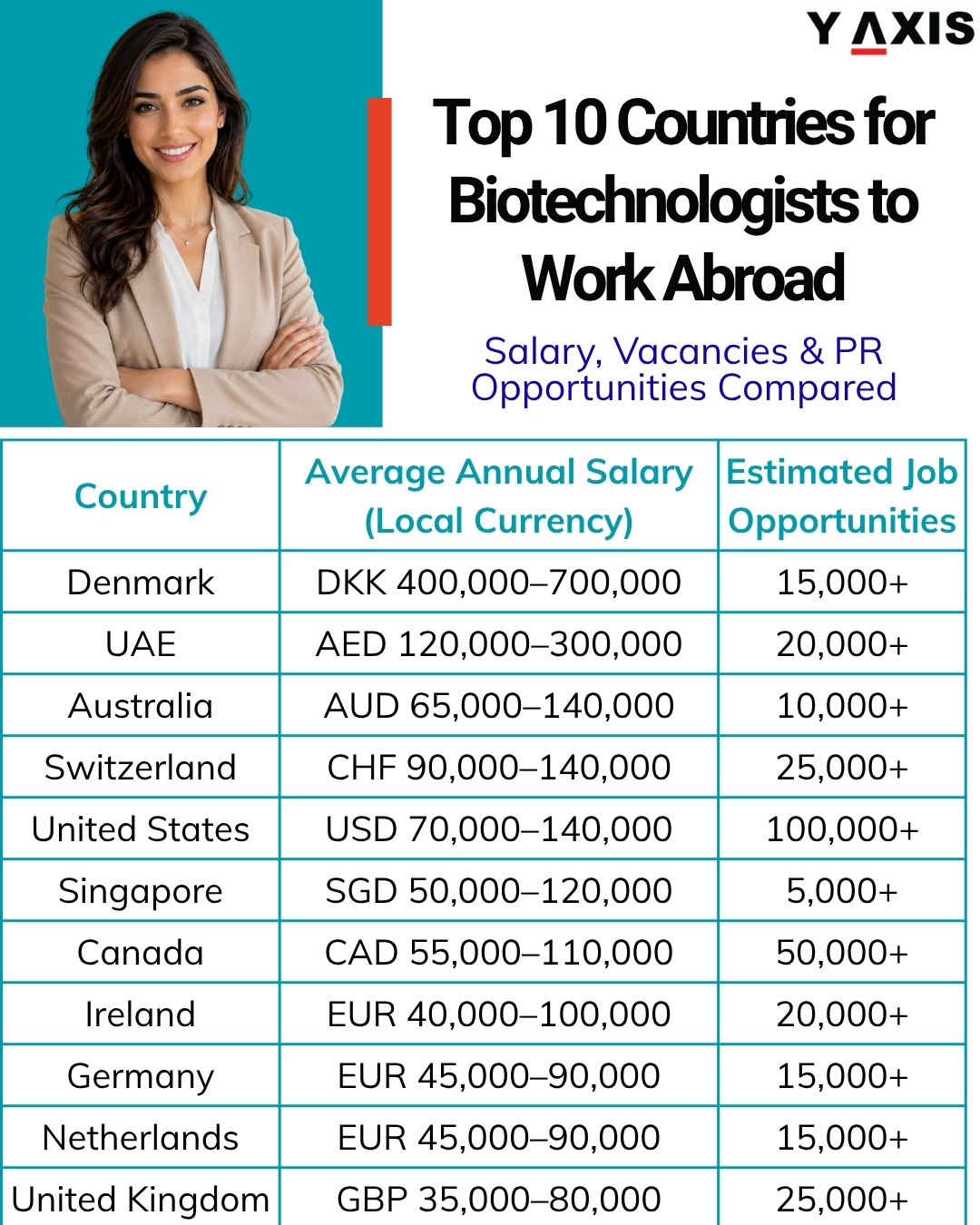
The United States, Switzerland, Canada, Australia, and Germany are among the best countries for Biotechnologists to work abroad, offering strong salaries and well-established biotechnology industries. Experienced Biotechnologists can earn more than AED 300,000 annually in some of these countries. Skilled worker visas and clear residency pathways make these markets attractive, with opportunities set to grow over the next 10 years.
|
Country |
Average Annual Salary (Local Currency) |
Estimated Biotechnologist |
|
United States |
USD 70,000–140,000 |
100,000+ |
|
Canada |
CAD 55,000–110,000 |
50,000+ |
|
Australia |
AUD 65,000–140,000 |
10,000+ |
|
Germany |
EUR 45,000–90,000 |
15,000+ |
|
Switzerland |
CHF 90,000–140,000 |
25,000+ |
|
United Kingdom |
GBP 35,000–80,000 |
25,000+ |
|
Ireland |
EUR 40,000–100,000 |
20,000+ |
|
Singapore |
SGD 50,000–120,000 |
5,000+ |
|
Netherlands |
EUR 45,000–90,000 |
15,000+ |
|
UAE |
AED 120,000–300,000 |
20,000+ |
*Want to work abroad? Sign up with Y-Axis Resume Marketing Services to find right job faster.
Best Countries for Biotechnologists to Work and Settle Abroad
Biotechnologists have strong opportunities to work and settle abroad in countries with well-established biotechnology industries and growing demand for skilled professionals. These destinations offer competitive salaries, accessible work visas, and clear pathways to permanent residency. This combination makes it easier for Biotechnologists to build long-term careers in research, drug development, or biomanufacturing.
Biotechnologist Jobs in the United States
The United States has the largest biotechnology job market in the world, with major hubs such as Boston, San Diego, and the San Francisco Bay Area driving innovation in drug development, genomics, and biomanufacturing. Its strong pharmaceutical and life sciences sectors, backed by leading research institutions and ongoing investment in advanced therapies, continue to attract skilled Biotechnologists from around the world. Government funding for medical research further strengthens the country's position as a global leader in biotechnology. Biotechnologists can pursue strong career growth in academic and industry settings, with visa options such as the H-1B and employer-sponsored green card pathways offering clear routes to long-term residency in the country.
|
Factor |
Details |
|
Biotechnologist Job Market & Job Vacancies for the Next Decade |
The United States is expected to see more than 100,000 job opportunities for Biotechnologists over the next decade, driven by hiring across drug discovery, biopharmaceuticals, genomics, bioinformatics, and cell and gene therapy. |
|
Investment in Biotechnology & Life Sciences |
The National Institutes of Health commits more than USD 48 billion each year to biomedical research, funding progress in genomics, drug discovery, disease research, and biotechnology development. |
|
In-Demand Biotechnology Roles & Skills |
Employers are actively hiring research scientists, bioinformatics scientists, bioprocess engineers, clinical scientists, and quality specialists. Core skills in demand include molecular biology, genomics, cell culture, data analysis, and bioprocessing. |
|
Work Visa Options for Biotechnologists |
Biotechnologists can pursue the H-1B Visa, O-1 Visa, L-1 Visa, or employment-based immigrant visa categories to work in the United States. |
|
Fast-Track Hiring Options |
Individuals with extraordinary ability can qualify for the O-1 Visa, while premium processing can speed up decisions on qualifying employment-based petitions. |
|
PR / Long-Term Residence Opportunities |
Biotechnologists can pursue permanent residency through employment-based Green Card categories, including EB-1, EB-2, and EB-3. |
|
Education & Qualification Requirements |
A bachelor's or master's degree in biotechnology, molecular biology, biochemistry, microbiology, or bioinformatics is commonly required, with a PhD often preferred for senior scientist and specialized R&D roles. |
|
Eligibility for Dependents |
Spouses and dependent children can accompany the main H-1B, O-1, or L-1 visa holder to the United States. |
|
Benefits for Family Members |
Dependent children can enroll in school, and spouses holding an H-4, O-3, or L-2 visa may apply for work authorization. |
*Want to Work in the USA? Let Y-Axis guide you through application process.
Biotechnologist Jobs in Canada
Canada stands out among biotech destinations for its points-based Express Entry system, which gives skilled Biotechnologists a direct path to permanent residency without employer sponsorship. The biotechnology sector is concentrated in Toronto, Montreal, and Vancouver, covering pharmaceutical research, clinical trials, and agricultural biotechnology. Canadian universities and research institutions drive advances in genomics and biomanufacturing, supporting a steady pipeline of specialized roles across both public and private organizations. Government investment in life sciences continues to strengthen Canada's research capacity, drawing skilled Biotechnologists seeking long-term career growth. Provincial nominee programs also let individual provinces fast-track skilled Biotechnologists based on regional demand in the life sciences sector.
|
Factor |
Details |
|
Biotechnologist Job Market & Job Vacancies for the Next Decade |
Canada's biotechnology sector could generate more than 50,000 new job opportunities over the next decade as the country builds out its capabilities in biopharmaceuticals, biomanufacturing, genomics, bioinformatics, and cell and gene therapies. |
|
Investment in Biotechnology & Life Sciences |
Canada has committed more than CAD 2.2 billion through its Biomanufacturing and Life Sciences Strategy to strengthen research, vaccine and therapeutics development, and domestic biomanufacturing. |
|
In-Demand Biotechnology Roles & Skills |
Key roles include research scientists, bioprocess specialists, bioinformatics specialists, quality assurance specialists, and regulatory affairs associates. Employers seek skills in molecular biology, genomics, data analysis, and bioprocessing. |
|
Work Visa Options for Biotechnologists |
Biotechnologists can pursue the Temporary Foreign Worker Program, International Mobility Program, Express Entry, Provincial Nominee Programs, and the Atlantic Immigration Program. |
|
Fast-Track Hiring Options |
The Global Talent Stream can speed up hiring for qualifying occupations, while employer-specific work permits and Provincial Nominee Programs offer additional routes. |
|
PR / Long-Term Residence Opportunities |
Biotechnologists can pursue permanent residency through Express Entry, the Canadian Experience Class, Provincial Nominee Programs, and the Atlantic Immigration Program. |
|
Education & Qualification Requirements |
Biotechnology roles commonly require a bachelor's or master's degree in biotechnology, biology, biochemistry, microbiology, or bioinformatics, with a PhD often preferred for research scientist, senior scientist, and specialized R&D roles. |
|
Eligibility for Dependents |
Spouses or partners and dependent children can accompany the main applicant to Canada. |
|
Benefits for Family Members |
Spouses can access work rights, children can attend public school, and family members can access provincial healthcare where coverage requirements are met. |
*Want to Work in Canada? Let Y-Axis guide you through application process.
Biotechnologist Jobs in Australia
Australia's biotechnology sector is centered in Melbourne, Sydney, and Brisbane, with strong activity in medical research, vaccine development, and agricultural biotechnology. Government funding for medical research continues to expand job openings across both public institutions and private biotech companies, creating steady demand for Biotechnologists. Skilled migration visas, including employer-sponsored and points-tested routes, give Biotechnologists a clear path to long-term residency. Leading universities and research institutes support advances in genomics and biomanufacturing, helping Australia remain a strong biotech hub in the Asia-Pacific region for Biotechnologists building a long-term international career in life sciences.
|
Factor |
Details |
|
Biotechnologist Job Market & Job Vacancies for the Next Decade |
Australia's growing medical, agricultural, and translational biotechnology sectors could generate more than 10,000 job opportunities for Biotechnologists over the next decade, spanning biopharmaceuticals, diagnostics, genomics, and research commercialisation. |
|
Investment in Biotechnology & Life Sciences |
Australia has committed AUD 1.7 billion over 10 years to innovation, science, and digital capabilities, supporting biotechnology research, commercialisation, and advanced technologies. |
|
In-Demand Biotechnology Roles & Skills |
Research scientists, molecular biologists, bioinformatics specialists, clinical research scientists, and bioprocess specialists are in high demand, with employers prioritizing molecular biology, genomics, data analysis, laboratory research, and bioprocessing skills. |
|
Work Visa Options for Biotechnologists |
Options include the Skills in Demand Visa (Subclass 482), Skilled Independent Visa (189), Skilled Nominated Visa (190), Employer Nomination Scheme (186), and Skilled Work Regional Visa (491). |
|
Fast-Track Hiring Options |
Occupations listed on applicable skilled occupation lists can move faster through employer sponsorship or state and territory nomination. |
|
PR / Long-Term Residence Opportunities |
Permanent residency is achievable through points-based visas (Subclasses 189 and 190), employer sponsorship (Subclass 186), or the regional pathway under Subclass 491. |
|
Education & Qualification Requirements |
Entry typically requires a bachelor's or master's degree in biotechnology, molecular biology, biochemistry, microbiology, or bioinformatics, while a PhD strengthens candidacy for senior scientist and specialized R&D positions. |
|
Eligibility for Dependents |
Spouses or partners and dependent children can relocate to Australia together with the main applicant. |
|
Benefits for Family Members |
Medicare coverage, public schooling for children, and work rights for spouses are available under Subclasses 189, 190, 186, and 491 visa conditions. |
Biotechnologist Jobs in Germany
Germany is one of Europe's largest producers of biopharmaceuticals, with a manufacturing base that supports large-scale production of vaccines, enzymes, and biologics alongside cutting-edge research. Munich, Berlin, and the Rhine-Neckar region form the country's core biotech corridor, home to both global pharmaceutical companies and a dense network of startups. Strong government support for research and innovation continues to strengthen Germany's position within the European biotechnology industry. The EU Blue Card allows Biotechnologists to work in Germany and later move within the European Union with fewer restrictions. Settlement becomes possible after a few years of qualifying work, giving skilled Biotechnologists a realistic route to build a long-term career.
|
Factor |
Details |
|
Biotechnologist Job Market & Job Vacancies for the Next Decade |
Germany's expanding biotechnology and life sciences sector could generate over 15,000 job opportunities for Biotechnologists over the next decade, particularly in biopharmaceuticals, industrial biotechnology, molecular biology, and medical research. |
|
Investment in Biotechnology & Life Sciences |
Biotechnology investment in Germany reached approximately EUR 2 billion, a 70% annual increase, fueling progress in cancer therapies, drug development, personalised medicine, and biotechnology R&D. |
|
In-Demand Biotechnology Roles & Skills |
Germany's biotech sector is actively hiring research scientists, bioprocess engineers, molecular biologists, bioinformatics specialists, and quality assurance specialists, with fermentation, bioprocessing, genomics, and data analysis among the most valued skills. |
|
Work Visa Options for Biotechnologists |
Building a biotechnology career in Germany is possible through the EU Blue Card, Skilled Worker Visa, Opportunity Card, or employer-sponsored work routes. |
|
Fast-Track Hiring Options |
Employer-supported hires can move through qualification recognition and visa processing faster under the Accelerated Skilled Worker Procedure. |
|
PR / Long-Term Residence Opportunities |
EU Blue Card holders can apply for permanent residence after 21 months with B1 German proficiency, or 27 months with A1 German proficiency. |
|
Education & Qualification Requirements |
Most biotechnology positions call for a bachelor's or master's degree in biotechnology, biology, biochemistry, microbiology, or bioinformatics, and a PhD often carries added weight for senior scientist and specialized R&D roles. |
|
Eligibility for Dependents |
The main visa holder's spouse and dependent children are permitted to accompany them to Germany. |
|
Benefits for Family Members |
Germany's healthcare system, public schooling, and spousal work rights are available to family members under qualifying visa terms. |
*Want to Work in Germany? Let Y-Axis guide you through application process.
Biotechnologist Jobs in Switzerland
Switzerland is home to some of the world's largest pharmaceutical companies, based around Basel, Zurich, and Geneva, giving Biotechnologists access to advanced research in drug development and precision medicine. The country's work permit system ties residency to a confirmed job offer, and permanent settlement becomes possible after several years of continuous residence. Switzerland's investment in life sciences research, combined with close collaboration between universities and industry, supports specialized roles in genomics, biomanufacturing, and clinical research. This strong research culture, paired with a stable economy, continues to draw skilled Biotechnologists seeking a highly focused and rewarding long-term biotech career.
|
Factor |
Details |
|
Biotechnologist Job Market & Job Vacancies for the Next Decade |
Switzerland could see more than 25,000 new Biotechnologist job opportunities open up over the next decade, as its pharmaceutical and biotech sector expands across biologics, precision medicine, advanced therapies, and drug development. |
|
Investment in Biotechnology & Life Sciences |
Swiss biotech companies raised CHF 2.6 billion in funding and invested CHF 2.5 billion in R&D, strengthening drug development, clinical research, and biotechnology innovation. |
|
In-Demand Biotechnology Roles & Skills |
Switzerland's biotech employers are hiring research scientists, bioprocess specialists, bioinformatics specialists, clinical scientists, and regulatory affairs specialists, with drug discovery, genomics, molecular biology, and data analysis ranking among the most sought-after skills. |
|
Work Visa Options for Biotechnologists |
Short-term employment runs through Permit L, longer-term work through Permit B, EU/EFTA nationals work under free-movement rules, and non-EU/EFTA nationals can access employer-sponsored permits. |
|
Fast-Track Hiring Options |
Highly qualified specialists can move through employer-sponsored permit routes, and intra-company transfers ease relocation for employees within multinational companies. |
|
PR / Long-Term Residence Opportunities |
After roughly 10 years on Permit B, most Biotechnologists become eligible for Permit C permanent residence, though some nationalities qualify in as few as 5 years. |
|
Education & Qualification Requirements |
Entry into Swiss biotech roles generally calls for a bachelor's or master's in biotechnology, molecular biology, biochemistry, microbiology, or bioinformatics, with senior scientist and R&D positions frequently going to PhD holders. |
|
Eligibility for Dependents |
Family reunification allows spouses or partners and dependent children to join the main permit holder in Switzerland. |
|
Benefits for Family Members |
Children of permit holders can enroll directly in Swiss public schools, spouses can seek employment, and the entire family is required to hold Swiss mandatory health insurance. |
*Want to Work in Switzerland? Let Y-Axis guide you through application process.
Biotechnologist Jobs in the United Kingdom
The United Kingdom's biotechnology industry is built around the "Golden Triangle" of London, Oxford, and Cambridge, where leading universities, teaching hospitals, and biotech companies work closely together. This concentration drives fast progress in genomics, cell therapy, and vaccine development, backed by strong government funding for medical research. The UK's National Health Service also provides a steady pipeline of clinical data and research partnerships that support drug development and diagnostics. The Skilled Worker visa allows Biotechnologists to work in the UK with a job offer from a licensed employer, with settlement possible after five years of continuous residence in the country.
|
Factor |
Details |
|
Biotechnologist Job Market & Job Vacancies for the Next Decade |
The UK could see more than 70,000 new life sciences jobs created over the next decade, fueled by growth in biopharmaceuticals, medical technology, genomics, and data-led life sciences. |
|
Investment in Biotechnology & Life Sciences |
The UK has committed up to GBP 600 million to strengthen health data research infrastructure, supporting drug discovery, clinical research, genomics, and life sciences innovation. |
|
In-Demand Biotechnology Roles & Skills |
The UK's life sciences employers are hiring research scientists, bioinformatics specialists, bioprocess engineers, clinical research scientists, and regulatory affairs specialists, with molecular biology, genomics, data analysis, drug development, and bioprocessing among the most valued skills. |
|
Work Visa Options for Biotechnologists |
Biotechnologists can pursue the Skilled Worker Visa, Global Talent Visa, Scale-up Worker Visa, High Potential Individual Visa, or an employer-sponsored work visa. |
|
Fast-Track Hiring Options |
Recognised research and innovation talent can move through the Global Talent Visa, while approved employers can sponsor candidates directly under the Skilled Worker Visa. |
|
PR / Long-Term Residence Opportunities |
Indefinite Leave to Remain becomes available to Skilled Worker and Global Talent visa holders once they complete the required residence period. |
|
Education & Qualification Requirements |
Most roles require a bachelor's or master's degree in biotechnology, molecular biology, biochemistry, microbiology, or bioinformatics, while senior research and specialised R&D positions require a PhD. |
|
Eligibility for Dependents |
Spouses or partners and dependent children can join the primary applicant under the Skilled Worker, Global Talent, Scale-up Worker, or High Potential Individual visa routes. |
|
Benefits for Family Members |
Spouses can seek employment, children can access public education, and the family gains NHS healthcare access once the Immigration Health Surcharge is paid. |
* Want to Work in the UK? Let Y-Axis guide you through the steps.
Biotechnologist Jobs in Ireland
Ireland is home to manufacturing and research facilities for nine of the world's ten largest pharmaceutical companies, making it a major biopharma hub for its size. Dublin and Cork lead the industry, with roles in drug production, quality control, and clinical research. Strong foreign investment in life sciences has supported steady hiring over the years. Ireland's position within the European Union also allows Biotechnologists to build a career from a single, English-speaking base while staying close to other EU markets. Biotechnologists can work in Ireland through the Critical Skills Employment Permit and apply for permanent residency after five years of qualifying work.
|
Factor |
Details |
|
Biotechnologist Job Market & Job Vacancies for the Next Decade |
Ireland's position as a major centre for biologics and biopharmaceutical production could support more than 20,000 job opportunities for Biotechnologists over the next decade, particularly in cell therapies, process development, manufacturing science, and pharmaceutical R&D. |
|
Investment in Biotechnology & Life Sciences |
More than EUR 15 billion in biopharma foreign direct investment has strengthened Ireland's biologics manufacturing, pharmaceutical production, R&D, and life sciences infrastructure. |
|
In-Demand Biotechnology Roles & Skills |
Ireland's biopharma employers are hiring bioprocess scientists, research scientists, validation specialists, manufacturing scientists, and quality specialists, with bioprocessing, cell culture, validation, technology transfer, and GMP compliance ranking among the most sought-after skills. |
|
Work Visa Options for Biotechnologists |
Biotechnologists can pursue the Critical Skills Employment Permit, General Employment Permit, Intra-Company Transfer Employment Permit, or Hosting Agreement for Researchers. |
|
Fast-Track Hiring Options |
Qualifying scientific roles can move faster through the Critical Skills Employment Permit, while researchers have a dedicated route through the Hosting Agreement. |
|
PR / Long-Term Residence Opportunities |
Stamp 4 becomes available after 21 months for those on a Critical Skills Employment Permit or Hosting Agreement, or after 57 months under a General Employment Permit. |
|
Education & Qualification Requirements |
Most roles call for a bachelor's or master's degree in biotechnology, biochemistry, microbiology, molecular biology, or bioprocessing, while a PhD is often preferred for senior scientist and specialised R&D positions. |
|
Eligibility for Dependents |
Spouses or partners and dependent children can join the main applicant through the Critical Skills Employment Permit, General Employment Permit, or Hosting Agreement routes. |
|
Benefits for Family Members |
Spouses can access work rights, children can attend public school, and family members gain access to Ireland's public healthcare services. |
*Want to Work in Ireland? Let Y-Axis guide you through application process.
Biotechnologist Jobs in Singapore
Singapore built Biopolis, a dedicated research district that brings together public research institutes, universities, and private biotech companies in one location. This setup supports faster progress from research to real-world application, especially in genomics and precision medicine. Strong government investment continues to expand Singapore's role as a leading biotech center in Asia. Biotechnologists can work in Singapore through the Employment Pass, with permanent residency available to eligible long-term holders. Singapore's location also makes it a strong base for exploring biotech roles across Southeast Asia, adding further reach beyond the local job market for long-term career growth.
|
Factor |
Details |
|
Biotechnologist Job Market & Job Vacancies for the Next Decade |
Singapore's growth as an Asia-Pacific biopharmaceutical and biomedical hub could support more than 5,000 job opportunities for Biotechnologists over the next decade, particularly in biologics, advanced therapies, bioprocessing, and pharmaceutical manufacturing. |
|
Investment in Biotechnology & Life Sciences |
Singapore has committed SGD 28 billion to its Research, Innovation and Enterprise 2025 plan, supporting biomedical sciences, health technologies, advanced manufacturing, and biotechnology commercialisation. |
|
In-Demand Biotechnology Roles & Skills |
Singapore's biomedical employers are hiring bioprocess scientists, research scientists, cell culture specialists, bioinformatics specialists, and quality specialists, with bioprocessing, cell culture, molecular biology, data analysis, and GMP manufacturing ranking among the most sought-after skills. |
|
Work Visa Options for Biotechnologists |
Biotechnologists can pursue the Employment Pass, S Pass, ONE Pass, or Personalised Employment Pass. |
|
Fast-Track Hiring Options |
The COMPASS framework streamlines Employment Pass applications, while the ONE Pass gives high-earning talent with strong professional achievements greater employment flexibility. |
|
PR / Long-Term Residence Opportunities |
Employment Pass and S Pass holders can apply for permanent residence through the Professionals, Technical Personnel and Skilled Workers Scheme. |
|
Education & Qualification Requirements |
Most roles call for a bachelor's or master's degree in biotechnology, molecular biology, biochemistry, microbiology, bioinformatics, or biochemical engineering, while a PhD is often preferred for advanced research and specialised scientist positions. |
|
Eligibility for Dependents |
Employment Pass and qualifying S Pass holders can bring spouses and dependent children to Singapore through the Dependant's Pass route. |
|
Benefits for Family Members |
Children can enrol in school, spouses can work once they secure an appropriate work pass, and permanent residents gain access to broader long-term benefits. |
*Want to Work in Singapore? Let Y-Axis guide you through application process.
Biotechnologist Jobs in the Netherlands
The Netherlands is known for its strength in agricultural biotechnology, led by Wageningen University, alongside a well-established pharmaceutical sector. Amsterdam, Utrecht, and Leiden add further depth in biotech research and drug development. Strong collaboration between universities and industry continues to support innovation in genomics and sustainable agriculture. Biotechnologists can work in the Netherlands through the Highly Skilled Migrant visa, with permanent residency available after five years. Close ties with neighboring EU countries also give Biotechnologists access to opportunities across Europe, adding further flexibility to a long-term career built from the Netherlands.
|
Factor |
Details |
|
Biotechnologist Job Market & Job Vacancies for the Next Decade |
The Netherlands could support more than 15,000 job opportunities for Biotechnologists over the next decade as biotechnology applications expand across biopharmaceuticals, regenerative medicine, agricultural innovation, and diagnostics. |
|
Investment in Biotechnology & Life Sciences |
A EUR 1.3 billion commitment through 2040 is set to strengthen biotechnology research, infrastructure, commercialisation, and sector-wide innovation in the Netherlands. |
|
In-Demand Biotechnology Roles & Skills |
Dutch biotech employers are hiring research scientists, molecular biologists, bioinformatics specialists, bioprocess specialists, and regenerative medicine scientists, with molecular biology, genomics, cell culture, data analysis, and bioprocessing ranking among the most sought-after skills. |
|
Work Visa Options for Biotechnologists |
Biotechnologists can pursue the Highly Skilled Migrant Permit, EU Blue Card, Intra-Corporate Transferee Permit, or other employer-sponsored work permits. |
|
Fast-Track Hiring Options |
IND-recognised sponsors can use the Highly Skilled Migrant Scheme's streamlined residence permit process for international hires. |
|
PR / Long-Term Residence Opportunities |
Permanent residence becomes available after five years of continuous legal residence, subject to income and civic integration requirements. |
|
Education & Qualification Requirements |
Most roles call for a bachelor's or master's degree in biotechnology, molecular biology, biochemistry, microbiology, or bioinformatics, while a PhD is often preferred for senior scientist and specialised R&D positions. |
|
Eligibility for Dependents |
Spouses or partners and dependent children can accompany the main applicant to the Netherlands. |
|
Benefits for Family Members |
Spouses can access work rights, children can attend public school, and family members gain access to the Dutch healthcare system through mandatory health insurance. |
Biotechnologist Jobs in the UAE
The UAE has made biotechnology a key part of its national growth plan, backing genomics, healthcare innovation, and biomanufacturing through direct government investment. Abu Dhabi and Dubai lead this growth, each building dedicated research and healthcare infrastructure. Growing partnerships between government bodies and private healthcare providers continue to expand opportunities in the sector. Biotechnologists can apply for the Golden Visa, which offers long-term residency without needing a local sponsor. Tax-free income adds further financial benefit for those building a long-term career in the UAE, making it an increasingly attractive base for Biotechnologists.
|
Factor |
Details |
|
Biotechnologist Job Market & Job Vacancies for the Next Decade |
The UAE's growing biotechnology and life sciences sector could generate more than 20,000 job opportunities over the next decade, particularly in genomics, biopharmaceuticals, precision medicine, diagnostics, and biomanufacturing. |
|
Investment in Biotechnology & Life Sciences |
More than AED 1 billion in life sciences investment is funding biotechnology research, genomics, drug development, and advanced R&D facilities in the UAE. |
|
In-Demand Biotechnology Roles & Skills |
UAE employers are hiring Biotechnologists, Molecular Biologists, Bioinformatics Specialists, Research Scientists, Clinical Research Specialists, and Regulatory Affairs Specialists, with molecular biology, genomics, bioinformatics, analytical testing, and GMP compliance ranking among the most sought-after skills. |
|
Work Visa Options for Biotechnologists |
Biotechnologists can pursue the employer-sponsored UAE work residence visa, the 5-year Green Residency for skilled workers, or the 10-year Golden Residency for qualifying scientists and researchers. |
|
Fast-Track Hiring Options |
Biotechnologists with a confirmed UAE job offer can move through the employer-sponsored work visa route, while skilled workers earning at least AED 15,000 per month, holding a bachelor's degree, and working in skill levels 1–3 may qualify for the 5-year Green Residency. |
|
PR / Long-Term Residence Opportunities |
The UAE does not offer conventional permanent residency, but qualifying Biotechnologists can obtain 5-year Green Residency, and qualifying scientists and researchers can access renewable 10-year Golden Residency. |
|
Education & Qualification Requirements |
Most biotechnology roles call for a bachelor's or master's degree in biotechnology, molecular biology, biochemistry, microbiology, bioengineering, or bioinformatics, while advanced research positions often call for a PhD and research experience. |
|
Eligibility for Dependents |
UAE residents earning at least AED 4,000 per month, or AED 3,000 plus accommodation, can sponsor eligible family members. |
|
Benefits for Family Members |
Sponsored spouses and children can live in the UAE, children can enrol in school, and spouses can work once they obtain the required UAE work permit. |
Job Outlook for Biotechnologists over the Next Decade
Job opportunities for Biotechnologists are set to grow steadily over the next decade, driven by rising investment in genomics, drug development, and advanced therapies. The United States, Germany, and Switzerland are expanding their biopharmaceutical and research capacity, while Canada and the UK continue to strengthen genomics and clinical research infrastructure. Emerging biotech hubs in Singapore and the UAE are also creating new roles in precision medicine, biomanufacturing, and diagnostics. This growth spans academic research, pharmaceutical production, and biotechnology startups. Skilled worker visas and residency pathways across these countries continue to support long-term career growth for Biotechnologists building an international career.
*Want to work abroad? Sign up with Y-Axis Resume Marketing Services to find right job faster.
FAQs
Which are the best countries for Biotechnologists to work abroad?
The best countries for Biotechnologists to work abroad are the United States, Canada, Australia, Germany, Switzerland, the United Kingdom, Ireland, Singapore, the Netherlands, and the UAE. These countries offer strong biotechnology industries, competitive salaries, and accessible work visa options, along with clear pathways to permanent residency for building a long-term career in research, drug development, or biomanufacturing.
Which country pays the highest salary to Biotechnologists?
Switzerland pays the highest salaries to Biotechnologists, with average annual pay ranging from CHF 90,000 to CHF 140,000. The country's pharmaceutical industry, concentrated around Basel, Zurich, and Geneva, drives high compensation for roles in drug development, precision medicine, and clinical research, making it a leading destination for experienced Biotechnologists.
Which country has the most Biotechnologist job opportunities?
The United States has the most Biotechnologist job opportunities, with more than 100,000 roles expected over the next decade. Boston, San Diego, and the San Francisco Bay Area drive strong demand across drug development, genomics, and biomanufacturing, supported by continued investment in pharmaceutical research and advanced therapies.
What qualifications are needed to work as a Biotechnologist abroad?
A bachelor's or master's degree in biotechnology, molecular biology, biochemistry, microbiology, or bioinformatics is required to work as a Biotechnologist abroad. A PhD is preferred for senior scientist and specialised R&D roles. Requirements vary by country, so checking local visa and licensing rules before applying is recommended.
Which countries offer easy work visas for Biotechnologists?
Canada, Australia, and the Netherlands offer accessible work visa routes for Biotechnologists through points-based and employer-sponsored systems. Canada's Express Entry, Australia's skilled migration visas, and the Netherlands' Highly Skilled Migrant Permit provide structured pathways for Biotechnologists to work and eventually settle in these countries.
Can Biotechnologists get permanent residency abroad?
Yes, Canada, Australia, Germany, and Ireland offer points-based or employer-sponsored routes to permanent residency for Biotechnologists after a qualifying period of work. The UAE offers Golden Visa access for qualifying scientists and researchers, giving Biotechnologists several long-term settlement options depending on the destination country.
Which visa is best for Biotechnologists to work in the United States?
The H-1B Visa is the primary route for Biotechnologists to work in the United States, requiring a job offer from a US employer. The O-1 Visa suits individuals with extraordinary ability, while employer-sponsored Green Card categories such as EB-1, EB-2, and EB-3 support long-term residency after employment.
How can Biotechnologists get permanent residency in Canada?
Biotechnologists can obtain permanent residency in Canada through Express Entry, the Canadian Experience Class, or Provincial Nominee Programs. These points-based systems assess education, work experience, and language skills, giving Biotechnologists a structured pathway to long-term residency without requiring employer sponsorship.
What is the average salary of a Biotechnologist in Germany?
The average salary of a Biotechnologist in Germany ranges from EUR 45,000 to EUR 90,000 annually, depending on experience and specialisation. Germany's biopharmaceutical manufacturing base, centered in Munich, Berlin, and the Rhine-Neckar region, supports steady demand and competitive pay for skilled Biotechnologists.
Which countries in Europe are best for Biotechnologist jobs?
Germany, Switzerland, the United Kingdom, Ireland, and the Netherlands are the best European countries for Biotechnologist jobs. Each offers a strong pharmaceutical or life sciences industry, competitive salaries, and structured work visa routes, including the EU Blue Card, giving Biotechnologists access to established research and manufacturing hubs.
What skills are in demand for Biotechnologists working abroad?
Molecular biology, genomics, bioinformatics, cell culture, data analysis, and bioprocessing are the skills in highest demand for Biotechnologists working abroad. Employers across major biotech hubs also value GMP compliance, clinical research, and drug development experience for roles in biopharmaceuticals, diagnostics, and biomanufacturing.
How long does it take to get permanent residency in Australia as a Biotechnologist?
Biotechnologists can apply for permanent residency in Australia through points-based visas such as Subclass 189 and 190, or employer-sponsored Subclass 186. Skilled applicants on a qualifying visa can become eligible for permanent residency within a few years of arriving in Australia.
Can family members accompany Biotechnologists moving abroad?
Yes, spouses or partners and dependent children can accompany Biotechnologists on qualifying work visas in most countries. Family members can access public education and healthcare, and spouses can work once they obtain the required permit, supporting Biotechnologists relocating abroad with dependents.
Which country is best for Biotechnologists interested in agricultural biotechnology?
The Netherlands is the best country for Biotechnologists interested in agricultural biotechnology, led by Wageningen University's reputation in the field. The country combines strong agricultural research with an established pharmaceutical sector, giving Biotechnologists opportunities across food technology, sustainable agriculture, and biopharmaceuticals.
What is the job market like for Biotechnologists in Singapore?
Singapore's biotechnology job market is growing steadily, with more than 5,000 opportunities expected over the next decade. Centered around Biopolis, Singapore brings together public research institutes, universities, and private biotech companies, driving demand for roles in genomics, precision medicine, and biomanufacturing across the region.
Which visa allows Biotechnologists to work in the UAE long-term?
The UAE's 10-year Golden Residency allows qualifying scientists and researchers, including Biotechnologists, to live and work in the country long-term. The 5-year Green Residency supports skilled workers meeting salary and qualification requirements, giving Biotechnologists flexible options for building a career in the UAE.
How much does a Biotechnologist earn in Ireland?
Biotechnologists in Ireland earn between EUR 40,000 and EUR 100,000 annually, depending on experience and role. Ireland's biopharmaceutical manufacturing sector, home to several of the world's largest pharmaceutical companies, supports consistent demand and competitive salaries for skilled Biotechnologists across Dublin and Cork.
What industries employ the most Biotechnologists abroad?
Pharmaceuticals, biomanufacturing, agricultural biotechnology, and clinical research employ the most Biotechnologists abroad. Genomics, precision medicine, cell and gene therapy, and bioinformatics are also creating specialised roles across major biotech hubs in the United States, Europe, and Asia-Pacific.
Is a PhD required to work as a Biotechnologist abroad?
A PhD is not required for most Biotechnologist roles abroad, but it is preferred for senior scientist and specialised R&D positions. A bachelor's or master's degree is sufficient for entry-level and mid-level roles in research, quality control, and biomanufacturing across most countries.
Which country offers the fastest path to residency for Biotechnologists?
Canada's Express Entry system offers the fastest path to permanent residency for Biotechnologists, using a points-based model that can lead to permanent residency within a few years. Switzerland and the Netherlands process employer-sponsored work visas quickly, while Singapore's Employment Pass allows fast entry for skilled roles.
Posted on July 09 2026
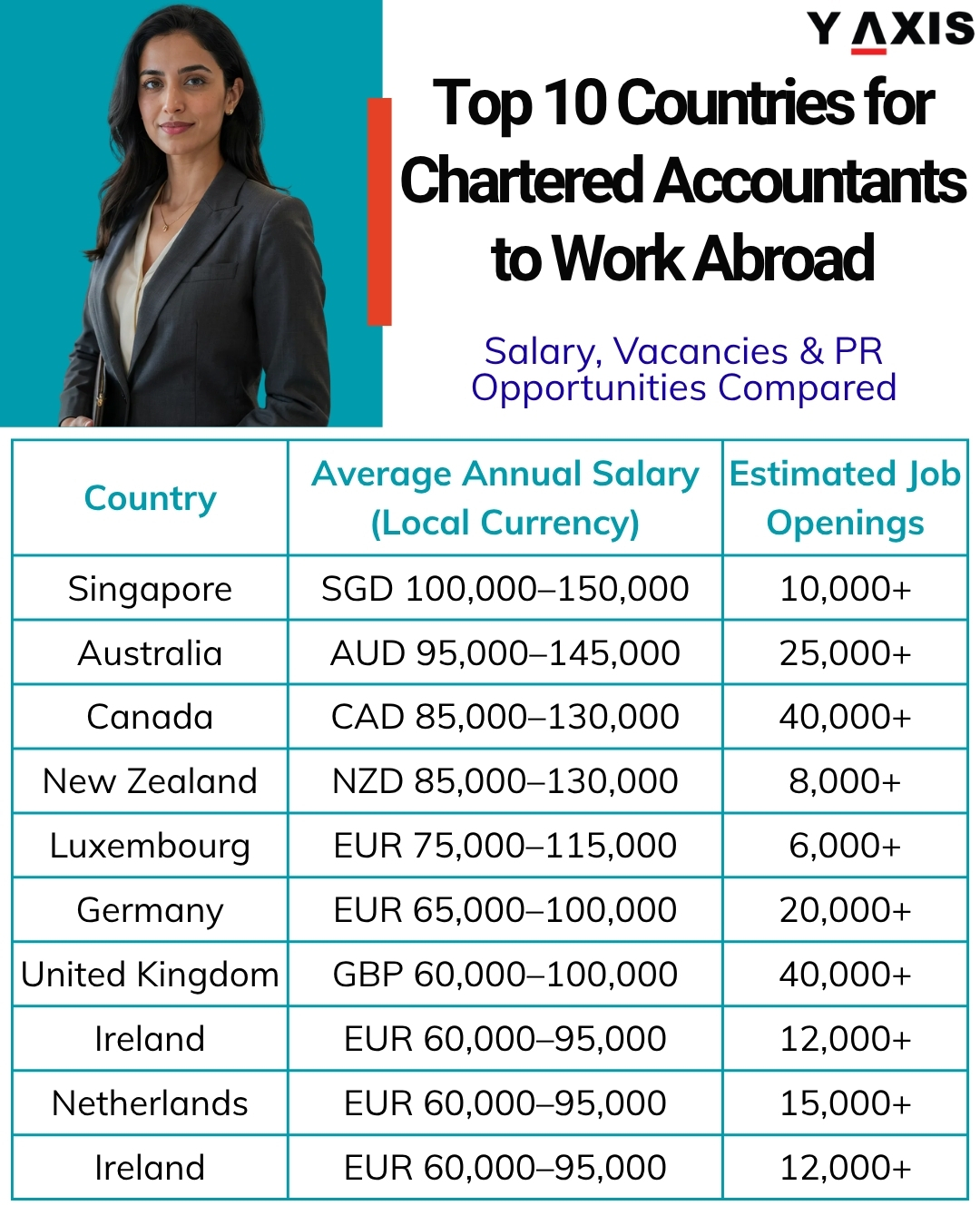
Top 10 Countries for Chartered Accountants to Work Abroad: Salary, Demand & PR Opportunities Compared
Top 10 Countries for Chartered Accountants to Work Abroad: Salary, Demand & PR Opportunities Compared
The top 10 countries for Chartered Accountants to work abroad include Canada, Australia, the United Kingdom, Ireland, New Zealand, Singapore, Luxembourg, Germany, the Netherlands, and the United States. These countries offer competitive salaries, strong demand for Chartered Accountants, employer-sponsored work visas, and permanent residency or long-term settlement pathways. Chartered Accountants are in demand across auditing, taxation, financial reporting, regulatory compliance, corporate finance, risk management, and advisory services. The global accounting services market is projected to reach USD 1.5 trillion by 2032, driven by increasing demand for accounting, compliance, and financial advisory services across industries, supporting continued demand for Chartered Accountants worldwide.
*Want to work abroad? Sign up with Y-Axis Resume Marketing Services to find right job faster.
Benefits of Working Abroad as a Chartered Accountant
Working abroad as a Chartered Accountant offers higher salaries, global career opportunities, and long-term settlement options. Many countries actively hire Chartered Accountants through employer-sponsored work visas and skilled migration programmes, making it easier to build an international career.
- Higher salaries: Earn competitive salaries, bonuses, and employee benefits.
- Strong job demand: Access opportunities across accounting firms, multinational companies, banks, and consulting firms.
- Career growth: Advance into senior roles in audit, taxation, corporate finance, and advisory services.
- Permanent residency pathways: Settle abroad through skilled migration and permanent residency programmes.
- International experience: Build expertise in global accounting standards and international business practices.
- Better quality of life: Benefit from improved work-life balance, healthcare, paid leave, and retirement benefits.
Top 10 Countries for Chartered Accountants to Work Abroad
Chartered Accountants (CAs) are in demand worldwide across audit, taxation, financial reporting, corporate finance, regulatory compliance, and advisory services. Countries such as Canada, Australia, the United Kingdom, Ireland, and Singapore offer competitive salaries, strong hiring demand, employer-sponsored work visas, and permanent residency or long-term settlement pathways. These factors make them preferred destinations for Chartered Accountants looking to build an international career.
|
Country |
Average Annual Salary (Local Currency) |
Estimated Chartered Accountant Job Openings |
|
Canada |
CAD 85,000–130,000 |
40,000+ |
|
Australia |
AUD 95,000–145,000 |
25,000+ |
|
United Kingdom |
GBP 60,000–100,000 |
40,000+ |
|
Ireland |
EUR 60,000–95,000 |
12,000+ |
|
New Zealand |
NZD 85,000–130,000 |
8,000+ |
|
Singapore |
SGD 100,000–150,000 |
10,000+ |
|
Luxembourg |
EUR 75,000–115,000 |
6,000+ |
|
Germany |
EUR 65,000–100,000 |
20,000+ |
|
Netherlands |
EUR 60,000–95,000 |
15,000+ |
|
United States |
USD 95,000–150,000 |
100,000+ |
*Want to work abroad? Sign up with Y-Axis Resume Marketing Services to find right job faster.
Best Countries for Chartered Accountants to Work and Settle Abroad
Many countries offer excellent opportunities for Chartered Accountants (CAs) to build a successful career and settle abroad. Canada, Australia, Ireland, and New Zealand are among the preferred destinations, offering competitive salaries, employer-sponsored work visas, and clear permanent residency pathways for skilled accounting professionals.
Chartered Accountant Jobs in Canada
Chartered Accountants are in high demand in Canada, with strong hiring across public accounting firms, banks, multinational corporations, government organisations, and corporate finance teams. Employers actively recruit internationally qualified CAs skilled in auditing, taxation, IFRS, financial reporting, corporate finance, and advisory services, offering competitive salaries and long-term career growth. Canada also supports skilled professionals through employer-sponsored work permits and well-established permanent residence pathways such as Express Entry and Provincial Nominee Programs (PNPs). For Chartered Accountants planning an international career, Canada offers the right mix of job opportunities, financial stability, and a clear route to settlement.
|
Factor |
Details |
|
Chartered Accountant Job Market & Job Outlook |
Canada is expected to generate over 40,000 job openings for Chartered Accountants over the next decade, with hiring spread across public accounting firms, financial institutions, multinational corporations, government organisations, and corporate finance teams. |
|
Accounting Industry & Growth Drivers |
Canada's planned investment of more than CAD 1 trillion is set to accelerate business expansion, creating steady demand for Chartered Accountants in auditing, taxation, financial reporting, corporate finance, and advisory services. |
|
Top Companies Hiring Chartered Accountants |
Leading employers include Deloitte, PwC, EY, KPMG, RBC, TD Bank, BMO, Scotiabank, CIBC, Manulife, Sun Life, and Brookfield Corporation. |
|
Top Cities for Chartered Accountant Jobs |
Toronto, Vancouver, Montréal, Calgary, Ottawa, and Edmonton offer the strongest opportunities, with active hiring across public accounting firms, banks, multinational corporations, consulting firms, and government organisations. |
|
In-Demand Chartered Accountant Roles & Skills |
High-demand roles include Audit Managers, Tax Consultants, Financial Controllers, Financial Reporting Managers, Corporate Accountants, Advisory Consultants, and FP&A Analysts, with employers valuing expertise in auditing, taxation, IFRS, financial reporting, corporate finance, financial analysis, Microsoft Excel, SAP, and Oracle. |
|
Work Visa Options |
Chartered Accountants can work in Canada through the Global Talent Stream, LMIA-based Work Permit, Temporary Foreign Worker Program (TFWP), and Intra-Company Transfer (ICT). |
|
Fast-Track Hiring Options |
The Global Talent Stream allows Canadian employers to hire foreign Chartered Accountants with faster work permit processing, reducing waiting times significantly. |
|
PR / Long-Term Residence Opportunities |
Chartered Accountants can secure permanent residence through Express Entry, the Canadian Experience Class (CEC), Provincial Nominee Programs (PNPs), and other federal and provincial economic immigration programmes. |
|
Eligibility for Dependents |
Spouses or common-law partners and dependent children are eligible to accompany the primary applicant to Canada. |
|
Benefits for Family Members |
Spouses can apply for an open work permit to work in Canada, while dependent children can study in Canadian public schools. |
*Want to Work in Canada? Let Y-Axis guide you through application process.
Chartered Accountant Jobs in Australia
Australia offers Chartered Accountants some of the highest accounting salaries in the Asia-Pacific region, with accountants consistently listed on the country's skilled occupation lists. Beyond the Big Four and corporate finance roles, Australia's mining, energy, and superannuation sectors create demand for CAs that few other countries can match. Internationally qualified accountants benefit from clear recognition pathways through CA ANZ and CPA Australia, making the transition smoother. With employer-sponsored work visas and points-based skilled migration leading to permanent residency, Australia rewards Chartered Accountants who want both a well-paid career and a permanent future in one move.
|
Factor |
Details |
|
Chartered Accountant Job Market & Job Outlook |
Australia is expected to generate more than 25,000 job openings for Chartered Accountants over the next decade, with hiring driven by public accounting firms, banks, multinational corporations, government agencies, and corporate finance teams. |
|
Accounting Industry & Growth Drivers |
Australia's superannuation industry, managing more than AUD 4 trillion in retirement savings, is creating steady demand for Chartered Accountants across financial services, taxation, auditing, financial reporting, corporate finance, and regulatory compliance. |
|
Top Companies Hiring Chartered Accountants |
Leading employers include Deloitte, PwC, EY, KPMG, Commonwealth Bank, Westpac, ANZ, NAB, Macquarie Group, BHP, Rio Tinto, and Woolworths Group. |
|
Top Cities for Chartered Accountant Jobs |
Sydney, Melbourne, Brisbane, Perth, Canberra, and Adelaide offer the strongest opportunities, with active hiring across public accounting firms, banks, multinational corporations, consulting firms, and government agencies. |
|
In-Demand Chartered Accountant Roles & Skills |
High-demand roles include Audit Managers, Tax Consultants, Financial Controllers, Financial Reporting Managers, Corporate Accountants, Advisory Consultants, and FP&A Analysts, with employers valuing expertise in auditing, taxation, IFRS, financial reporting, corporate finance, financial analysis, Microsoft Excel, SAP, and Oracle. |
|
Work Visa Options |
Chartered Accountants can work in Australia through the Skills in Demand Visa (Subclass 482), Employer Nomination Scheme (Subclass 186), Skilled Independent Visa (Subclass 189), and Skilled Nominated Visa (Subclass 190). |
|
Fast-Track Hiring Options |
The Skills in Demand Visa (Subclass 482) allows Australian employers to recruit overseas Chartered Accountants quickly to fill workforce shortages. |
|
PR / Long-Term Residence Opportunities |
Chartered Accountants can secure permanent residence through the Skilled Independent Visa (Subclass 189), Skilled Nominated Visa (Subclass 190), Employer Nomination Scheme (Subclass 186), and Skilled Work Regional Visa (Subclass 491). |
|
Eligibility for Dependents |
Spouses or partners and dependent children are eligible to accompany the primary applicant to Australia. |
|
Benefits for Family Members |
Spouses or partners can work in Australia, while dependent children can access public education and healthcare, subject to visa conditions. |
Chartered Accountant Jobs in the United Kingdom
The United Kingdom is the home of chartered accountancy, with London ranking among the world's top financial centres and hosting the global headquarters of major accounting and consulting firms. Chartered Accountants find opportunities across the Big Four, FTSE 100 companies, investment banks, insurance firms, and fintech companies, with strong demand for expertise in auditing, taxation, IFRS, regulatory compliance, and corporate finance. Internationally qualified CAs can gain recognition through ICAEW and ACCA routes, easing entry into the profession. With employer-sponsored Skilled Worker visas offering a route to long-term settlement, the UK gives Chartered Accountants a career at the very centre of global finance.
|
Factor |
Details |
|
Chartered Accountant Job Market & Job Outlook |
The United Kingdom has more than 40,000 job openings for Chartered Accountants, with hiring spread across public accounting firms, banks, multinational corporations, financial institutions, consulting firms, and corporate finance teams. |
|
Accounting Industry & Growth Drivers |
The UK's financial and professional services sector adds more than GBP 280 billion to the economy every year, sustaining strong demand for Chartered Accountants in auditing, taxation, financial reporting, regulatory compliance, and advisory services. |
|
Top Companies Hiring Chartered Accountants |
Leading employers include Deloitte, PwC, EY, KPMG, HSBC, Barclays, Lloyds Banking Group, NatWest Group, Unilever, BP, and Rolls-Royce. |
|
Top Cities for Chartered Accountant Jobs |
London, Edinburgh, Manchester, Birmingham, Leeds, and Bristol offer the strongest opportunities, with active hiring across public accounting firms, banks, multinational corporations, consulting firms, and financial institutions. |
|
In-Demand Chartered Accountant Roles & Skills |
High-demand roles include Audit Managers, Tax Managers, Financial Controllers, Financial Reporting Managers, Corporate Accountants, Advisory Consultants, and FP&A Managers, with employers valuing expertise in auditing, taxation, IFRS, financial reporting, corporate finance, financial analysis, Microsoft Excel, SAP, and Oracle. |
|
Work Visa Options |
Chartered Accountants can work in the UK through the Skilled Worker Visa, Global Talent Visa, High Potential Individual (HPI) Visa, or Scale-up Worker Visa. |
|
Fast-Track Hiring Options |
The Skilled Worker Visa allows approved UK employers to recruit qualified overseas Chartered Accountants directly. |
|
PR / Long-Term Residence Opportunities |
Chartered Accountants can apply for Indefinite Leave to Remain (ILR) after completing the qualifying residence period and can later progress to British citizenship. |
|
Eligibility for Dependents |
Spouses, partners, and dependent children are eligible to accompany the primary applicant to the UK. |
|
Benefits for Family Members |
Spouses and partners can work in the United Kingdom, while dependent children can access public education and the National Health Service (NHS), subject to visa conditions. |
* Want to Work in the UK? Let Y-Axis guide you through the steps.
Chartered Accountant Jobs in Ireland
Ireland is the only English-speaking country in the Eurozone, making it the preferred European base for global technology, pharmaceutical and financial services companies, and a hotspot for Chartered Accountants. CAs are in demand across the Big Four, multinational European headquarters in Dublin, aircraft leasing firms, and fund administration companies, with expertise in auditing, taxation, IFRS, and regulatory compliance highly valued. Accountants feature on Ireland's Critical Skills Occupations List, giving qualified CAs access to fast-track employment permits and a shorter route to long-term residence. For Chartered Accountants targeting the European market, Ireland combines global employers with one of its quickest settlement pathways.
|
Factor |
Details |
|
Chartered Accountant Job Market & Job Outlook |
Ireland is expected to generate more than 12,000 job openings for Chartered Accountants over the next decade, with strong hiring across public accounting firms, multinational corporations, financial institutions, technology companies, pharmaceutical companies, and corporate finance teams. |
|
Accounting Industry & Growth Drivers |
With more than EUR 5 trillion in investment fund assets under management, Ireland sustains steady demand for Chartered Accountants across financial services, auditing, taxation, financial reporting, regulatory compliance, and advisory services. |
|
Top Companies Hiring Chartered Accountants |
Leading employers include Deloitte, PwC, EY, KPMG, State Street, JPMorgan Chase, Citi, Bank of Ireland, AIB, Accenture, and CRH. |
|
Top Cities for Chartered Accountant Jobs |
Dublin, Cork, Galway, Limerick, and Waterford offer the strongest opportunities, with active hiring across public accounting firms, multinational corporations, banks, consulting firms, and financial institutions. |
|
In-Demand Chartered Accountant Roles & Skills |
High-demand roles include Audit Managers, Tax Managers, Financial Controllers, Financial Reporting Managers, Corporate Accountants, Advisory Consultants, and FP&A Managers, with employers valuing expertise in auditing, taxation, IFRS, financial reporting, corporate finance, financial analysis, Microsoft Excel, SAP, and Oracle. |
|
Work Visa Options |
Chartered Accountants can work in Ireland through the Critical Skills Employment Permit, General Employment Permit, or Intra-Company Transfer Employment Permit. |
|
Fast-Track Hiring Options |
The Critical Skills Employment Permit provides a streamlined route for qualified Chartered Accountants holding a valid job offer. |
|
PR / Long-Term Residence Opportunities |
Chartered Accountants can qualify for Stamp 4 permission and long-term residence after fulfilling Ireland's employment and residence requirements. |
|
Eligibility for Dependents |
Spouses, partners, and dependent children are eligible to accompany the primary applicant to Ireland. |
|
Benefits for Family Members |
Spouses can work in Ireland, while dependent children can access public education and healthcare, subject to Irish regulations. |
Chartered Accountant Jobs in New Zealand
New Zealand lists accountants on its Green List, giving qualified Chartered Accountants one of the most direct residence pathways offered to any profession in the country. Demand is steady across public accounting firms, banks, government agencies, and the agribusiness and export sectors that drive the national economy, with skills in auditing, taxation, IFRS, and management accounting highly valued. CAs qualified under CA ANZ enjoy seamless recognition, while others can transition through straightforward assessment routes. Combined with employer-sponsored work visas, a renowned work-life balance, and the Straight to Residence pathway, New Zealand lets Chartered Accountants secure both career and settlement from day one.
|
Factor |
Details |
|
Chartered Accountant Job Market & Job Outlook |
New Zealand is expected to generate more than 8,000 job openings for Chartered Accountants over the next decade, with hiring driven by public accounting firms, multinational corporations, banks, government agencies, agricultural businesses, and corporate finance teams. |
|
Accounting Industry & Growth Drivers |
New Zealand's infrastructure investment programme worth more than NZD 68 billion continues to fuel business growth, creating steady demand for Chartered Accountants across auditing, taxation, financial reporting, regulatory compliance, and advisory services. |
|
Top Companies Hiring Chartered Accountants |
Leading employers include Deloitte, PwC, EY, KPMG, ANZ New Zealand, ASB Bank, BNZ, Westpac New Zealand, Fonterra, Spark New Zealand, and Air New Zealand. |
|
Top Cities for Chartered Accountant Jobs |
Auckland, Wellington, Christchurch, Hamilton, and Tauranga offer the strongest opportunities, with active hiring across public accounting firms, banks, multinational corporations, consulting firms, and government agencies. |
|
In-Demand Chartered Accountant Roles & Skills |
High-demand roles include Audit Managers, Tax Managers, Financial Controllers, Financial Reporting Managers, Corporate Accountants, Advisory Consultants, and FP&A Managers, with employers valuing expertise in auditing, taxation, IFRS, financial reporting, corporate finance, financial analysis, Microsoft Excel, SAP, and Oracle. |
|
Work Visa Options |
Chartered Accountants can work in New Zealand through the Accredited Employer Work Visa (AEWV), Straight to Residence Visa, Work to Residence Visa, or other employer-sponsored work visas. |
|
Fast-Track Hiring Options |
The Accredited Employer Work Visa (AEWV) allows accredited employers to recruit qualified overseas Chartered Accountants directly. |
|
PR / Long-Term Residence Opportunities |
Chartered Accountants can secure residence through the Straight to Residence Visa, Work to Residence Visa, or other skilled residence pathways, subject to eligibility. |
|
Eligibility for Dependents |
Spouses or partners and dependent children are eligible to accompany the primary applicant to New Zealand. |
|
Benefits for Family Members |
Spouses or partners can work in New Zealand, while dependent children can access public education and healthcare, subject to visa conditions. |
Chartered Accountant Jobs in Singapore
Singapore is Asia's leading financial hub and the regional headquarters capital of the Asia-Pacific, with thousands of multinational corporations managing their regional operations from the city-state. This concentration of global banks, wealth management firms, trading companies, and Big Four practices creates constant demand for Chartered Accountants skilled in IFRS, auditing, taxation, transfer pricing, and regulatory compliance. CAs also benefit from Singapore's low personal tax rates, which significantly boost take-home earnings compared to Western markets. With employer-sponsored work passes such as the Employment Pass, Singapore offers Chartered Accountants a high-earning career at the crossroads of global finance and Asian growth.
|
Factor |
Details |
|
Chartered Accountant Job Market & Job Outlook |
Singapore is expected to generate more than 10,000 job openings for Chartered Accountants over the next decade, with hiring driven by public accounting firms, multinational corporations, banks, financial institutions, and corporate finance teams. |
|
Accounting Industry & Growth Drivers |
With more than SGD 5 trillion in assets under management, Singapore sustains steady demand for Chartered Accountants across financial services, auditing, taxation, financial reporting, regulatory compliance, and advisory services. |
|
Top Companies Hiring Chartered Accountants |
Leading employers include Deloitte, PwC, EY, KPMG, DBS Bank, OCBC Bank, UOB, GIC, Temasek Holdings, Singtel, and Singapore Airlines. |
|
Top Cities for Chartered Accountant Jobs |
As a global financial centre, Singapore concentrates its strongest opportunities within the city-state itself, with active hiring across public accounting firms, multinational corporations, banks, financial institutions, and consulting firms. |
|
In-Demand Chartered Accountant Roles & Skills |
High-demand roles include Audit Managers, Tax Managers, Financial Controllers, Financial Reporting Managers, Corporate Accountants, Advisory Consultants, and FP&A Managers, with employers valuing expertise in auditing, taxation, IFRS, financial reporting, corporate finance, financial analysis, Microsoft Excel, SAP, and Oracle. |
|
Work Visa Options |
Chartered Accountants can work in Singapore through the Employment Pass (EP), S Pass, Overseas Networks & Expertise (ONE) Pass, or EntrePass, subject to eligibility. |
|
Fast-Track Hiring Options |
The Employment Pass (EP) allows Singapore employers to recruit qualified Chartered Accountants for professional accounting and finance roles directly. |
|
PR / Long-Term Residence Opportunities |
Chartered Accountants can apply for Singapore Permanent Residence (PR) through the Professionals, Technical Personnel and Skilled Workers (PTS) Scheme, subject to eligibility. |
|
Eligibility for Dependents |
Spouses and dependent children are eligible to accompany the primary applicant to Singapore. |
|
Benefits for Family Members |
Family members can apply for a Dependant's Pass and access education and healthcare, subject to Singapore's immigration regulations. |
Chartered Accountant Jobs in Luxembourg
Luxembourg is the world's second-largest investment fund centre after the United States, making fund accounting one of the most in-demand and best-paid specialisations for Chartered Accountants in Europe. Private equity firms, custodian banks, fund administrators, and the Big Four compete for CAs skilled in IFRS, fund accounting, taxation, and regulatory reporting under frameworks like UCITS and AIFMD. The country also offers among the highest accounting salaries in the European Union, reflecting its wealth and concentration of financial institutions. With employer-sponsored work permits and the EU Blue Card route, Luxembourg gives Chartered Accountants a lucrative career at the heart of global investment management.
|
Factor |
Details |
|
Chartered Accountant Job Market & Job Outlook |
Luxembourg is expected to generate more than 6,000 job openings for Chartered Accountants over the next decade, with hiring driven by investment funds, public accounting firms, banks, multinational corporations, and financial institutions. |
|
Accounting Industry & Growth Drivers |
Administering more than EUR 7 trillion in investment fund assets, Luxembourg stands as Europe's largest investment fund centre, sustaining steady demand for Chartered Accountants across fund management, financial services, auditing, taxation, financial reporting, regulatory compliance, and advisory services. |
|
Top Companies Hiring Chartered Accountants |
Leading employers include Deloitte, PwC, EY, KPMG, State Street, BlackRock, Fidelity International, BNP Paribas, Clearstream, and Banque de Luxembourg. |
|
Top Cities for Chartered Accountant Jobs |
Luxembourg City, Esch-sur-Alzette, and Kirchberg offer the strongest opportunities, with active hiring across investment funds, public accounting firms, banks, multinational corporations, and financial institutions. |
|
In-Demand Chartered Accountant Roles & Skills |
High-demand roles include Audit Managers, Tax Managers, Financial Controllers, Financial Reporting Managers, Corporate Accountants, Fund Accountants, and Advisory Consultants, with employers valuing expertise in auditing, taxation, IFRS, financial reporting, corporate finance, financial analysis, Microsoft Excel, SAP, and Oracle. |
|
Work Visa Options |
Chartered Accountants can work in Luxembourg through the EU Blue Card, Salaried Worker Permit, Intra-Company Transfer Permit, or other employer-sponsored work permits. |
|
Fast-Track Hiring Options |
The EU Blue Card allows Luxembourg employers to recruit qualified Chartered Accountants for specialist accounting and finance roles directly. |
|
PR / Long-Term Residence Opportunities |
Chartered Accountants can apply for a Long-Term Residence Permit and permanent residence after fulfilling Luxembourg's residence requirements. |
|
Eligibility for Dependents |
Spouses and dependent children are eligible to accompany the primary applicant to Luxembourg. |
|
Benefits for Family Members |
Spouses can receive work rights, while dependent children can access education and healthcare services in Luxembourg. |
Chartered Accountant Jobs in Germany
Germany is Europe's largest economy, home to DAX-listed giants in automotive, engineering, and manufacturing needs more Chartered Accountants compared to other European countries. Beyond industry, Frankfurt stands as the Eurozone's banking capital and seat of the European Central Bank, driving demand for CAs skilled in auditing, taxation, IFRS, and regulatory compliance. Germany is also one of the few countries offering a dedicated job seeker route, the Opportunity Card, alongside the EU Blue Card for skilled work. With permanent residence possible in as little as 21 months for Blue Card holders, Germany rewards Chartered Accountants with both industrial-scale opportunity and a fast settlement track.
|
Factor |
Details |
|
Chartered Accountant Job Market & Job Outlook |
Germany is expected to generate more than 20,000 job openings for Chartered Accountants over the next decade, with hiring spread across public accounting firms, multinational corporations, banks, manufacturing companies, consulting firms, and corporate finance teams. |
|
Accounting Industry & Growth Drivers |
With more than EUR 2 trillion in investment fund assets under management, Germany's expanding financial services sector sustains steady demand for Chartered Accountants across auditing, taxation, financial reporting, regulatory compliance, and advisory services. |
|
Top Companies Hiring Chartered Accountants |
Leading employers include Deloitte, PwC, EY, KPMG, Deutsche Bank, Commerzbank, Allianz, Siemens, BMW Group, Mercedes-Benz Group, and BASF. |
|
Top Cities for Chartered Accountant Jobs |
Frankfurt, Munich, Berlin, Hamburg, Düsseldorf, and Stuttgart offer the strongest opportunities, with active hiring across public accounting firms, banks, multinational corporations, consulting firms, and manufacturing companies. |
|
In-Demand Chartered Accountant Roles & Skills |
High-demand roles include Audit Managers, Tax Managers, Financial Controllers, Financial Reporting Managers, Corporate Accountants, Advisory Consultants, and FP&A Managers, with employers valuing expertise in auditing, taxation, IFRS, financial reporting, corporate finance, financial analysis, Microsoft Excel, SAP, and Oracle. |
|
Work Visa Options |
Chartered Accountants can work in Germany through the EU Blue Card, Skilled Worker Visa, Opportunity Card (Chancenkarte), or other employer-sponsored German work permits. |
|
Fast-Track Hiring Options |
The EU Blue Card offers a streamlined route for Chartered Accountants holding a recognised qualification and a job offer from a German employer. |
|
PR / Long-Term Residence Opportunities |
Chartered Accountants can secure a Permanent Settlement Permit or an EU Long-Term Residence Permit after fulfilling Germany's residence and employment requirements. |
|
Eligibility for Dependents |
Spouses and dependent children are eligible to accompany the primary applicant to Germany. |
|
Benefits for Family Members |
Spouses can work in Germany, while dependent children can access public education and healthcare in accordance with German regulations. |
Chartered Accountant Jobs in Netherlands
The Netherlands hosts the European headquarters of thousands of international companies, drawn by Amsterdam's business climate and one of the most English-friendly work environments in continental Europe, ideal for internationally qualified Chartered Accountants. Global names like ING, Philips, Heineken, and the Big Four hire CAs for auditing, taxation, financial reporting, risk management, and advisory roles. Chartered Accountants may also benefit from the Dutch 30% tax ruling, which increases net income during the initial years of employment. With the Highly Skilled Migrant Programme, the EU Blue Card, and routes to long-term residence, the Netherlands offers Chartered Accountants an international career without the language barrier.
|
Factor |
Details |
|
Chartered Accountant Job Market & Job Outlook |
The Netherlands is expected to generate more than 15,000 job openings for Chartered Accountants over the next decade, with hiring spread across public accounting firms, multinational corporations, banks, consulting firms, and corporate finance teams. |
|
Accounting Industry & Growth Drivers |
With more than EUR 2 trillion in pension assets under management, the Netherlands' expanding financial services sector sustains steady demand for Chartered Accountants across auditing, taxation, financial reporting, regulatory compliance, and advisory services. |
|
Top Companies Hiring Chartered Accountants |
Leading employers include Deloitte, PwC, EY, KPMG, ING, ABN AMRO, Rabobank, Philips, Shell, Heineken, and ASML. |
|
Top Cities for Chartered Accountant Jobs |
Amsterdam, Rotterdam, The Hague, Utrecht, and Eindhoven offer the strongest opportunities, with active hiring across public accounting firms, multinational corporations, banks, consulting firms, and financial institutions. |
|
In-Demand Chartered Accountant Roles & Skills |
High-demand roles include Audit Managers, Tax Managers, Financial Controllers, Financial Reporting Managers, Corporate Accountants, Advisory Consultants, and FP&A Managers, with employers valuing expertise in auditing, taxation, IFRS, financial reporting, corporate finance, financial analysis, Microsoft Excel, SAP, and Oracle. |
|
Work Visa Options |
Chartered Accountants can work in the Netherlands through the Highly Skilled Migrant Visa, EU Blue Card, Intra-Corporate Transferee Permit, or other employer-sponsored Dutch work permits. |
|
Fast-Track Hiring Options |
The Highly Skilled Migrant Program allows recognised Dutch employers to recruit qualified Chartered Accountants directly. |
|
PR / Long-Term Residence Opportunities |
Chartered Accountants can secure a Permanent Residence Permit or an EU Long-Term Residence Permit after fulfilling the Netherlands' residence requirements. |
|
Eligibility for Dependents |
Spouses and dependent children are eligible to accompany the primary applicant to the Netherlands. |
|
Benefits for Family Members |
Spouses can work in the Netherlands, while dependent children can access public education and healthcare in accordance with Dutch regulations. |
Chartered Accountant Jobs in the United States
The United States offers Chartered Accountants the highest earning potential in the profession, powered by the world's largest economy, Wall Street, and the headquarters of more Fortune 500 companies than any other country. Demand is exceptional for CAs skilled in US GAAP, SEC reporting, auditing, taxation, and mergers and acquisitions, specialisations that command premium salaries across the Big Four, investment banks, and consulting firms. A widely reported shortage of accountants in the US has further intensified hiring of internationally qualified professionals. With employer-sponsored work visas such as the H-1B, the United States gives Chartered Accountants access to the biggest stage in global finance.
|
Factor |
Details |
|
Chartered Accountant Job Market & Job Outlook |
The United States is expected to generate more than 100,000 job openings for Chartered Accountants over the next decade, with hiring driven by sustained demand across accounting, banking, investment, consulting, corporate finance, and financial services. |
|
Accounting Industry & Growth Drivers |
Generating more than USD 145 billion annually, the U.S. accounting services industry sustains steady demand for Chartered Accountants across auditing, taxation, financial reporting, regulatory compliance, and advisory services. |
|
Top Companies Hiring Chartered Accountants |
Leading employers include Deloitte, PwC, EY, KPMG, JPMorgan Chase, Goldman Sachs, Bank of America, Citigroup, Microsoft, Amazon, and Apple. |
|
Top Cities for Chartered Accountant Jobs |
New York City, Chicago, San Francisco, Boston, Dallas, Charlotte, Seattle, and Los Angeles offer the strongest opportunities, with active hiring across accounting firms, financial institutions, multinational corporations, consulting firms, and corporate finance teams. |
|
In-Demand Chartered Accountant Roles & Skills |
High-demand roles include Audit Managers, Tax Managers, Financial Controllers, Financial Reporting Managers, Corporate Accountants, Advisory Consultants, and FP&A Managers, with employers valuing expertise in US GAAP, IFRS, auditing, taxation, financial reporting, corporate finance, financial analysis, Microsoft Excel, SAP, and Oracle. |
|
Work Visa Options |
Chartered Accountants can work in the United States through the H-1B Visa, L-1 Intracompany Transfer Visa, O-1 Visa, or E-2 Treaty Investor Visa. |
|
Fast-Track Hiring Options |
Cap-exempt H-1B employers, the L-1 Intracompany Transfer Visa, and the O-1 Visa provide faster or specialised routes for qualified Chartered Accountants. |
|
PR / Long-Term Residence Opportunities |
Chartered Accountants can secure permanent residence through Employment-Based Green Cards (EB-1, EB-2, and EB-3) and other employer-sponsored immigration pathways. |
|
Eligibility for Dependents |
Spouses and dependent children are eligible to accompany the primary applicant to the United States. |
|
Benefits for Family Members |
Depending on the visa category, spouses can be eligible for work authorisation, while dependent children can attend school in the United States. |
Job Outlook for Chartered Accountants over the Next Decade
The job outlook for Chartered Accountants is highly positive over the next decade, with exceptional demand across the United States, Canada, the United Kingdom, and Australia. Rising IFRS adoption, expanding global businesses, and a worldwide shortage of qualified accountants are creating outstanding job security, faster career progression, and premium salaries across auditing, taxation, financial reporting, corporate finance, and advisory services. Specialists in IFRS, US GAAP, and fund accounting command top packages in the United States, Luxembourg, and Singapore. With welcoming skilled migration programmes in Canada, Australia, and New Zealand, plus employer-sponsored visas across the UK and Europe, Chartered Accountants can turn this demand into high-paying global careers and permanent settlement abroad.
*Want to work abroad? Sign up with Y-Axis Resume Marketing Services to find right job faster.
FAQs
Which is the best country to migrate to from the UAE for Chartered Accountants?
Canada is the best country to migrate to from the UAE for Chartered Accountants, offering Express Entry PR in about six months, strong demand across banks and the Big Four, and full family benefits. Australia and New Zealand follow closely with accountants on their skilled occupation lists, while the UK suits CAs targeting the world's leading financial centre.
Is a CA qualification from the UAE region accepted abroad?
Yes, Chartered Accountancy qualifications are recognised abroad through Mutual Recognition Agreements between accounting bodies. Institutes such as ICAEW, ACCA, ICAI, and others hold MRAs with CPA Canada, CA ANZ, and CPA Ireland, allowing qualified CAs to earn the local designation through a streamlined assessment rather than requalifying completely. Checking your institute's current MRA terms with the target country is the first step.
Can a Chartered Accountant in Dubai apply for Canada PR?
Yes, Chartered Accountants in Dubai can apply for Canada PR directly through Express Entry without needing a job offer. The process requires an Educational Credential Assessment, an approved language test like IELTS, and a strong Comprehensive Ranking System score. Accountants fall under an eligible NOC category, and a provincial nomination adds 600 points, virtually guaranteeing an Invitation to Apply.
Will I earn more abroad than my tax-free salary in the UAE?
It depends on the destination. Gross salaries for Chartered Accountants in the US, Switzerland, and Luxembourg often exceed UAE pay even after tax, while Canada and Australia offer comparable take-home income with the added value of permanent residency, free healthcare, public education, and citizenship. Singapore combines high salaries with low tax rates, keeping take-home earnings closest to UAE levels.
How can a Chartered Accountant move from the UAE to Australia?
Chartered Accountants can move from the UAE to Australia through the points-based skilled migration programme by obtaining a positive skills assessment from CA ANZ or CPA Australia, scoring at least 65 points, and submitting an Expression of Interest through SkillSelect. Employer-sponsored routes like the Skills in Demand Visa (Subclass 482) offer an alternative path with a job offer.
Does UAE work experience count for immigration points?
Yes, UAE work experience counts as skilled foreign work experience in points-based systems like Canada's Express Entry and Australia's skilled migration programme. Experience with multinational corporations and Big Four firms in the UAE is well regarded by both immigration authorities and overseas employers, provided it is properly documented through reference letters, contracts, and payslips matching your nominated occupation.
Can I apply for PR abroad while working in the UAE?
Yes, you can apply for permanent residency in Canada, Australia, or New Zealand while living and working in the UAE. Express Entry and SkillSelect are fully online systems that do not require you to resign or relocate during processing. Most applicants continue their UAE jobs until the visa is granted, then move with confirmed status.
Which country gives PR fastest for Chartered Accountants applying from the UAE?
Canada offers the fastest PR for Chartered Accountants applying from the UAE, with Express Entry applications typically processed in about six months. New Zealand's Straight to Residence Visa grants residence with a Green List job offer, while Germany's EU Blue Card can lead to permanent settlement in as little as 21 months with German language proficiency.
Do Chartered Accountants need IELTS to migrate from the UAE?
Yes, an approved English test such as IELTS or PTE is required for skilled migration to Canada, Australia, New Zealand, and the UK, even if you have worked in English in the UAE. Higher scores directly increase points in Canada's CRS and Australia's points test. Employment-based routes like Singapore's Employment Pass generally do not require a formal test.
Is it worth leaving the UAE for a CA job abroad?
Yes, for Chartered Accountants seeking permanent settlement, moving abroad offers what the UAE cannot: permanent residency, citizenship, free public healthcare and education, and long-term security. While UAE salaries are tax-free, countries like Canada and Australia provide stability, family benefits, and career mobility. Many CAs treat UAE experience as a strong springboard for skilled migration applications.
Can my family move with me if I get a work visa abroad?
Yes, all major destinations allow Chartered Accountants to bring their spouse and dependent children. Spouses receive work rights in Canada, Australia, the UK, Ireland, New Zealand, Germany, and the Netherlands, while children access public education. Singapore offers the Dependant's Pass, and the US H-1B allows dependants through the H-4 route, with work authorisation in eligible cases.
How much does it cost to migrate from the UAE as a Chartered Accountant?
Migration costs vary by country. Canada PR through Express Entry costs approximately CAD 2,500 to 3,000 in government fees plus proof of funds starting around CAD 14,690 for a single applicant. Australia's PR visa application charge starts at AUD 4,910. Employer-sponsored routes like the UK Skilled Worker Visa shift most sponsorship costs to the employer.
Which country is easiest for Chartered Accountants to get a work visa?
Ireland and New Zealand are among the easiest countries for Chartered Accountants to get work visas, as accountants appear on Ireland's Critical Skills Occupations List and New Zealand's Green List, both offering fast-track processing. Germany's Opportunity Card is also accessible, allowing qualified professionals to enter and search for jobs without a prior offer.
Can a CA get a job abroad without a job offer in hand?
Yes, Canada's Express Entry, Australia's Skilled Independent Visa (Subclass 189), and New Zealand's Skilled Migrant Category grant residence without requiring a job offer. Germany's Opportunity Card allows entry specifically to search for jobs. However, a job offer strengthens every application, adding CRS points in Canada and enabling faster employer-sponsored routes elsewhere.
Are Chartered Accountants on the skilled occupation lists of Canada and Australia?
Yes. In Canada, accountants and auditors fall under eligible Express Entry occupations, and several Provincial Nominee Programs target finance professionals. In Australia, accountants feature on the skilled occupation lists for the Subclass 189, 190, and 491 visas, subject to a positive skills assessment from CA ANZ or CPA Australia and the annual occupation ceilings.
Which countries in Europe hire Chartered Accountants from the UAE?
Ireland, Luxembourg, Germany, and the Netherlands actively hire internationally qualified Chartered Accountants. Ireland offers fast-track Critical Skills Employment Permits, Luxembourg recruits fund accounting specialists for Europe's largest investment fund centre, Germany hires through the EU Blue Card and Opportunity Card, and the Netherlands' Highly Skilled Migrant Programme suits CAs joining its English-friendly multinational headquarters.
What is the age limit for Chartered Accountants to migrate abroad?
Australia requires applicants to be under 45 at the time of invitation for skilled visas. Canada has no strict age limit, though maximum CRS points go to applicants aged 20 to 29 and decline gradually after. Employer-sponsored routes such as the UK Skilled Worker Visa, Singapore Employment Pass, and EU Blue Card have no age restrictions.
Do I need to requalify as an accountant after moving abroad?
Not necessarily. Chartered Accountants from bodies with Mutual Recognition Agreements can convert their qualification through bridging assessments rather than full requalification. CPA Canada, CA ANZ, ICAEW, and CPA Ireland all maintain MRA routes. Some roles, particularly statutory audit sign-off positions, require the local designation, while industry, advisory, and corporate finance roles often accept international qualifications directly.
What documents do Chartered Accountants need for skilled migration from the UAE?
Chartered Accountants need a valid passport, CA qualification certificates, an educational credential assessment, approved English test results, skilled work reference letters, salary certificates or payslips, police clearance certificates from the UAE and home country, and proof of funds. Employer-sponsored routes additionally require a job offer letter and sponsorship documents from the hiring company.
How can Y-Axis help Chartered Accountants in the UAE move abroad?
Y-Axis provides end-to-end support for Chartered Accountants in the UAE, including free eligibility assessment, points calculation, resume marketing, and job search assistance across Canada, Australia, the UK, and Europe. Expert counsellors in Dubai guide you through Express Entry, skilled migration, and employer-sponsored visa applications, ensuring your submission is complete, accurate, and decision-ready.
Posted on July 03 2026
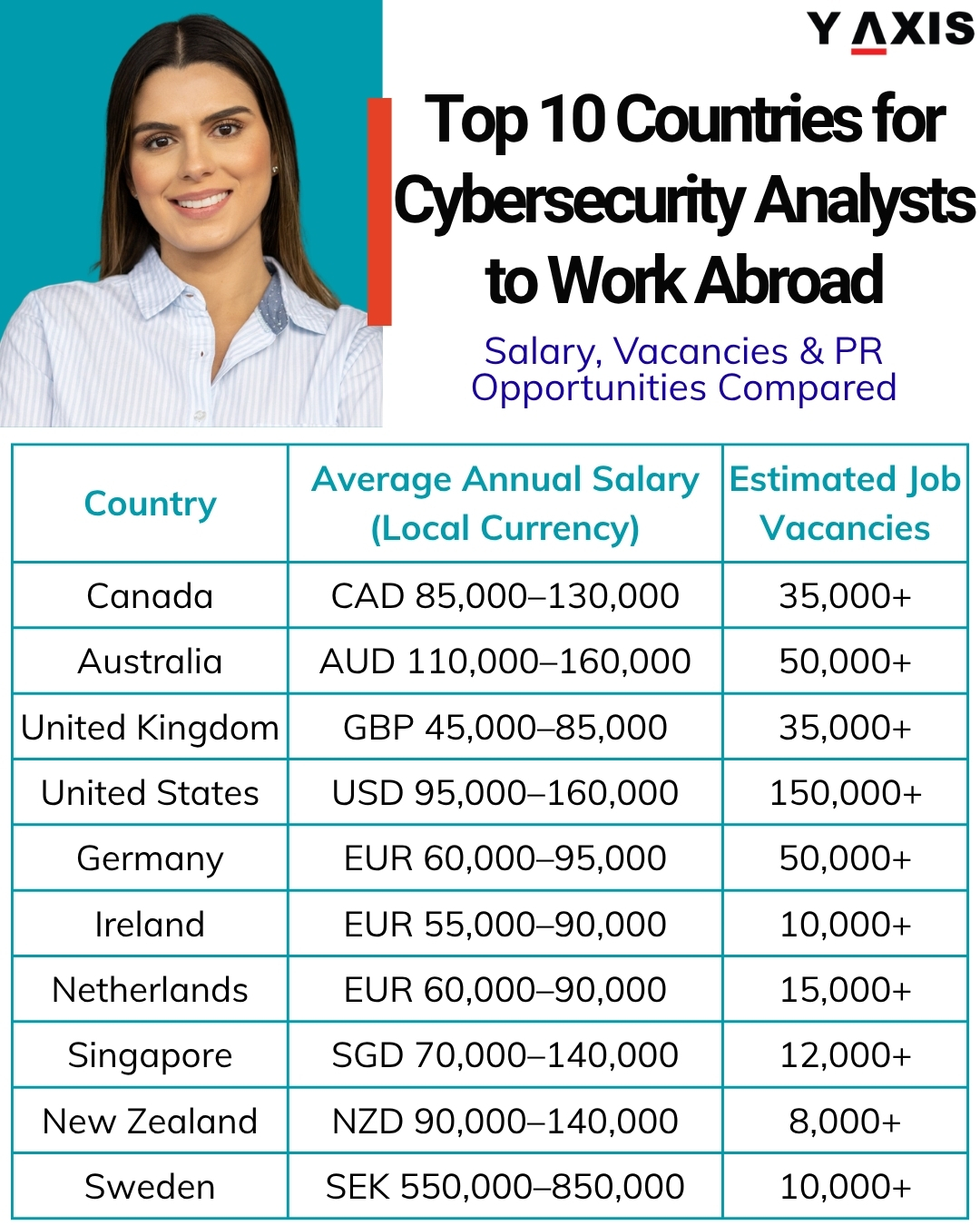
Top 10 Countries for Cybersecurity Analysts to Work Abroad: Salary, Demand & PR Opportunities Compared
Top 10 Countries for Cybersecurity Analysts to Work Abroad: Salary, Demand & PR Opportunities Compared
The top 10 countries for cybersecurity analysts are Canada, Australia, the United Kingdom, the United States, Germany, Ireland, the Netherlands, Singapore, New Zealand, and Sweden. These countries offer competitive salaries, strong job demand, work visa options, and permanent residency pathways for skilled cybersecurity professionals.
Cybersecurity analysts are among the most in-demand technology professionals worldwide. The World Economic Forum estimates the global cybersecurity workforce gap at over 4 million professionals. Rising cyber threats and growing demand for digital security across finance, healthcare, government, and technology sectors continue to drive hiring, creating strong career opportunities for qualified cybersecurity professionals.
*Want to work abroad? Sign up with Y-Axis Resume Marketing Services to find right job faster.
Benefits of Working Abroad as a Cybersecurity Analyst
Working abroad as a cybersecurity analyst can provide access to higher salaries, international career opportunities, employer-sponsored work visas, and long-term settlement options in several leading countries.
- Higher salaries and stronger benefits packages
- Strong and growing global demand for cybersecurity professionals
- Employer-sponsored work visa opportunities
- Permanent residency pathways in multiple countries
- Career growth in leading technology markets
- Opportunities across finance, healthcare, government, and technology sectors
How to Choose the Best Country for Cybersecurity Analyst Jobs Abroad?
Choosing the best country for cybersecurity analyst jobs depends on salary levels, job demand, visa options, and long-term settlement opportunities. Countries with cybersecurity skills shortages offer better employment prospects and immigration pathways for skilled professionals.
- Average cybersecurity analyst salary
- Availability of cybersecurity jobs
- Work visa and immigration options
- Permanent residency opportunities
- Cost of living and quality of life
- Long-term career growth prospects
Top 10 Countries for Cybersecurity Analyst Jobs Abroad
Cybersecurity analysts are among the most sought-after technology professionals worldwide. Growing investment in digital security, cloud technologies, and data protection has increased demand for skilled cybersecurity talent across multiple industries. Many countries are actively recruiting international professionals through work visa programs and skilled migration pathways, offering competitive salaries and long-term career opportunities abroad.
|
Country |
Average Annual Salary (Local Currency) |
Estimated Cybersecurity Analyst Job Vacancies |
|
Canada |
CAD 85,000 – 130,000 |
35,000+ |
|
Australia |
AUD 110,000 – 160,000 |
50,000+ |
|
United Kingdom |
GBP 45,000 – 85,000 |
35,000+ |
|
United States |
USD 95,000 – 160,000 |
150,000+ |
|
Germany |
EUR 60,000 – 95,000 |
50,000+ |
|
Ireland |
EUR 55,000 – 90,000 |
10,000+ |
|
Netherlands |
EUR 60,000 – 90,000 |
15,000+ |
|
Singapore |
SGD 70,000 – 140,000 |
12,000+ |
|
New Zealand |
NZD 90,000 – 140,000 |
8,000+ |
|
Sweden |
SEK 550,000 – 850,000 |
10,000+ |
*Want to work abroad? Sign up with Y-Axis Resume Marketing Services to find right job faster.
Best Countries for Cybersecurity Analysts to Work and Settle Abroad
Countries with strong demand for cybersecurity professionals offer some of the best opportunities for skilled talent to work and settle abroad. Factors such as competitive salaries, job availability, work visa options, and permanent residency pathways make destinations like Canada, Australia, the United Kingdom, and Germany attractive choices for cybersecurity analysts seeking long-term career growth and migration opportunities.
Cybersecurity Analyst Jobs in Canada
Canada is a popular destination for cybersecurity analysts due to its growing demand for cybersecurity talent, competitive salaries, and strong immigration pathways. As organisations across finance, healthcare, government, and technology sectors strengthen their digital security systems, demand for skilled cybersecurity professionals continues to increase. Major technology hubs such as Toronto, Vancouver, Ottawa, and Calgary offer a wide range of opportunities for cybersecurity analysts. In addition to strong career prospects, Canada provides several pathways to permanent residence through programs such as Express Entry and Provincial Nominee Programs (PNPs), making it an attractive destination for long-term settlement.
|
Factor |
Details |
|
Cybersecurity Job Market & Job Vacancies for the Next Decade |
Canada has a strong and growing cybersecurity job market, with more than 35,000 cybersecurity job openings expected over the next decade as organisations continue to strengthen their digital security capabilities. |
|
Cybersecurity Investment & Growth Drivers |
Canada's cybersecurity market is projected to exceed USD 46 billion by 2033, driven by increasing investment in cybersecurity, cloud security, artificial intelligence, and data protection across finance, healthcare, government, and technology sectors. |
|
Top Companies Hiring Cybersecurity Analysts |
IBM, Microsoft, Deloitte, CGI, Shopify, RBC, TD Bank, Bell, Rogers, and Accenture. |
|
Top Cities for Cybersecurity Jobs |
Toronto, Ottawa, Vancouver, Montreal, Calgary, and Waterloo. |
|
In-Demand Cybersecurity Roles & Skills |
Cybersecurity Analyst, SOC Analyst, Information Security Analyst, Cloud Security Analyst, and Security Consultant. Key skills include SIEM, threat intelligence, incident response, cloud security, AWS, Azure, and risk management. |
|
Work Visa Options |
Global Talent Stream, Temporary Foreign Worker Program (TFWP), and LMIA-based work permits. |
|
Fast-Track Hiring Options |
The Global Talent Stream provides expedited processing for eligible employers hiring cybersecurity analysts and other specialised cybersecurity roles. |
|
PR / Long-Term Residence Opportunities |
Express Entry, Canadian Experience Class (CEC), and Provincial Nominee Programs (PNPs). |
|
Eligibility for Dependents |
Yes, spouses and dependent children can accompany the primary applicant. |
|
Benefits for Family Members |
Eligible spouses may obtain open work permits, while dependent children can access public education and healthcare benefits. |
*Want to Work in Canada? Let Y-Axis guide you through application process.
Cybersecurity Analyst Jobs in Australia
Australia is one of the leading destinations for cybersecurity analysts, supported by strong demand for cybersecurity talent, competitive salaries, and skilled migration opportunities. The country's growing digital economy, increasing cybersecurity investment, and focus on protecting critical infrastructure continue to create job opportunities across government, finance, healthcare, telecommunications, and technology sectors. Major cities such as Sydney, Melbourne, Brisbane, Canberra, and Perth offer a wide range of cybersecurity roles for qualified professionals. Australia also provides several pathways to permanent residence through skilled migration programs, making it an attractive option for cybersecurity analysts seeking long-term career growth and settlement opportunities.
|
Factor |
Details |
|
Cybersecurity Job Market & Job Vacancies for the Next Decade |
Australia has a well-established cybersecurity job market, with more than 50,000 cybersecurity job vacancies expected over the next decade as employers address growing cyber threats and cybersecurity skills shortages. |
|
Cybersecurity Investment & Growth Drivers |
Australia has committed more than AUD 580 million under its Cyber Security Strategy and continues to invest in critical infrastructure protection, digital technologies, and cyber resilience initiatives. |
|
Top Companies Hiring Cybersecurity Analysts |
Telstra, Optus, Commonwealth Bank, NAB, ANZ, Accenture, Deloitte, IBM, EY, and KPMG. |
|
Top Cities for Cybersecurity Jobs |
Sydney, Melbourne, Brisbane, Canberra, Perth, and Adelaide. |
|
In-Demand Cybersecurity Roles & Skills |
Cybersecurity Analyst, SOC Analyst, Cloud Security Analyst, Information Security Analyst, and Security Consultant. Key skills include SIEM, threat intelligence, incident response, cloud security, AWS, Azure, and risk management. |
|
Work Visa Options |
Skills in Demand Visa (Subclass 482), Employer Nomination Scheme (Subclass 186), Skilled Independent Visa (Subclass 189), and Skilled Nominated Visa (Subclass 190). |
|
Fast-Track Hiring Options |
The Skills in Demand Visa (Subclass 482) enables eligible employers to recruit overseas cybersecurity analysts to address workforce shortages. |
|
PR / Long-Term Residence Opportunities |
Skilled Independent Visa (Subclass 189), Skilled Nominated Visa (Subclass 190), Employer Nomination Scheme (Subclass 186), and Skilled Work Regional Visa (Subclass 491). |
|
Eligibility for Dependents |
Yes, spouses and dependent children can accompany the primary applicant. |
|
Benefits for Family Members |
Eligible spouses may receive work rights, while dependent children can access education and healthcare benefits in Australia. |
*Planning to Work in Australia? Let Y-Axis guide you through every step of the process.
Cybersecurity Analyst Jobs in the UK
The United Kingdom is one of Europe's leading destinations for cybersecurity analysts, supported by a mature cybersecurity sector and strong demand across finance, government, defence, healthcare, and technology industries. As organisations continue to strengthen their cyber resilience and regulatory compliance, employers are actively recruiting cybersecurity talent to address ongoing skills shortages. Major cities such as London, Manchester, Birmingham, Bristol, and Edinburgh offer diverse career opportunities in cybersecurity. With competitive salaries, employer-sponsored work visa options, and pathways to long-term settlement, the UK remains an attractive destination for cybersecurity analysts seeking international career growth.
|
Factor |
Details |
|
Cybersecurity Job Market & Job Vacancies for the Next Decade |
The UK has a mature cybersecurity job market, with more than 35,000 cybersecurity job vacancies expected as organisations continue to address cybersecurity skills shortages and evolving digital security threats. |
|
Cybersecurity Investment & Growth Drivers |
The UK cybersecurity sector generates more than GBP 13 billion annually, supported by investment in cyber resilience, digital infrastructure, financial services security, and national cyber defence initiatives. |
|
Top Companies Hiring Cybersecurity Analysts |
BT Group, Vodafone, BAE Systems, Deloitte, PwC, KPMG, EY, Accenture, HSBC, and Barclays. |
|
Top Cities for Cybersecurity Jobs |
London, Manchester, Birmingham, Bristol, Edinburgh, and Leeds. |
|
In-Demand Cybersecurity Roles & Skills |
Cybersecurity Analyst, SOC Analyst, Information Security Analyst, Cloud Security Analyst, Penetration Tester, and Security Consultant. Key skills include SIEM, threat intelligence, incident response, cloud security, AWS, Azure, and risk management. |
|
Work Visa Options |
Skilled Worker Visa, Global Talent Visa, High Potential Individual (HPI) Visa, and Scale-up Worker Visa. |
|
Fast-Track Hiring Options |
The Skilled Worker Visa allows approved UK employers to recruit overseas cybersecurity analysts for eligible occupations. |
|
PR / Long-Term Residence Opportunities |
Indefinite Leave to Remain (ILR) after meeting residence requirements, followed by eligibility for British citizenship. |
|
Eligibility for Dependents |
Yes, eligible dependants can accompany the primary visa holder. |
|
Benefits for Family Members |
Eligible spouses can work in the UK, while children can access education and healthcare services. |
* Want to Work in the UK? Let Y-Axis guide you through the steps.
Cybersecurity Analyst Jobs in United States
The United States has the world's largest cybersecurity job market and is home to many of the world's leading technology, financial services, healthcare, and defence organisations. Growing cyber threats, increasing regulatory requirements, and continued investment in digital security have created strong demand for cybersecurity analysts across both public and private sectors. Major technology hubs such as Washington D.C., New York, San Francisco, Austin, Seattle, and Boston offer a wide range of cybersecurity career opportunities. With some of the highest salaries in the industry and demand spanning multiple sectors, the United States remains a top destination for cybersecurity professionals.
|
Factor |
Details |
|
Cybersecurity Job Market & Job Vacancies for the Next Decade |
The United States has the world's largest cybersecurity job market, with more than 150,000 cybersecurity positions available and continued demand expected over the coming decade. |
|
Cybersecurity Investment & Growth Drivers |
The U.S. cybersecurity market is projected to exceed USD 500 billion by 2033, driven by continued investment in cyber defence, cloud security, artificial intelligence, critical infrastructure protection, and national security initiatives. |
|
Top Companies Hiring Cybersecurity Analysts |
Microsoft, Google, Amazon, IBM, Cisco, Palo Alto Networks, CrowdStrike, Deloitte, Lockheed Martin, and Raytheon. |
|
Top Cities for Cybersecurity Jobs |
Washington D.C., New York City, San Francisco, Austin, Seattle, and Boston. |
|
In-Demand Cybersecurity Roles & Skills |
Cybersecurity Analyst, Security Operations Center (SOC) Analyst, Information Security Analyst, Cloud Security Analyst, Threat Intelligence Analyst, and Security Consultant. Key skills include SIEM, incident response, cloud security, AWS, Azure, threat hunting, and risk management. |
|
Work Visa Options |
H-1B Visa, L-1 Intracompany Transfer Visa, O-1 Visa, and employment-based sponsorship programs. |
|
Fast-Track Hiring Options |
Employers can sponsor qualified cybersecurity analysts through H-1B and other employment-based visa programs for specialised technology roles. |
|
PR / Long-Term Residence Opportunities |
Employment-Based Green Card categories including EB-2 and EB-3 provide pathways to permanent residence. |
|
Eligibility for Dependents |
Yes, eligible spouses and dependent children can accompany the primary applicant. |
|
Benefits for Family Members |
Eligible dependants can live, study, and access various benefits based on the visa category and immigration status. |
*Want to Work in United States? Let Y-Axis guide you through every step of the process.
Cybersecurity Analyst Jobs in Germany
Germany is one of Europe's leading destinations for cybersecurity analysts, driven by its strong industrial economy, advanced digital infrastructure, and growing focus on cyber resilience. As businesses and government organisations increase investment in cybersecurity and Industry 4.0 technologies, demand for cybersecurity professionals continues to rise across manufacturing, finance, healthcare, and technology sectors.
Major cities such as Berlin, Munich, Frankfurt, Hamburg, and Stuttgart offer diverse career opportunities for cybersecurity analysts. With competitive salaries, employer-sponsored work visas, and pathways to long-term residence, Germany remains an attractive destination for cybersecurity professionals seeking careers in Europe.
|
Factor |
Details |
|
Cybersecurity Job Market & Job Vacancies for the Next Decade |
Germany has an expanding cybersecurity job market, with more than 50,000 cybersecurity positions estimated to be unfilled as employers continue to address cybersecurity skills shortages across industries. |
|
Cybersecurity Investment & Growth Drivers |
Germany's cybersecurity market is projected to exceed EUR 30 billion by 2033, supported by growing investment in Industry 4.0, cloud security, artificial intelligence, digital infrastructure, and critical infrastructure protection. |
|
Top Companies Hiring Cybersecurity Analysts |
SAP, Siemens, Deutsche Telekom, Bosch, BMW Group, Volkswagen Group, Allianz, Accenture, Deloitte, and IBM. |
|
Top Cities for Cybersecurity Jobs |
Berlin, Munich, Frankfurt, Hamburg, Stuttgart, and Cologne. |
|
In-Demand Cybersecurity Roles & Skills |
Cybersecurity Analyst, Information Security Analyst, SOC Analyst, Cloud Security Analyst, Security Engineer, and Security Consultant. Key skills include SIEM, threat intelligence, incident response, cloud security, AWS, Azure, and risk management. |
|
Work Visa Options |
EU Blue Card, Skilled Worker Visa, Opportunity Card (Chancenkarte), and employer-sponsored work permits. |
|
Fast-Track Hiring Options |
The EU Blue Card provides a streamlined pathway for qualified cybersecurity analysts with a recognised qualification and a job offer from a German employer. |
|
PR / Long-Term Residence Opportunities |
Permanent Settlement Permit and EU Long-Term Residence Permit pathways are available for eligible foreign workers. |
|
Eligibility for Dependents |
Yes, spouses and dependent children can accompany the primary applicant. |
|
Benefits for Family Members |
Eligible spouses may receive work rights, while dependent children can access Germany's education system and healthcare benefits. |
*Want to Work in Germany? Let Y-Axis guide you through every step of the process.
Cybersecurity Analyst Jobs in Ireland
Ireland has become a major cybersecurity hub in Europe, driven by the presence of global technology companies, financial services firms, and multinational organisations. Increasing investment in digital security, cloud computing, and data protection continues to create demand for cybersecurity analysts across the country. Dublin, Cork, Galway, and Limerick are key centres for cybersecurity and technology careers. With competitive salaries, employer-sponsored work permits, and pathways to long-term residence, Ireland offers attractive opportunities for cybersecurity analysts seeking to build international careers in a fast-growing technology market.
|
Factor |
Details |
|
Cybersecurity Job Market & Job Vacancies for the Next Decade |
Ireland has a fast-growing cybersecurity job market, with more than 10,000 cybersecurity vacancies expected as employers continue to address cybersecurity skills shortages and expanding digital security requirements. |
|
Cybersecurity Investment & Growth Drivers |
Ireland's cybersecurity market is projected to exceed EUR 5 billion by 2033, supported by investment in cloud computing, digital transformation, data protection, and cybersecurity initiatives across technology and financial services sectors. |
|
Top Companies Hiring Cybersecurity Analysts |
Google, Microsoft, Meta, Amazon, Accenture, Deloitte, PwC, Workday, Stripe, and Mastercard. |
|
Top Cities for Cybersecurity Jobs |
Dublin, Cork, Galway, Limerick, and Waterford. |
|
In-Demand Cybersecurity Roles & Skills |
Cybersecurity Analyst, SOC Analyst, Information Security Analyst, Cloud Security Analyst, Security Engineer, and Security Consultant. Key skills include SIEM, threat intelligence, incident response, cloud security, AWS, Azure, and risk management. |
|
Work Visa Options |
Critical Skills Employment Permit, General Employment Permit, and Intra-Company Transfer Employment Permit. |
|
Fast-Track Hiring Options |
The Critical Skills Employment Permit offers a streamlined pathway for eligible cybersecurity analysts working in high-demand occupations. |
|
PR / Long-Term Residence Opportunities |
Stamp 4 permission and long-term residence pathways are available for eligible foreign workers. |
|
Eligibility for Dependents |
Yes, spouses and dependent children can accompany the primary applicant. |
|
Benefits for Family Members |
Eligible spouses may receive work rights, while dependent children can access education and healthcare services in Ireland. |
Cybersecurity Analyst Jobs in Netherlands
The Netherlands is a leading European technology and digital innovation hub, creating strong demand for cybersecurity analysts across finance, technology, logistics, and government sectors. As organisations continue to invest in cloud computing, digital infrastructure, and cyber resilience, cybersecurity professionals remain highly sought after throughout the country. Amsterdam, Rotterdam, The Hague, Utrecht, and Eindhoven offer a wide range of opportunities in cybersecurity and information security. With competitive salaries, a high quality of life, employer-sponsored work permits, and pathways to long-term residence, the Netherlands is an attractive destination for cybersecurity analysts seeking careers in Europe.
|
Factor |
Details |
|
Cybersecurity Job Market & Job Vacancies for the Next Decade |
The Netherlands has a mature cybersecurity job market, with more than 15,000 cybersecurity vacancies driven by growing digitalisation and increasing cybersecurity requirements across industries. |
|
Cybersecurity Investment & Growth Drivers |
The Netherlands' cybersecurity market is projected to exceed EUR 10 billion by 2033, supported by investment in cloud security, digital infrastructure, smart technologies, and cyber resilience initiatives. |
|
Top Companies Hiring Cybersecurity Analysts |
ASML, ING, Philips, KPN, Deloitte, Accenture, IBM, Capgemini, Rabobank, and PwC. |
|
Top Cities for Cybersecurity Jobs |
Amsterdam, Rotterdam, The Hague, Utrecht, and Eindhoven. |
|
In-Demand Cybersecurity Roles & Skills |
Cybersecurity Analyst, SOC Analyst, Information Security Analyst, Cloud Security Analyst, Security Engineer, and Security Consultant. Key skills include SIEM, threat intelligence, incident response, cloud security, AWS, Azure, and risk management. |
|
Work Visa Options |
Highly Skilled Migrant Visa, EU Blue Card, Intra-Corporate Transferee Permit, and employer-sponsored work permits. |
|
Fast-Track Hiring Options |
The Highly Skilled Migrant Program allows recognised employers to recruit qualified cybersecurity analysts from overseas. |
|
PR / Long-Term Residence Opportunities |
Permanent Residence Permit and long-term EU residence pathways are available for eligible foreign workers. |
|
Eligibility for Dependents |
Yes, spouses and dependent children can accompany the primary applicant. |
|
Benefits for Family Members |
Eligible spouses may receive work rights, while dependent children can access education and healthcare services in the Netherlands. |
Cybersecurity Analyst Jobs in Singapore
Singapore is one of Asia's leading cybersecurity hubs, supported by its position as a global financial centre and technology powerhouse. The country's strong focus on digital innovation, smart nation initiatives, and cyber resilience continues to drive demand for cybersecurity analysts across banking, fintech, government, healthcare, and technology sectors. Singapore offers a highly developed digital economy, competitive salaries, and opportunities to work with multinational companies and regional headquarters. With strong demand for cybersecurity talent and employer-sponsored work visa options, Singapore remains an attractive destination for cybersecurity professionals seeking international career growth.
|
Factor |
Details |
|
Cybersecurity Job Market & Job Vacancies for the Next Decade |
Singapore has a high-demand cybersecurity job market, with more than 12,000 cybersecurity vacancies driven by rapid digitalisation, growing cyber threats, and increasing demand for cyber resilience. |
|
Cybersecurity Investment & Growth Drivers |
Singapore's cybersecurity market is projected to exceed SGD 8 billion by 2033, supported by investment in Smart Nation initiatives, digital infrastructure, cloud security, fintech innovation, and critical infrastructure protection. |
|
Top Companies Hiring Cybersecurity Analysts |
DBS Bank, OCBC Bank, UOB, Singtel, GovTech, Accenture, Deloitte, IBM, Microsoft, and Google. |
|
Top Cities for Cybersecurity Jobs |
Singapore (city-state). |
|
In-Demand Cybersecurity Roles & Skills |
Cybersecurity Analyst, SOC Analyst, Information Security Analyst, Cloud Security Analyst, Threat Intelligence Analyst, and Security Consultant. Key skills include SIEM, threat intelligence, incident response, cloud security, AWS, Azure, and risk management. |
|
Work Visa Options |
Employment Pass (EP), S Pass, Tech.Pass, and Overseas Networks & Expertise (ONE) Pass. |
|
Fast-Track Hiring Options |
The Employment Pass allows eligible employers to recruit overseas cybersecurity analysts for professional and specialist roles. |
|
PR / Long-Term Residence Opportunities |
Eligible foreign professionals may apply for Singapore Permanent Residence (PR) through the Professionals, Technical Personnel and Skilled Workers (PTS) Scheme. |
|
Eligibility for Dependents |
Yes, eligible spouses and dependent children can accompany the primary applicant. |
|
Benefits for Family Members |
Eligible family members may receive dependant passes, access to education opportunities, and long-term residence benefits. |
Cybersecurity Analyst Jobs in New Zealand
New Zealand offers strong opportunities for cybersecurity analysts, supported by increasing investment in digital security, cloud technologies, and critical infrastructure protection. As organisations across government, finance, healthcare, and technology sectors strengthen their cybersecurity capabilities, demand for skilled cybersecurity professionals continues to grow. Auckland, Wellington, Christchurch, Hamilton, and Dunedin are key centres for cybersecurity and technology careers. With a high quality of life, competitive salaries, employer-sponsored work visas, and pathways to residence, New Zealand is an attractive destination for cybersecurity analysts seeking long-term career opportunities abroad.
|
Factor |
Details |
|
Cybersecurity Job Market & Job Vacancies for the Next Decade |
New Zealand has a steadily growing cybersecurity job market, with more than 8,000 cybersecurity job openings expected as employers continue to address cybersecurity skills shortages and evolving digital security challenges. |
|
Cybersecurity Investment & Growth Drivers |
New Zealand's cybersecurity market is projected to exceed NZD 3 billion by 2033, driven by investment in digital transformation, cloud security, cyber resilience, and critical infrastructure protection. |
|
Top Companies Hiring Cybersecurity Analysts |
Spark New Zealand, Datacom, Xero, ANZ New Zealand, ASB Bank, KPMG, Deloitte, PwC, IBM, and Accenture. |
|
Top Cities for Cybersecurity Jobs |
Auckland, Wellington, Christchurch, Hamilton, and Dunedin. |
|
In-Demand Cybersecurity Roles & Skills |
Cybersecurity Analyst, SOC Analyst, Information Security Analyst, Cloud Security Analyst, Security Engineer, and Security Consultant. Key skills include SIEM, threat intelligence, incident response, cloud security, AWS, Azure, and risk management. |
|
Work Visa Options |
Accredited Employer Work Visa (AEWV), Skilled Migrant Category Resident Visa, Straight to Residence Visa, and Green List pathways. |
|
Fast-Track Hiring Options |
The Accredited Employer Work Visa (AEWV) enables accredited employers to recruit overseas cybersecurity professionals to fill skills shortages. |
|
PR / Long-Term Residence Opportunities |
Skilled Migrant Category Resident Visa, Straight to Residence Visa, and Work to Residence pathways. |
|
Eligibility for Dependents |
Yes, spouses and dependent children can accompany the primary applicant. |
|
Benefits for Family Members |
Eligible spouses may receive work rights, while dependent children can access education and healthcare benefits in New Zealand. |
Cybersecurity Analyst Jobs in Sweden
Sweden is one of Northern Europe's leading digital economies and continues to invest heavily in cybersecurity, digital infrastructure, cloud technologies, and critical infrastructure protection. Growing cyber security requirements across government, finance, telecommunications, healthcare, and technology sectors have created steady demand for cybersecurity analysts and information security professionals. Stockholm, Gothenburg, Malmö, Uppsala, and Linköping offer strong employment opportunities in cybersecurity and technology. With competitive salaries, a high quality of life, employer-sponsored work permits, and pathways to permanent residence, Sweden is an attractive destination for cybersecurity professionals seeking long-term career growth in Europe.
|
Factor |
Details |
|
Cybersecurity Job Market & Job Vacancies for the Next Decade |
Sweden has a growing cybersecurity job market, with more than 10,000 cybersecurity vacancies driven by digital transformation, increasing cyber threats, and ongoing skills shortages. |
|
Cybersecurity Investment & Growth Drivers |
Sweden's cybersecurity market is projected to exceed SEK 40 billion by 2033, supported by investment in digital infrastructure, cloud security, artificial intelligence, smart technologies, and critical infrastructure protection. |
|
Top Companies Hiring Cybersecurity Analysts |
Ericsson, Volvo Group, Saab, Tietoevry, Telia, Accenture, Deloitte, IBM, KPMG, and PwC. |
|
Top Cities for Cybersecurity Jobs |
Stockholm, Gothenburg, Malmö, Uppsala, and Linköping. |
|
In-Demand Cybersecurity Roles & Skills |
Cybersecurity Analyst, Information Security Analyst, SOC Analyst, Cloud Security Analyst, Security Engineer, and Security Consultant. Key skills include SIEM, threat intelligence, incident response, cloud security, AWS, Azure, and risk management. |
|
Work Visa Options |
Sweden Work Permit, EU Blue Card, ICT Permit, and employer-sponsored work permits. |
|
Fast-Track Hiring Options |
Certified employers can use Sweden's fast-track work permit process to recruit qualified cybersecurity professionals from abroad more efficiently. |
|
PR / Long-Term Residence Opportunities |
Permanent residence may be available after meeting long-term residence requirements, followed by eligibility for Swedish citizenship. |
|
Eligibility for Dependents |
Yes, spouses, registered partners, and dependent children can accompany the primary applicant. |
|
Benefits for Family Members |
Eligible spouses may receive work rights, while dependent children can access Sweden's education system and healthcare services. |
Job Outlook for Cybersecurity Analysts over the Next 10 Years
The job outlook for cybersecurity analysts is expected to remain strong over the next decade as organisations worldwide increase investment in digital security and cyber resilience. Growing cyber threats, data breaches, ransomware attacks, and stricter regulatory requirements are driving demand for cybersecurity professionals across finance, healthcare, government, manufacturing, and technology sectors. According to the World Economic Forum, the global cybersecurity workforce gap exceeds 4 million professionals, highlighting the ongoing shortage of qualified talent. As cloud computing, artificial intelligence, and digital transformation continue to expand, cybersecurity analysts are expected to remain among the most in-demand technology professionals globally, creating excellent long-term career opportunities.
*Want to work abroad? Sign up with Y-Axis Resume Marketing Services to find right job faster.
FAQs
Which countries have the highest demand for cybersecurity analysts?
The countries with the highest demand for cybersecurity analysts include the United States, Canada, Australia, the United Kingdom, Germany, Ireland, Singapore, the Netherlands, New Zealand, and Sweden. These countries continue to face cybersecurity skills shortages and actively recruit international professionals to support digital transformation, cyber resilience, cloud security, and critical infrastructure protection initiatives across multiple industries.
Which country pays the highest salary for cybersecurity analysts?
The United States and Switzerland offer some of the highest salaries for cybersecurity analysts, with experienced professionals often earning more than USD 100,000 annually. Australia, Singapore, Canada, and the United Kingdom also provide competitive salaries, strong benefits packages, and attractive long-term career opportunities for cybersecurity professionals seeking international employment.
Can cybersecurity analysts get work visas abroad?
Yes. Many countries offer employer-sponsored work visas for cybersecurity analysts because of ongoing skills shortages. Popular destinations include Canada, Australia, Germany, the United Kingdom, New Zealand, Singapore, and the United States. Qualified cybersecurity professionals can often access specialised work permit programs, skilled migration pathways, or employer sponsorship routes depending on the country's immigration policies.
Can cybersecurity analysts get permanent residency abroad?
Yes. Countries such as Canada, Australia, New Zealand, Germany, and Sweden offer permanent residency pathways for qualified cybersecurity professionals. Depending on the country, applicants may qualify through skilled migration programs, employer sponsorship, work-to-residence pathways, or long-term residence permits that can eventually lead to citizenship.
Is cybersecurity analyst a good career for immigration?
Yes. Cybersecurity analysts are among the most in-demand technology professionals worldwide and are frequently listed on skilled occupation and shortage occupation lists. Strong global demand, competitive salaries, employer sponsorship opportunities, and permanent residency pathways make cybersecurity one of the most attractive careers for professionals planning to work and settle abroad.
Which country is best for cybersecurity analyst jobs abroad?
Canada, Australia, the United States, and the United Kingdom are among the best countries for cybersecurity analyst jobs abroad. These destinations offer strong hiring demand, competitive salaries, employer-sponsored work visas, and long-term settlement opportunities. The best choice depends on your career goals, salary expectations, immigration preferences, and preferred destination.
What qualifications are required to work as a cybersecurity analyst abroad?
Most employers require a degree in cybersecurity, computer science, information technology, or a related field. Relevant work experience, cybersecurity certifications, and technical skills in areas such as cloud security, threat intelligence, incident response, and risk management can significantly improve employment opportunities in international job markets.
Are cybersecurity analysts in demand worldwide?
Yes. Cybersecurity analysts are in demand worldwide due to increasing cyber threats, data breaches, ransomware attacks, cloud adoption, and digital transformation initiatives. The World Economic Forum estimates a global cybersecurity workforce gap of more than 4 million professionals, highlighting the ongoing need for qualified cybersecurity talent across multiple industries and countries.
What is the future job outlook for cybersecurity analysts?
The job outlook for cybersecurity analysts remains highly positive over the next decade. Increasing investment in cybersecurity, growing cyber threats, digital transformation, cloud computing, and stricter regulatory requirements are expected to drive sustained demand for cybersecurity professionals. Many countries continue to face cybersecurity talent shortages, creating strong long-term career opportunities for qualified specialists.
Which industries hire cybersecurity analysts the most?
Cybersecurity analysts are employed across a wide range of industries, with the highest demand coming from finance, healthcare, government, defence, technology, telecommunications, manufacturing, and critical infrastructure sectors. These organisations rely on cybersecurity professionals to protect sensitive data, secure networks, manage cyber risks, and respond to evolving security threats.
Can cybersecurity analysts move abroad without a job offer?
Yes, some countries offer immigration pathways that do not require a job offer. Options such as skilled migration programs, points-based immigration systems, and job seeker visas may allow qualified cybersecurity professionals to relocate and search for employment after arrival. Eligibility requirements vary depending on the destination country and immigration program.
What skills are most in demand for cybersecurity analysts?
Employers commonly seek cybersecurity analysts with skills in SIEM, threat intelligence, incident response, cloud security, risk management, vulnerability assessment, penetration testing, network security, and security operations. Experience with cloud platforms such as AWS and Azure, along with cybersecurity certifications, can improve job prospects and salary potential.
Which cities offer the best cybersecurity job opportunities?
Some of the best cities for cybersecurity jobs include Toronto, Vancouver, Sydney, Melbourne, London, Manchester, New York, Washington D.C., Berlin, Dublin, Amsterdam, Singapore, Auckland, and Stockholm. These cities are major technology and business hubs with strong demand for cybersecurity professionals across multiple industries.
Do cybersecurity analysts qualify for skilled migration programs?
Yes. Cybersecurity analysts qualify for skilled migration programs in several countries, including Canada, Australia, New Zealand, Germany, and the United Kingdom. Cybersecurity-related occupations are often listed among high-demand professions, making qualified applicants eligible for work visas, skilled migration pathways, and permanent residency opportunities.
Is cybersecurity a future-proof career?
Yes. Cybersecurity is considered one of the most future-proof careers due to increasing cyber threats, digital transformation, cloud adoption, artificial intelligence, and stricter data protection regulations. Organisations across all industries require cybersecurity expertise, ensuring long-term demand for qualified professionals and strong career growth opportunities.
Can cybersecurity analysts take their families abroad?
Yes. Most work visa and skilled migration programs allow cybersecurity professionals to include eligible spouses and dependent children in their applications. In many countries, spouses may receive work rights, while children can access education and healthcare benefits, depending on the visa category and local regulations.
What is the average salary of a cybersecurity analyst abroad?
Cybersecurity analyst salaries vary by country, experience, and industry. In major international job markets, annual salaries typically range from USD 60,000 to USD 160,000 or more. Countries such as the United States, Switzerland, Australia, Singapore, and Canada offer some of the highest salaries for experienced cybersecurity professionals.
Which country is easiest for cybersecurity analysts to immigrate to?
Canada, Australia, New Zealand, and Germany are often considered among the most accessible destinations for cybersecurity professionals. These countries face ongoing cybersecurity skills shortages and offer established skilled migration programs, employer-sponsored work visas, and pathways to permanent residency for qualified applicants.
What is the future job outlook for cybersecurity analysts?
The future job outlook for cybersecurity analysts remains highly positive. As cyber threats become more sophisticated and organisations increase investment in digital security, demand for cybersecurity professionals is expected to grow steadily. Global skills shortages and expanding cybersecurity requirements across industries will continue to create strong employment opportunities over the next decade.
Posted on July 03 2026

What are the eligibility requirements for an Italy Work Visa?
What are the eligibility requirements for an Italy Work Visa?
Italy is one of Europe’s most active destinations for skilled professionals from the UAE, with nearly 500,000 work permits planned under the Decreto Flussi framework. To qualify for an Italy Work Visa, you need a confirmed job offer from an Italian employer, a work authorisation called the Nulla Osta, and a Type D National Long Stay Visa. The Standard Work Visa covers employer-sponsored roles subject to Italy’s annual quota system, while the EU Blue Card suits highly qualified professionals with a minimum salary of approximately €35,000 per year and is quota-free. Visa applications from the UAE are handled through VFS Global in Dubai and Abu Dhabi.
|
Requirement |
Details |
|
Job Offer |
Confirmed offer from an Italian employer for both Standard Work Visa and EU Blue Card routes |
|
Permit Type |
Standard Work Visa (Lavoro Subordinato) or EU Blue Card depending on qualifications and salary |
|
Standard Visa Salary |
Must meet sector collective bargaining agreement (CCNL) minimum for the role |
|
EU Blue Card Salary |
Minimum approximately €35,000 per year for standard roles; €28,200 for shortage sectors |
|
Qualifications |
Relevant experience for Standard Visa; university degree or equivalent for EU Blue Card |
|
Nulla Osta |
Work authorisation applied for by the Italian employer before visa application |
|
Quota |
Standard Work Visa subject to annual Decreto Flussi quota; EU Blue Card is quota-free |
|
Processing Time |
2 to 6 months end-to-end for Standard Visa; 30 to 90 days Nulla Osta for EU Blue Card |
*Want to apply for an Italy Work Visa? Let Y-Axis guide you through every step of the process.
Eligibility Requirements for an Italy Work Visa
Italy’s work visa system is employer-led, with the employer applying for work authorisation before the applicant submits the visa. UAE residents from any non-EU nationality are eligible to apply provided they meet the job offer, salary, and qualification requirements for the chosen route.
To be eligible for an Italy Work Visa, you need:
- A confirmed job offer from an Italian employer willing to sponsor the Nulla Osta application
- A salary meeting the minimum collective bargaining agreement rate for the role under the Standard Work Visa
- A minimum annual salary of approximately €35,000 for the EU Blue Card route
- A recognised university degree of at least three years, or five years of highly qualified professional experience, for the EU Blue Card
- A valid passport with sufficient validity for the duration of your permit
- Availability within Italy’s annual Decreto Flussi quota for the Standard Work Visa route
- For the EU Blue Card: a role in a qualifying occupation with a binding job offer meeting the salary threshold
- Nulla Osta approval from the Italian immigration authority before applying for the visa
*Want to check your eligibility? Get a free eligibility assessment from Y-Axis today.
Documents Required for an Italy Work Visa
Your Italy Work Visa application from the UAE must include documents covering your employment offer, qualifications, identity, and financial standing. The Nulla Osta is submitted by the employer in Italy, while the visa application is submitted through VFS Global in Dubai or Abu Dhabi.
- Valid passport with sufficient validity for the duration of your intended stay in Italy
- Completed Type D National Long Stay Visa application form
- Recent passport-size photographs meeting Italian consulate specifications
- Nulla Osta approval letter issued by the Italian immigration authority
- Signed employment contract confirming job title, salary, and employment conditions
- Educational certificates, degrees, and professional qualification documents
- Evidence of relevant work experience such as reference letters or payslips
- Bank statements showing proof of sufficient funds to support yourself on arrival
- Proof of accommodation in Italy for the initial period of the stay
- Any additional documents requested by VFS Global or the Italian consulate during processing
How to Apply for an Italy Work Visa from the UAE?
Applying for an Italy Work Visa from the UAE involves two stages. The employer in Italy submits the Nulla Osta application first. Once approved, the applicant submits the Type D visa application through VFS Global in Dubai or Abu Dhabi.
Step 1: Secure a confirmed job offer from an Italian employer for a role that meets the eligibility and salary requirements for the Standard Work Visa or EU Blue Card.
Step 2: The employer submits the Nulla Osta (work authorisation) application to the Italian immigration authority on your behalf.
Step 3: Once the Nulla Osta is approved, gather all required documents including your passport, Nulla Osta approval letter, employment contract, qualification certificates, and financial documents.
Step 4: Book an appointment through VFS Global in Dubai or Abu Dhabi and submit your Type D visa application with all supporting documents.
Step 5: Pay the visa application fee and attend the VFS Global appointment in person.
Step 6: Travel to Italy once your Type D visa is approved and begin employment.
Step 7: Within 8 working days of arriving in Italy, apply for your Permesso di Soggiorno (residence permit) at the local post office and register with your employer.
*Want to apply for an Italy Work Visa? Get expert guidance from Y-Axis professionals.
FAQs
Can UAE residents apply for an Italy Work Visa?
Yes. UAE residents who are non-EU nationals can apply for an Italy Work Visa if they have a confirmed job offer from an Italian employer and meet the relevant salary and qualification requirements. The employer must first obtain a Nulla Osta (work authorisation). Applicants then submit their visa application through VFS Global in Dubai or Abu Dhabi before travelling to Italy.
What is the Decreto Flussi and how does it work for UAE applicants?
The Decreto Flussi is Italy’s annual quota system that limits the number of non-EU workers who can enter Italy for employment. Employers applying for a Standard Work Visa must secure a quota slot during designated application periods. Some nationalities may benefit from dedicated allocations under bilateral agreements. The EU Blue Card is exempt from quotas and can be applied for year-round.
What salary do I need for an Italy Work Visa from the UAE?
Salary requirements depend on the visa route. Standard Work Visa applicants must receive the minimum salary set by the relevant collective labour agreement (CCNL) for their occupation. EU Blue Card applicants generally require a minimum salary of approximately €35,000 per year, with reduced thresholds of around €28,200 for shortage occupations such as IT, healthcare, and engineering.
What qualifications are needed for an Italy Work Visa?
Standard Work Visa applicants must have the qualifications and experience required for the position offered by the employer. EU Blue Card applicants generally require a recognised university degree of at least three years relevant to the role, or five years of highly qualified professional experience. Relevant qualifications can significantly strengthen employment and visa approval prospects.
What is the EU Blue Card and who qualifies from the UAE?
The EU Blue Card is a residence and work permit for highly qualified professionals with a recognised university degree and a qualifying job offer. Applicants generally need a minimum salary of approximately €35,000 per year. It is exempt from the Decreto Flussi quota system and provides greater mobility within the European Union after meeting eligibility requirements.
How does Italy compare to other European work destinations for UAE professionals?
Italy offers access to one of Europe’s largest economies and a pathway to long-term EU residence. The EU Blue Card salary threshold is competitive compared to several other European countries. Employees benefit from a mandatory 13th-month salary payment, at least four weeks of paid annual leave, public healthcare access, and the opportunity to live and work across the EU in the future.
How long does Italy Work Visa processing take from the UAE?
Standard Work Visa applications generally take between 2 and 6 months, including Nulla Osta approval and visa processing. After the work authorisation is issued, visa processing through VFS Global typically takes around 7 to 15 working days. EU Blue Card applications are often faster, with Nulla Osta processing generally completed within 30 to 90 days.
What are the employee benefits when working in Italy?
Employees in Italy receive a mandatory 13th-month salary payment, known as the Tredicesima, in addition to their regular wages. Workers are generally entitled to at least four weeks of paid annual leave, public holidays, and access to Italy’s public healthcare system after registration. Standard working hours are usually between 36 and 40 hours per week.
Can the Italy Work Visa lead to permanent residency?
Yes. After five years of continuous legal residence in Italy on a qualifying work permit, applicants may become eligible for permanent residency. Those who meet the residence requirements can generally apply for Italian citizenship after ten years. Permanent residency and citizenship provide long-term settlement rights and access to opportunities throughout the European Union.
Can I bring my family to Italy on a Work Visa?
Yes. Italy Work Visa holders can sponsor their spouse or partner and dependent children through the family reunification process. Family members must apply for their own visas before travelling. EU Blue Card holders benefit from more flexible family reunification rules, and spouses are generally permitted to work in Italy without obtaining a separate work permit.
Posted on July 02 2026
Trending Article
Posted On July 10 2026
Top 10 Countries for Physiotherapists to Work Abroad: Salary, Demand & PR Opportunities Compared