

Posted on November 04 2026
Australia vs. Europe for STEM Professionals: Which Country Should You Choose?

By , Editor & Director
Updated November 04 2026
Both Australia and Europe offer STEM professionals strong career opportunities in software engineering, artificial intelligence, data science, renewable energy and biotechnology, with competitive salaries and pathways to permanent residency. Australia offers PR without employer sponsorship through the Skilled Independent visa (subclass 189) and Skilled Nominated visa (subclass 190), while the Skills in Demand visa (subclass 482) requires employer sponsorship.
Europe has diverse job markets, technology hubs and research opportunities in Germany, the Netherlands, Ireland and Sweden, with work visas such as the EU Blue Card and Germany’s Opportunity Card. Compare jobs, salaries, work visas, living costs and PR pathways to find the best destination for your STEM career.
*Want to work abroad? Let Y-Axis help you through application process.
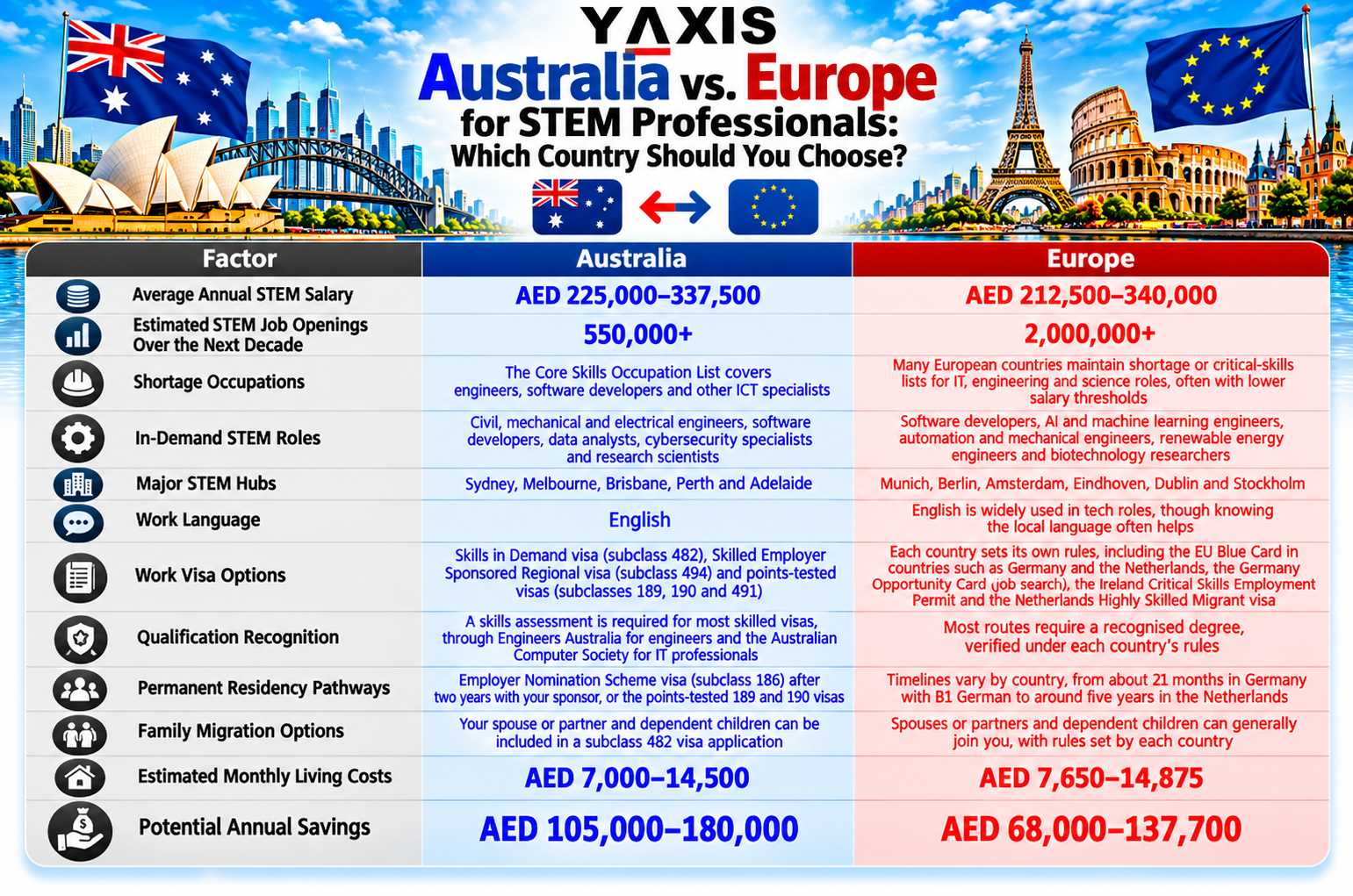
Australia vs. Europe for STEM Professionals: Quick Comparison
Australia offers English-speaking workplaces and skilled migration pathways to permanent residency. Europe provides a wider choice of countries and STEM industries, from technology and engineering to scientific research. The best destination depends on your occupation, salary expectations and long-term career goals.
| Factor | Australia | Europe |
|---|---|---|
| Average Annual STEM Salary | AUD 90,000-135,000 | €50,000-80,000 |
| Estimated STEM Job Opportunities Over the Next Decade | 550,000+ | 2,000,000+ |
| Shortage Occupations | The Core Skills Occupation List covers engineers, software developers and other ICT specialists | Many European countries maintain shortage or critical-skills lists for IT, engineering and science roles, often with lower salary thresholds |
| In-Demand STEM Roles | Civil, mechanical and electrical engineers, software developers, data analysts, cybersecurity specialists and research scientists | Software developers, AI and machine learning engineers, automation and mechanical engineers, renewable energy engineers and biotechnology researchers |
| Major STEM Hubs | Sydney, Melbourne, Brisbane, Perth and Adelaide | Munich, Berlin, Amsterdam, Eindhoven, Dublin and Stockholm |
| Work Language | English | English is widely used in tech roles, though knowing the local language is often an advantage |
| Work Visa Options | Skills in Demand visa (subclass 482), Skilled Employer Sponsored Regional visa (subclass 494) and points-tested visas (189, 190, 491) | Each country has its own system, including the EU Blue Card in countries such as Germany and the Netherlands, the Germany Opportunity Card (job search), the Ireland Critical Skills Employment Permit and the Netherlands Highly Skilled Migrant visa |
| Qualification Recognition | Most skilled visas require a skills assessment first, by Engineers Australia for engineers and the Australian Computer Society for IT professionals | Most routes require a recognized degree, verified under each country’s rules |
| Permanent Residency Pathways | Employer Nomination Scheme visa (subclass 186) after two years with your sponsor, or the points-tested 189 and 190 visas | Timelines vary by country, from about 21 months in Germany with B1 German to around five years in the Netherlands |
| Estimated Monthly Living Costs | AUD 2,800-5,800 | €1,800-3,500 |
| Family Migration Options | Spouse or partner and dependent children can be included in a subclass 482 visa application | Spouse or partner and dependent children can generally join you, with rules set by each country |
Australia vs Europe: Which Offers Better Opportunities for STEM Professionals
Australia offers STEM professionals English-speaking workplaces, opportunities in engineering, IT and infrastructure, and skilled migration pathways to permanent residency. Europe provides a wider choice of countries, with technology hubs, advanced manufacturing, renewable energy and research centers across Germany, the Netherlands, Ireland and Sweden. The best destination depends on your specialization, experience and long-term career goals.

Australia is a strong choice if you want:
- High-demand jobs in engineering, software, data and cybersecurity
- Salaries over AUD 100,000 for many in-demand STEM roles
- English-speaking workplaces with no language barrier
- Sponsored (subclass 482) and sponsor-free (subclass 189) visa routes
- PR through subclass 186 after two years
- Family inclusion and a strong work-life balance
*Planning to work in Australia? Speak to Y-Axis for a clear route to your visa.
Europe is a strong choice if you want:
- STEM jobs in software, AI, automation and renewable energy
- Major tech hubs in Munich, Berlin, Amsterdam, Dublin and Stockholm
- Lower EU Blue Card salary thresholds for many STEM jobs in Germany
- Job-search options without a job offer through Germany’s Opportunity Card
- Faster permanent residency with local language skills
- Spouse work rights, family reunification and easy travel across Europe
Australia vs. Europe: Salaries, Living Costs and Savings for STEM Professionals
Australia and Europe offer STEM professionals competitive salaries, but take-home pay and living costs vary. Australia offers strong earning potential in engineering and IT, while Germany, the Netherlands, Ireland and Sweden provide opportunities across technology and research. Comparing after-tax salaries, rent and everyday expenses helps identify where your STEM career offers better savings.
| Factor | Australia | Europe |
|---|---|---|
| Average Annual STEM Salary (Before Tax) | AUD 90,000-135,000 | €50,000-80,000 |
| Monthly Gross Salary | AUD 7,500-11,250 | €4,200-6,700 |
| Estimated Monthly Take-Home Pay | AUD 5,900-8,400 | €2,700-4,000 |
| Monthly Rent for a 1-Bedroom City-Centre Apartment | AUD 1,600-4,100 | €700-2,400 |
| Monthly Grocery Costs | AUD 350-700 | €250-400 |
| Monthly Public Transport Costs | AUD 120-220 | €63-100 |
| Monthly Utilities, Internet and Mobile | AUD 300-400 | €250-400 |
| Estimated Total Monthly Living Costs | AUD 2,400-5,400 | €1,300-3,500 |
| Potential Monthly Savings | AUD 3,500-6,000 | €1,400-2,700 |
| Potential Annual Savings | AUD 42,000-72,000 | €16,800-32,400 |
| Lower-Cost Cities | Adelaide, Brisbane and Perth | Leipzig and Dresden |
| Higher-Cost Cities | Sydney and Melbourne | Munich, Amsterdam, Stockholm and Dublin |
| Retirement Benefits | 12% employer superannuation contribution | State pension contributions vary, for example 9.3% each in Germany |
*Plan Your STEM Career Abroad? Book a Free Consultation with Y-Axis Today.
FAQs
Is Australia better than Europe for STEM professionals?
Australia suits you when you want English-speaking workplaces, higher salaries of AUD 90,000-135,000 and a sponsor-free route to PR. Europe suits you when you want a wider choice of countries and job markets, such as Germany, the Netherlands, Ireland and Sweden. The better destination depends on your occupation, experience and long-term settlement plans.
Which European country is best for STEM jobs?
Germany leads for engineering, automation and manufacturing, with a lower EU Blue Card salary threshold for many STEM roles. The Netherlands is strong in technology and high-tech engineering, Ireland in software and pharmaceuticals, and Sweden in innovation and research. English is widely used in tech roles, though local language skills often help with settling in.
What is the average STEM salary in Australia vs Europe?
STEM professionals in Australia earn about AUD 90,000-135,000 a year on average, while Europe averages about €50,000-80,000. Europe’s figure varies widely by country, with Germany, Ireland and the Netherlands paying more than many other markets. Compare take-home pay after tax and living costs, since gross salary alone does not show how much you keep.
Which visa is best for STEM professionals moving to Australia?
The best visa depends on your situation. The Skills in Demand visa (subclass 482) works when you have an employer sponsor. The Skilled Independent visa (subclass 189) offers PR without a sponsor, while the 190 and 491 visas add points through state or regional nomination. Most routes start with a skills assessment for your occupation.
Can STEM professionals get PR in Australia without a job offer?
Yes. The points-tested Skilled Independent visa (subclass 189) and Skilled Nominated visa (subclass 190) do not need an employer sponsor. You need an eligible occupation, a positive skills assessment and enough points for age, experience, qualifications and English. The Employer Nomination Scheme visa (subclass 186) is the employer route, available after two years with your sponsor.
Can STEM professionals move to Europe without a job offer?
Yes, in some countries. The Germany Opportunity Card lets qualified professionals enter Germany to look for work, and Sweden offers a job-seeker permit. Many other routes, such as the EU Blue Card and the Netherlands Highly Skilled Migrant visa, are employer-led, so you need a job offer first. Each country sets its own rules.
Is the EU Blue Card better than Australian skilled visas?
The EU Blue Card suits you when you have a job offer in a country like Germany or the Netherlands, with lower salary thresholds for many STEM roles. Australia’s Skilled Independent visa (subclass 189) suits you when you want PR without a sponsor and have enough points. The better option depends on whether you already have an employer.
Is the cost of living lower in Europe than in Australia?
In many European cities, yes. Monthly living costs run about €1,800-3,500 in Europe and AUD 2,800-5,800 in Australia, with rent making the biggest difference. Leipzig and Dresden cost far less than Dublin, Amsterdam or Munich, and Adelaide, Brisbane and Perth cost less than Sydney or Melbourne.
Do STEM professionals need a skills assessment to work in Australia?
Yes, for most skilled visas. Engineers Australia assesses engineers and the Australian Computer Society assesses IT professionals, while other STEM occupations use their own assessing bodies. The assessment confirms your qualifications and experience match your nominated occupation, and completing it early keeps your visa application moving smoothly.
Which STEM jobs are in demand in Australia and Europe?
Australia has strong demand for civil, mechanical and electrical engineers, software developers, data analysts, cybersecurity specialists and research scientists. Europe has demand for software developers, AI and machine learning engineers, automation and mechanical engineers, renewable energy engineers and biotechnology researchers. Both regions keep shortage or skilled occupation lists that favor these roles.
Tags:
Australia vs Europe for STEM
STEM Jobs in Australia
STEM Jobs in Europe
Australia Skilled Visa
EU Blue Card
Australia PR for STEM Professionals
STEM Salaries Australia vs Europe
Skills in Demand Visa 482
Best Country for STEM Professionals
Work Visa for STEM Professionals
Share
Y-Axis Services

Get it on your mobile
Get News alerts
Contact Y-Axis
Latest Article
Popular Post
Trending Article
Posted On November 04 2026
Australia vs. Europe for STEM Professionals: Which Country Should You Choose?