


Posted on October 29 2026
How Can I Get Permanent Residency in Australia?

By , Editor & Director
Updated October 29 2026
To qualify for permanent residency (PR) in Australia, you can apply through skilled migration, employer sponsorship or a partner visa. The Skilled Independent visa (subclass 189) and Skilled Nominated visa (subclass 190) require an eligible occupation, a positive skills assessment, competent English, at least 65 points and an invitation to apply. Applicants must generally be under 45 when invited, and the subclass 190 also requires nomination from an Australian state or territory.
The Employer Nomination Scheme visa (subclass 186) requires nomination by an Australian employer, while partner visas are available if your spouse or de facto partner is an Australian citizen, permanent resident or eligible New Zealand citizen. Once your PR visa is granted, you can live, work and study in Australia indefinitely.
*Want to apply for Australia PR? Let Y-Axis guide you through the application process.
What Are the Main Pathways to Get Australia PR?
The main pathways for Australia PR are skilled migration visas (subclasses 189 and 190), employer-sponsored PR (subclass 186), regional migration (subclasses 491 and 494, leading to 191), partner and family visas, and the National Innovation visa (subclass 858). The right pathway depends on your occupation, whether an employer or state will nominate you, your family circumstances and your professional achievements.
- Skilled Independent visa (subclass 189): For skilled workers who meet the points test and apply without employer sponsorship or state or territory nomination.
- Skilled Nominated visa (subclass 190): For skilled workers nominated by an Australian state or territory based on its nomination requirements.
- Employer Nomination Scheme visa (subclass 186): For skilled workers nominated by an Australian employer for permanent residence in an approved position.
- Regional migration (subclass 491 or 494 leading to subclass 191): For skilled workers who live and work in designated regional areas and meet the requirements for permanent residency through subclass 191.
- Partner and family visas: For people applying to join an Australian citizen, permanent resident or eligible New Zealand citizen through a qualifying partner or family relationship.
- National Innovation visa (subclass 858): For people with an internationally recognised record of exceptional achievement in areas such as research, sports, the arts or business.
Eligibility Requirements for Australia PR
To qualify for Australia PR, you must meet the criteria of your specific visa. Skilled visa applicants generally need to be under 45 when invited, hold an eligible occupation, have a positive skills assessment, show competent English and score at least 65 points on the points test. Employer-sponsored visas require employer nomination, and partner visas require a qualifying relationship. All applicants must also meet health and character requirements.
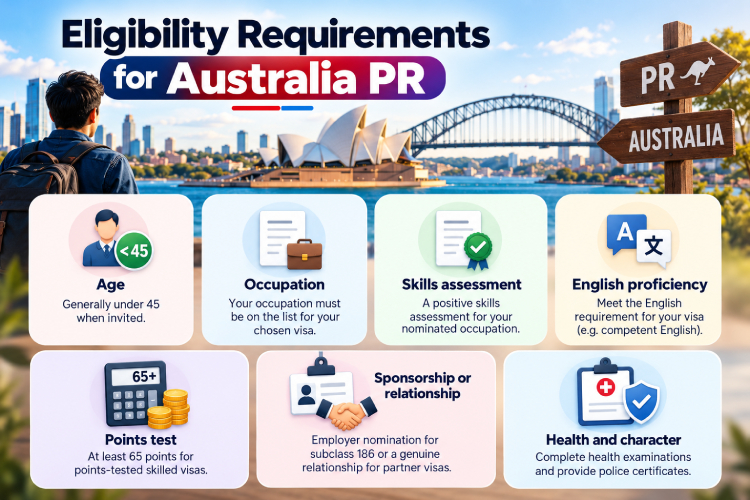
- Age: You must generally be under 45 when invited to apply for a skilled visa.
- Occupation: Your occupation must be on the list for your chosen skilled visa.
- Skills assessment: You need a positive skills assessment for your nominated occupation.
- English proficiency: You must meet the English requirement for your visa, such as competent English for most skilled visas.
- Points test: You need at least 65 points to be eligible for an invitation for a points-tested skilled visa.
- Sponsorship or relationship: Subclass 186 requires nomination by an Australian employer, and partner visas require a genuine relationship with an eligible sponsor.
- Health and character: You must complete health examinations and provide police certificates.
*Not sure which visa you qualify for? Book a free consultation with Y-Axis for an eligibility check.
Documents Required for Australia Permanent Residency
The documents you need depend on your visa subclass. Most applicants need a valid passport, a birth certificate, English test results, police certificates and medical examination results, plus evidence specific to their pathway, such as a skills assessment, work experience records or nomination approval.
- Identity documents: A valid passport and your full birth certificate.
- English test results: Results from an accepted test, such as IELTS or PTE Academic.
- Skills assessment: A positive assessment for your nominated occupation.
- SkillSelect invitation: An invitation to apply for a points-tested skilled visa.
- Work experience evidence: Employer reference letters stating your job title, duties and employment dates.
- Educational certificates: Degree certificates and academic transcripts.
- Employer nomination: Nomination details submitted by an Australian employer for subclass 186.
- State nomination: Approval from an Australian state or territory for subclass 190 or 491.
- Relationship evidence: A marriage certificate or proof of a genuine de facto relationship for partner visas.
- Police certificates: Certificates from every country where you have lived for 12 months or more in the past 10 years.
- Medical examinations: Results from an approved panel physician.
How to Apply for Permanent Residency in Australia from the UAE?
You can apply for Australia PR from the UAE through skilled migration, employer sponsorship or partner visas, without moving to Australia first. Each pathway has its own eligibility criteria and document requirements. For points-tested skilled visas, follow these steps:
Step 1: Check your eligibility
Choose a suitable visa based on your occupation, age, qualifications and work experience.
Step 2: Complete a skills assessment and English test
Get your occupation assessed by the relevant assessing authority and take an accepted English test, such as IELTS or PTE Academic.
Step 3: Calculate your points
Add up your points for age, English proficiency, qualifications and work experience. You need at least 65 points.
Step 4: Submit an Expression of Interest (EOI)
Create a SkillSelect profile and enter your skills assessment, English results, qualifications and work experience.
Step 5: Receive an invitation or nomination
Wait for an invitation through SkillSelect. For subclasses 190 and 491, you also need nomination from an Australian state or territory.
Step 6: Lodge your visa application
Apply online through ImmiAccount, upload your documents and pay the visa application charge within 60 days of your invitation.
Step 7: Complete health and character checks
Attend your medical examination and submit police certificates, including one from the UAE if you have lived there for 12 months or more. The Department of Home Affairs will then assess your application and issue a decision.
*Ready to start your Australia PR application? Book a free consultation with Y-Axis today.
Cost of Australian PR
The visa application charge for the main applicant is AUD 6,135 for the Skilled Independent visa (subclass 189) and AUD 6,140 for the Skilled Nominated visa (subclass 190). You should also budget for skills assessments, English tests and medical examinations.
| Visa subclass | Visa fee |
|---|---|
| Skilled Independent (subclass 189) | AUD 6,135 |
| Skilled Nominated (subclass 190) | AUD 6,140 |
| Skilled Work Regional (subclass 491) | AUD 6,140 |
| Employer Nomination Scheme (subclass 186) | AUD 6,140 |
| Partner visa (subclasses 820/801 or 309/100) | AUD 11,710 |
Australia PR Processing Time
Processing times for Australia PR vary by visa subclass. For points-tested skilled visas, about 50% of applications are decided within 2 to 5 months, and 90% within 8 to 18 months. The Employer Nomination Scheme visa takes longer.
| Visa Category | Median processing time | 90% processed within |
|---|---|---|
| Skilled Independent (subclass 189) | 61 days | 8 months |
| Skilled Nominated (subclass 190) | 4 months | 16 months |
| Skilled Work Regional (subclass 491) | 5 months | 18 months |
| Employer Nomination Scheme (subclass 186) | 13 to 14 months | 21 to 22 months |
*Want to migrate to Australia permanently? Book a free consultation with Y-Axis today.
FAQs
What documents do I need for Australia PR?
Most applicants need a valid passport, a birth certificate, English test results, police certificates and medical examination results. Depending on the visa, you may also need a positive skills assessment, a SkillSelect invitation, work experience evidence, educational certificates, and state or employer nomination documents.
How many points do I need for Australia PR?
You need at least 65 points to be eligible for an invitation under a points-tested skilled visa. Points are awarded for age, English proficiency, qualifications, work experience and other factors. Invitation rounds are competitive, so the score needed in practice can be higher than 65.
Can I apply for Australia PR from the UAE?
Yes. You can lodge a skilled visa application from outside Australia, including from Dubai, Abu Dhabi and other UAE cities. You do not need to live in Australia first.
What is the age limit for Australia PR?
For skilled visas, you must generally be under 45 when you are invited to apply. Partner visas and some other pathways have no age limit, and limited exemptions apply in specific cases.
Do I need a job offer to get Australia PR?
No. The Skilled Independent (189), Skilled Nominated (190) and regional (491) visas do not require a job offer. The Employer Nomination Scheme visa (subclass 186) does require nomination by an Australian employer.
How much does Australia PR cost?
The cost depends on the visa subclass. The main applicant’s visa application charge is the largest expense, and additional charges apply for each family member included. Skills assessments, English tests, medical examinations and police certificates are paid separately. See the cost table above for the current figures.
How long does it take to get Australia PR?
Processing time depends on the visa subclass. Points-tested skilled visas are generally decided within a few months to around 18 months, while the Employer Nomination Scheme visa takes longer. See the processing time table above for each subclass.
Which English test is accepted for Australia PR?
The Department of Home Affairs accepts several tests, including IELTS and PTE Academic. Most skilled visas require at least competent English, for example IELTS 6 in each band or the PTE Academic equivalent. Higher scores earn extra points.
Does my UAE work experience count for Australia PR?
Yes, it can. Overseas work experience counts towards your points if it is in your nominated occupation and assessed as skilled employment by the relevant assessing authority. Keep employer reference letters, contracts and payslips ready as evidence.
Can I include my family in my Australia PR application?
Yes. You can include your spouse or de facto partner and dependent children as secondary applicants on most skilled visas. They must meet health and character requirements, and additional visa charges apply for each person.
Tags:
Australia Permanent Residency
Australia PR
Australia PR from UAE
Australia PR requirements
Australia PR eligibility
Australia PR points calculator
Australia PR application process
Australia skilled migration
Australia PR visa subclasses
Australian permanent residency pathways
Share
Y-Axis Services

Get it on your mobile
Get News alerts
Contact Y-Axis
Latest Article
Popular Post
Trending Article
Posted On October 29 2026
How Can I Get Permanent Residency in Australia?