

Posted on September 17 2026
Top 10 Countries for Molecular Scientists to Work Abroad: Salary, Demand & PR Opportunities Compared

By , Editor & Director
Updated September 17 2026
The top 10 countries for Molecular Scientists to work abroad include the USA, Germany, Canada, Australia, the UK, Ireland, Switzerland, the Netherlands, Singapore, and the UAE. These countries offer competitive salaries, advanced research facilities, work visa options, and permanent residency pathways.
The global biotechnology market is projected to reach approximately USD 3.88 trillion by 2030, driven by advances in genetic research, precision medicine, pharmaceutical innovation, and biotechnology applications. This expansion is creating more job opportunities in gene sequencing, drug development, molecular diagnostics, and DNA and RNA research, giving Molecular Scientists more options to build specialised careers abroad and pursue long-term residency.
*Want to work abroad? Sign up with Y-Axis Resume Marketing Services to find right job faster.
Benefits of Working Abroad as a Molecular Scientist
Working abroad as a Molecular Scientist offers competitive salaries, advanced laboratories, specialised roles, and international career growth. The global precision medicine market is projected to reach USD 254.7 billion by 2030, driven by advances in genomic testing, molecular diagnostics, biomarker research, and targeted drug development.
- Competitive Salaries: Earn attractive salaries in biotechnology and pharmaceuticals.
- Advanced Research: Access modern laboratories and molecular technologies.
- Specialised Roles: Work in genomics, sequencing, and drug discovery.
- Career Growth: Gain global experience and expand scientific expertise.
- Work Visa Options: Explore employment-based visa pathways.
- Permanent Residency: Pursue long-term settlement opportunities.
How to Choose the Right Country for Molecular Scientist Jobs Abroad?
Choosing the right country for Molecular Scientist jobs abroad depends on salary, job demand, research facilities, qualifications, and immigration options. Compare career opportunities in genomics, biotechnology, molecular diagnostics, and drug discovery, along with work visa requirements, living costs, and permanent residency pathways.
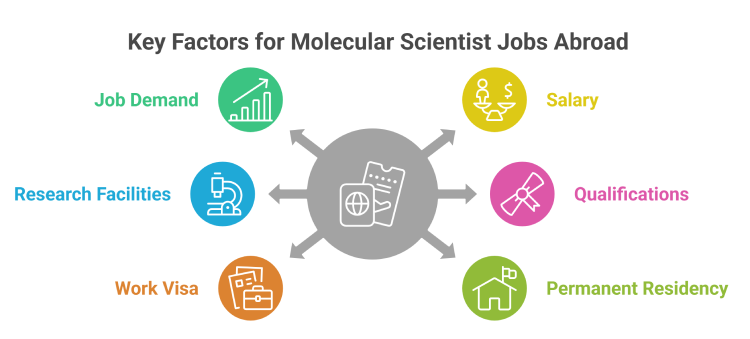
- Job Demand: Check opportunities in molecular biology, genomics, biotechnology, and pharmaceuticals.
- Salary: Compare average salaries with living costs and tax rates.
- Research Facilities: Look for countries with advanced laboratories and research institutions.
- Qualifications: Check degree, experience, and professional recognition requirements.
- Work Visa: Review visa eligibility, sponsorship requirements, and processing times.
- Permanent Residency: Compare skilled migration routes, eligibility criteria, and settlement timelines.
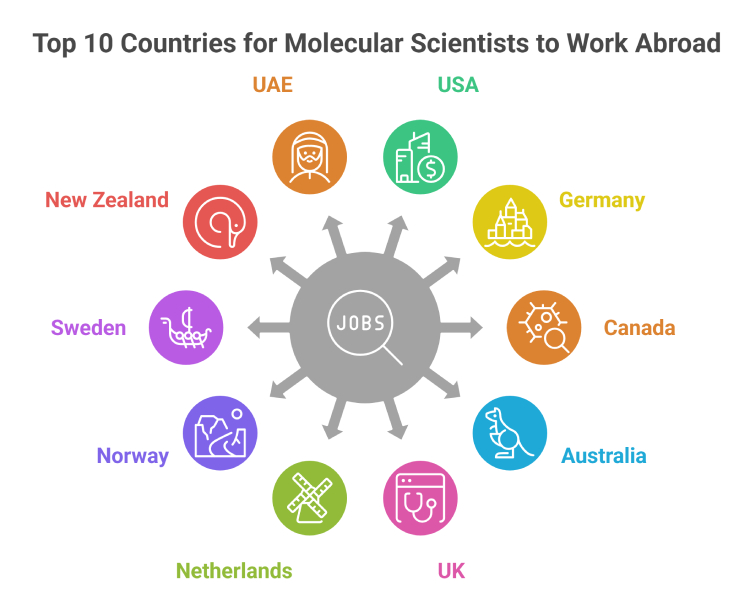
Top 10 Countries for Molecular Scientists to Work Abroad
The USA, Germany, Canada, Australia, the UK, and the UAE have growing demand for Molecular Scientists across biotechnology, pharmaceuticals, genomics, and molecular diagnostics. Many countries are offering specialised job roles such as Molecular Biologist, Genomics Scientist, Research Scientist, and Molecular Diagnostics Specialist, along with work visa and permanent residency pathways.
The global molecular diagnostics market is projected to reach USD 30.74 billion by 2030, growing at a CAGR of 9.6%. This expansion is increasing opportunities in DNA and RNA testing, gene sequencing, disease diagnosis, and precision medicine, supporting career growth for Molecular Scientists in international research and healthcare industries.
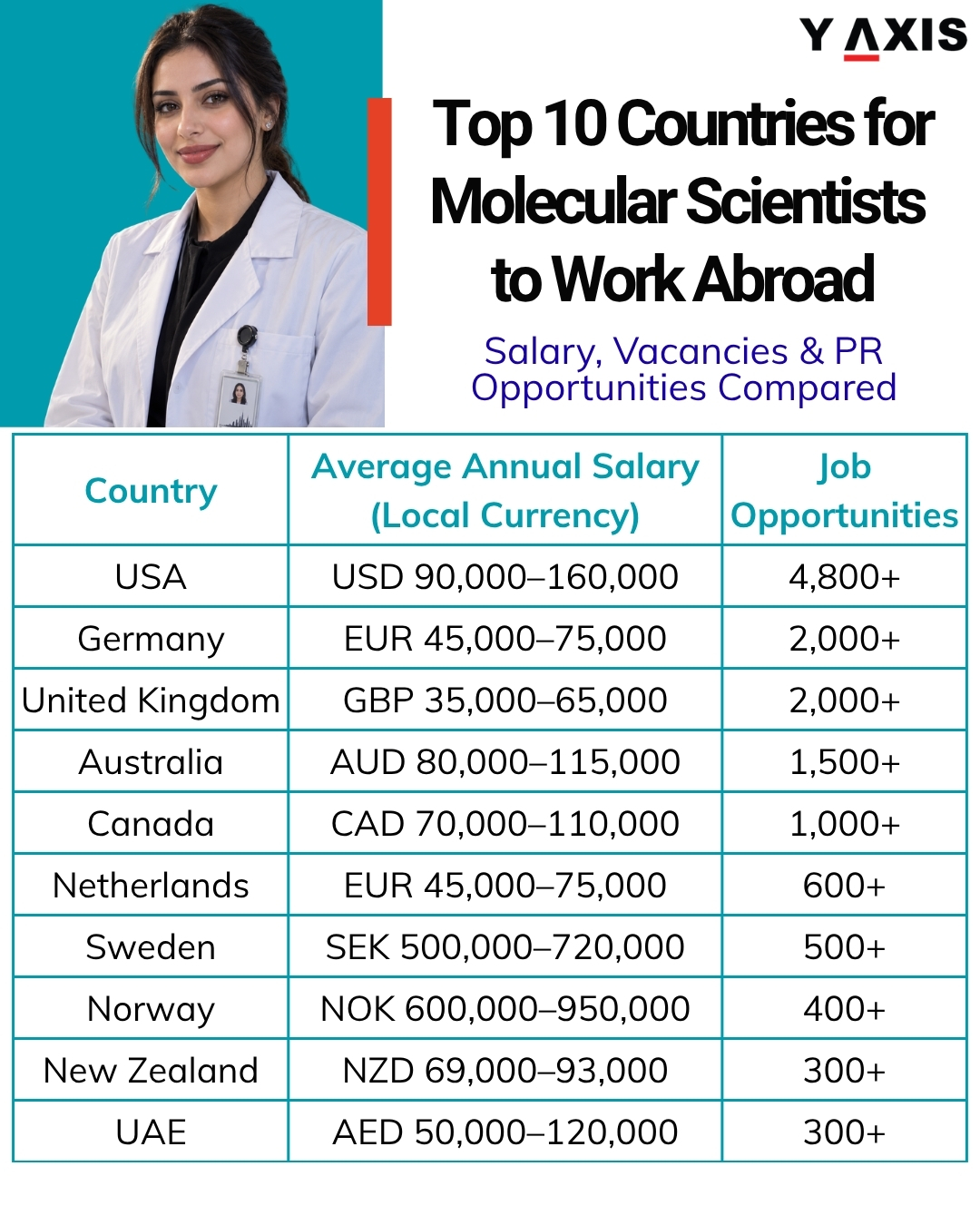
| Country | Average Annual Salary (Local Currency) | Estimated Molecular Scientist Job Opportunities |
|---|---|---|
| Canada | CAD 70,000–110,000 | 1,000+ |
| USA | USD 90,000–160,000 | 4,800+ |
| Germany | EUR 45,000–75,000 | 2,000+ |
| Australia | AUD 80,000–115,000 | 1,500+ |
| United Kingdom | GBP 35,000–65,000 | 2,000+ |
| Netherlands | EUR 45,000–75,000 | 600+ |
| Norway | NOK 600,000–950,000 | 400+ |
| Sweden | SEK 500,000–720,000 | 500+ |
| New Zealand | NZD 69,000–93,000 | 300+ |
| UAE | AED 50,000–120,000 | 300+ |
*Want to work abroad? Sign up with Y-Axis Resume Marketing Services to find right job faster.
Best Countries for Molecular Scientists to Work and Settle Abroad
The USA, Germany, Australia, Canada and the UK offer strong career opportunities for Molecular Scientists in molecular biology, biotechnology, pharmaceutical research, genomics and biomedical sciences. These countries provide competitive salaries, advanced research facilities and potential pathways to permanent residency.
The best country depends on your specialisation, qualifications, work experience and settlement goals. Comparing salary potential, job demand, research opportunities, visa requirements and permanent residency pathways can help you identify the right destination for your career and future abroad.
Molecular Scientist Jobs in the USA
The USA is a leading destination for Molecular Scientists seeking advanced research facilities, high-value career opportunities and scientific innovation. The country offers roles in molecular biology, genomics, drug discovery, biotechnology, genetic engineering and biomedical research. Employment for biochemists and biophysicists is projected to grow by 12% by 2035, driven by pharmaceutical development and genetic research. Molecular Scientists can work in biotechnology companies, pharmaceutical firms, universities and medical research institutions. The H-1B visa supports specialised employment, while EB-2 and EB-3 provide permanent residency pathways. The USA’s world-class research ecosystem enables Molecular Scientists to advance their expertise and build rewarding international careers.
| Factor | Details |
|---|---|
| Molecular Scientist Job Market & Job Vacancies for the Next Decade | The USA is expected to have more than 4,800 Molecular Scientist job opportunities over the next decade in molecular biology, genomics, gene therapy, molecular diagnostics, drug discovery and biotechnology research. |
| Investment in Biotechnology & Biomedical Research | The National Institutes of Health (NIH) receives more than USD 47 billion annually, supporting research in gene editing, DNA sequencing, cancer biology, precision medicine and therapeutic development. |
| Top Companies Hiring Molecular Scientists | Major employers include Pfizer, Moderna, Genentech, Amgen, Merck, Regeneron, Illumina and Thermo Fisher Scientific. Universities, NIH laboratories, biotechnology start-ups and contract research organisations also hire Molecular Scientists. |
| Top Cities for Molecular Scientist Jobs | Boston, San Diego, San Francisco, Washington DC, Raleigh-Durham and New York-New Jersey offer opportunities in genomics, pharmaceutical research, molecular diagnostics, cell biology and drug development. |
| In-Demand Molecular Scientist Roles & Skills | Key roles include Molecular Biologist, Genomics Scientist, Research Scientist, Cell Biology Scientist, Assay Development Scientist and Molecular Diagnostics Scientist. In-demand skills include PCR, qPCR, CRISPR, DNA/RNA sequencing, cell culture, molecular cloning and bioinformatics. |
| Work Visa Options | Molecular Scientists with a US job offer can pursue the H-1B visa for specialised scientific positions. Universities and research institutions may offer additional employment-based visa options. |
| Fast-Track Hiring Options | USCIS Premium Processing provides expedited processing for eligible petitions. Scientists with significant achievements in molecular research may also explore the O-1A visa. |
| PR / Long-Term Residence Opportunities | Molecular Scientists can pursue permanent residence through EB-2, EB-3, EB-2 National Interest Waiver and EB-1A pathways. Employer sponsorship, advanced research and scientific contributions can support different Green Card options. |
| Eligibility for Dependents | Molecular Scientists moving to the USA can generally include their spouse and unmarried children under 21 through H-4 or O-3 dependent status, depending on their visa category. |
| Benefits for Family Members | H-4 children can study in the USA, and certain H-4 spouses may obtain employment authorisation. O-3 dependents can study but generally cannot work. |
Molecular Scientist Jobs in Canada
Canada offers Molecular Scientists career opportunities in genomics, molecular diagnostics, biotechnology, drug discovery and biomedical research. The country’s expanding life sciences sector supports research in genetic testing, precision medicine, pharmaceutical development and advanced laboratory technologies. Molecular Scientists can work in pharmaceutical companies, universities, biotechnology firms, research institutes and diagnostic laboratories. Major research centres in Toronto, Montreal and Vancouver provide opportunities in molecular biology and genomic science. Express Entry and Provincial Nominee Programs offer permanent residency pathways for professionals who meet the relevant requirements. Canada’s research infrastructure, biotechnology investments and demand for specialised scientific expertise create opportunities for Molecular Scientists seeking international experience and long-term career development.
| Factor | Details |
|---|---|
| Molecular Scientist Job Market & Job Vacancies for the Next Decade | Canada is expected to have more than 1,000 Molecular Scientist job opportunities over the next decade in genomics, molecular diagnostics, gene therapy, drug discovery, vaccine development and biotechnology research. |
| Investment in Biotechnology & Biomedical Research | Canada is investing more than CAD 2.2 billion over seven years through its Biomanufacturing and Life Sciences Strategy. The investment supports genomics, vaccine development, therapeutics, molecular diagnostics and biomedical research. |
| Top Companies Hiring Molecular Scientists | Major employers include AbCellera, STEMCELL Technologies, BioVectra, Sanofi, Moderna, Pfizer, Roche and Thermo Fisher Scientific. Molecular Scientists work in genomics, cell biology, molecular testing, drug development and biomanufacturing. |
| Top Cities for Molecular Scientist Jobs | Toronto, Vancouver, Montreal, Ottawa, Calgary and Edmonton offer Molecular Scientist jobs in genomics, molecular diagnostics, pharmaceutical R&D, cell biology and biomedical research. |
| In-Demand Molecular Scientist Roles & Skills | Key roles include Molecular Biologist, Genomics Scientist, Research Scientist, Cell Biology Scientist, Molecular Diagnostics Scientist and Assay Development Scientist. Important skills include PCR, qPCR, CRISPR, DNA/RNA sequencing, cell culture, molecular cloning and bioinformatics. |
| Work Visa Options | Molecular Scientists with a Canadian job offer can apply for an employer-specific work permit. The employer provides the required employment documents and an LMIA when applicable. |
| Fast-Track Hiring Options | The Global Talent Stream offers faster work permit processing for Molecular Scientists working in genomics, molecular diagnostics, gene therapy and pharmaceutical research. |
| PR / Long-Term Residence Opportunities | Molecular Scientists can pursue permanent residence through Express Entry, including the Federal Skilled Worker Program and Canadian Experience Class. Provincial Nominee Programs provide additional routes through provincial nomination. |
| Eligibility for Dependents | Molecular Scientists moving to Canada can include their spouse or common-law partner and dependent children under 22 in their immigration application. |
| Benefits for Family Members | A spouse or common-law partner can apply for an open work permit under applicable immigration rules. Dependent children can study in Canada, while healthcare access follows provincial regulations and immigration status. |
*Want to Work in Canada? Let Y-Axis guide you through application process.
Molecular Scientist Jobs in Germany
Germany offers Molecular Scientists career opportunities in molecular diagnostics, genomics, drug discovery, cell biology and biopharmaceutical research. Its pharmaceutical, chemical and biotechnology industries support research in genetic testing, therapeutic development and advanced laboratory technologies. Biotechnology and nanotechnology are important innovation sectors, creating opportunities in research institutes, universities and private companies. The EU Blue Card and German work visa provide employment pathways for international scientific workers. Academic STEM occupations are included in the EU Blue Card shortage-occupation framework. Blue Card holders can obtain settlement after 21 months with B1 German or 27 months with A1 German. Germany’s advanced research infrastructure supports Molecular Scientists seeking international career growth.
| Factor | Details |
|---|---|
| Molecular Scientist Job Market & Job Vacancies for the Next Decade | Germany offers more than 2,000 estimated Molecular Scientist job opportunities over the next decade in molecular biology, genomics, drug discovery, gene therapy, molecular diagnostics and pharmaceutical research. |
| Investment in Biotechnology & Biomedical Research | Germany invests more than EUR 4.6 billion annually in medical biotechnology R&D. Pharmaceutical companies also invest more than EUR 10.7 billion in research and development, supporting genomics, gene therapy, molecular diagnostics and biopharmaceutical research. |
| Top Companies Hiring Molecular Scientists | Major employers include BioNTech, Bayer, Merck, Roche, Qiagen, Boehringer Ingelheim and Evotec. Universities, research institutes and biotechnology companies hire Molecular Scientists for genomic research, drug development and molecular testing. |
| Top Cities for Molecular Scientist Jobs | Berlin, Munich, Frankfurt, Hamburg and Heidelberg offer Molecular Scientist jobs in genomics, pharmaceutical research, molecular diagnostics, biotechnology and biomedical science. |
| In-Demand Molecular Scientist Roles & Skills | Key roles include Molecular Biologist, Research Scientist, Genomics Scientist, Cell Biology Scientist and Molecular Diagnostics Scientist. Important skills include PCR, CRISPR, DNA/RNA sequencing, cell culture, molecular cloning, protein analysis and bioinformatics. |
| Work Visa Options | Molecular Scientists can apply for the EU Blue Card with a recognised academic qualification and a German employment contract. A researcher residence permit supports employment at approved research institutions. |
| Fast-Track Hiring Options | Germany’s Accelerated Skilled Worker Procedure allows employers to begin the residence process with the foreigners authority before the scientist submits the visa application. |
| PR / Long-Term Residence Opportunities | EU Blue Card holders can apply for a settlement permit after 27 months with A1-level German or 21 months with B1-level German. Researchers have additional settlement routes under German residence rules. |
| Eligibility for Dependents | EU Blue Card holders can generally bring their spouse and minor children through family reunification. Family members receive residence permits to live in Germany. |
| Benefits for Family Members | Spouses can work in Germany without a separate work permit, while children can attend German schools. Family members can live with the Molecular Scientist during the residence period. |
Molecular Scientist Jobs in Australia
Australia offers Molecular Scientists opportunities in molecular biology, genomics, genetic engineering, biotechnology and pharmaceutical research. Employment across Australia is projected to grow 13.3% by 2035, supporting workforce expansion across scientific and technical industries. Molecular Scientists can pursue roles in pharmaceutical research, medical laboratories, universities, biotechnology companies and agricultural science. The Skills in Demand visa (subclass 482) provides an employment route, while the Employer Nomination Scheme visa (subclass 186) and skilled visas such as subclasses 189 and 190 offer permanent residency pathways. Australia’s research institutions and biotechnology investments create opportunities for Molecular Scientists to build long-term scientific careers.
| Factor | Details |
|---|---|
| Molecular Scientist Job Market & Job Vacancies for the Next Decade | Australia is expected to have more than 1,500 estimated Molecular Scientist job opportunities over the next decade in molecular biology, genomics, gene therapy, molecular diagnostics, drug discovery and biotechnology research. |
| Investment in Biotechnology & Biomedical Research | Australia is investing more than AUD 2 billion in medical research through the Medical Research Future Fund (MRFF), supporting genomics, precision medicine, cell therapies, vaccine development and molecular research. |
| Top Companies Hiring Molecular Scientists | Major employers include CSL, Cochlear, AstraZeneca, Pfizer, ResMed, Thermo Fisher Scientific, QIAGEN and Vaxxas. Universities, medical research institutes and biotechnology companies also hire Molecular Scientists. |
| Top Cities for Molecular Scientist Jobs | Melbourne, Sydney, Brisbane, Adelaide and Perth offer Molecular Scientist jobs in genomics, pharmaceutical research, molecular diagnostics, cell biology and biotechnology. Melbourne and Sydney have major biomedical research centres. |
| In-Demand Molecular Scientist Roles & Skills | Key roles include Molecular Biologist, Research Scientist, Genomics Scientist, Cell Biology Scientist, Molecular Diagnostics Scientist and Assay Development Scientist. Important skills include PCR, qPCR, CRISPR, DNA/RNA sequencing, cell culture, molecular cloning and bioinformatics. |
| Work Visa Options | The Skills in Demand visa (subclass 482) supports employer-sponsored employment in eligible occupations. Molecular Scientists can also explore skilled migration pathways based on their occupation, qualifications and experience. |
| Fast-Track Hiring Options | The Skills in Demand visa (subclass 482) provides an employer-sponsored route for Molecular Scientists. Scientists with internationally recognised achievements can explore the National Innovation visa (subclass 858). |
| PR / Long-Term Residence Opportunities | Molecular Scientists can explore Skilled Independent (subclass 189), Skilled Nominated (subclass 190) and Employer Nomination Scheme (subclass 186) visas. Regional workers can progress from subclass 491 to subclass 191 permanent residence. |
| Eligibility for Dependents | Skilled Australian visas can include a spouse or de facto partner and dependent children. Applicants must provide the required identity and relationship documents for their selected visa. |
| Benefits for Family Members | Family members can live in Australia with the Molecular Scientist. Partners can work according to their visa conditions, while dependent children can attend Australian schools. Medicare access depends on the visa and applicable rules. |
*Planning to Work in Australia? Let Y-Axis guide you through every step of the process.
Molecular Scientist Jobs in the UK
The UK offers Molecular Scientists opportunities in genomics, molecular diagnostics, pharmaceutical research, drug discovery and biomedical science. Government projections indicate approximately 66,000 additional jobs in priority life sciences occupations by 2035, supporting workforce expansion across research, biotechnology and pharmaceutical development. Molecular Scientists can work in universities, research institutions, pharmaceutical companies and biotechnology firms. The Skilled Worker visa provides a route to sponsored employment, while qualifying residence can lead to Indefinite Leave to Remain (ILR). The UK’s established life sciences clusters, research infrastructure and pharmaceutical industry create opportunities for Molecular Scientists seeking specialised expertise and long-term professional development.
| Factor | Details |
|---|---|
| Molecular Scientist Job Market & Job Vacancies for the Next Decade | The UK is expected to have more than 2,000 Molecular Scientist job opportunities over the next decade in genomics, molecular diagnostics, gene therapy, drug discovery, vaccine research and biotechnology. |
| Investment in Biotechnology & Biomedical Research | The UK has attracted more than £3 billion in life sciences investment, while the government’s sector plan includes more than £2 billion in funding. The investment supports genomics, molecular diagnostics, drug development and biomedical research. |
| Top Companies & Organisations Hiring Molecular Scientists | Major employers include AstraZeneca, GSK, Oxford Nanopore, BioNTech, Lonza, Charles River Laboratories, Thermo Fisher Scientific and Abcam. Universities, NHS laboratories and research institutes also hire Molecular Scientists. |
| Top Cities for Molecular Scientist Jobs | London, Cambridge, Oxford, Manchester, Edinburgh and Glasgow offer Molecular Scientist jobs in genomics, pharmaceutical R&D, molecular diagnostics, cell biology and biomedical research. |
| In-Demand Molecular Scientist Roles & Skills | Key roles include Molecular Biologist, Research Scientist, Genomics Scientist, Cell Biology Scientist, Molecular Diagnostics Scientist and Assay Development Scientist. Important skills include PCR, qPCR, CRISPR, DNA/RNA sequencing, cell culture, molecular cloning and bioinformatics. |
| Work Visa Options | The Skilled Worker visa allows Molecular Scientists to work for approved UK employers in eligible occupations. The visa requires an eligible job, sponsorship and the applicable salary. |
| Fast-Track Hiring Options | Priority visa processing can reduce processing times for eligible applications. Researchers with recognised achievements can also explore the Global Talent visa, which does not require employer sponsorship. |
| PR / Long-Term Residence Opportunities | The Skilled Worker route can lead to Indefinite Leave to Remain after five years of qualifying residence. Global Talent settlement is available after three or five years, depending on the applicant’s route. |
| Eligibility for Dependents | Skilled Worker and Global Talent visa holders can generally bring their partner and dependent children through the dependant visa route. |
| Benefits for Family Members | Dependant partners can generally work in the UK, while dependent children can attend UK schools. Family members can apply for settlement after meeting the relevant residence and visa requirements. |
* Want to Work in the UK? Let Y-Axis guide you through the steps.
Molecular Scientist Jobs in the Netherlands
The Netherlands offers Molecular Scientists career opportunities in genomics, molecular diagnostics, biotechnology, drug discovery and biopharmaceutical research. The country aims to increase research and development investment to 3% of GDP by 2030, supporting innovation in healthcare and biotechnology. Its biotechnology strategy also focuses on sector development through 2040, including medical, agricultural and industrial applications. Molecular Scientists can work in pharmaceutical companies, biotechnology firms, university medical centres and research institutes. The Highly Skilled Migrant permit and EU Blue Card provide work visa routes, while five years of continuous legal residence can support permanent residency. The Netherlands’ international research ecosystem offers opportunities for long-term scientific careers.
| Factor | Details |
|---|---|
| Molecular Scientist Job Market & Job Vacancies for the Next Decade | The Netherlands is expected to have more than 600 estimated Molecular Scientist job opportunities over the next decade in molecular biology, genomics, molecular diagnostics, drug discovery and biotechnology research. |
| Investment in Biotechnology & Biomedical Research | The Netherlands has more than EUR 1.27 billion allocated through National Growth Fund programmes for biotechnology research and commercialisation, supporting genomics, biomedical research, cellular therapies and pharmaceutical innovation. |
| Top Companies Hiring Molecular Scientists | Major employers include Genmab, Galapagos, QIAGEN, Thermo Fisher Scientific, Merck, Wageningen University & Research and Leiden University Medical Center. |
| Top Cities for Molecular Scientist Jobs | Amsterdam, Leiden, Utrecht, Rotterdam, Delft and Eindhoven offer jobs in genomics, molecular diagnostics, pharmaceutical research and biotechnology. |
| In-Demand Molecular Scientist Roles & Skills | Key roles include Molecular Biologist, Research Scientist, Genomics Scientist, Molecular Diagnostics Scientist and Cell Biology Scientist. Important skills include PCR, CRISPR, DNA/RNA sequencing, cell culture, molecular cloning and bioinformatics. |
| Work Visa Options | The Highly Skilled Migrant permit is a major route for scientists hired by an IND-recognised sponsor. The EU Blue Card is another option for qualified scientists who meet its salary and employment requirements. |
| Fast-Track Hiring Options | IND-recognised employers can submit Highly Skilled Migrant applications directly to the IND, streamlining residence processing. |
| PR / Long-Term Residence Opportunities | Molecular Scientists can apply for permanent residence after five consecutive years of lawful residence, with a valid permit, sufficient income and required civic integration. |
| Eligibility for Dependents | Residence-permit holders can generally bring their spouse or registered partner and dependent children through family reunification. |
| Benefits for Family Members | A Highly Skilled Migrant’s spouse or partner can generally work without a separate work permit. Dependent children can live in the Netherlands and attend Dutch schools. |
Molecular Scientist Jobs in Norway
Norway offers Molecular Scientists opportunities in molecular diagnostics, genomics, marine biotechnology, pharmaceutical research and aquaculture science. Molecular research supports genetic testing, disease investigation, therapeutic development and biotechnology applications across healthcare and marine industries. Molecular Scientists can pursue roles in universities, research institutes, pharmaceutical laboratories and biotechnology companies. Norway’s Skilled Worker residence permit provides an employment route for scientific workers with a relevant job offer. After three years of qualifying residence, applicants can pursue permanent residency under Norway’s settlement rules. The country’s strengths in medical research, marine science and biotechnology create opportunities for Molecular Scientists seeking international research experience and long-term career development.
| Factor | Details |
|---|---|
| Molecular Scientist Job Market & Job Vacancies for the Next Decade | Norway is expected to have more than 400 estimated Molecular Scientist job opportunities over the next decade in molecular biology, genomics, biotechnology, molecular diagnostics and pharmaceutical research. |
| Investment in Biotechnology & Biomedical Research | Norway allocates more than NOK 51 billion in public research funding, supporting biotechnology, biomedical research, genomics and pharmaceutical innovation. |
| Top Companies & Organisations Hiring Molecular Scientists | Major employers include Nykode Therapeutics, Thermo Fisher Scientific, GE HealthCare, Oslo University Hospital, the University of Oslo and NTNU, alongside biotechnology companies and research institutes. |
| Top Cities for Molecular Scientist Jobs | Oslo, Trondheim, Bergen, Tromsø and Stavanger offer Molecular Scientist jobs in biomedical research, biotechnology, genomics and molecular diagnostics. Oslo and Trondheim have major university and research centres. |
| In-Demand Molecular Scientist Roles & Skills | Key roles include Molecular Biologist, Research Scientist, Genomics Scientist, Molecular Diagnostics Scientist and Cell Biology Scientist. Important skills include PCR, CRISPR, DNA/RNA sequencing, cell culture, molecular cloning and bioinformatics. |
| Work Visa Options | Molecular Scientists with a relevant university degree and a Norwegian job offer can apply for a skilled-worker residence permit. The position must require their qualifications and offer standard Norwegian pay and working conditions. |
| Fast-Track Hiring Options | Norway’s Early Employment Start scheme can allow qualified Molecular Scientists to begin work before their residence application is decided when the required conditions are met. |
| PR / Long-Term Residence Opportunities | Molecular Scientists can generally apply for permanent residence after three years, with sufficient income, Norwegian language skills and a social-studies test, unless exempt. |
| Eligibility for Dependents | Skilled Molecular Scientists can generally bring their spouse, cohabitant and children through family immigration. |
| Benefits for Family Members | Spouses and cohabitants can generally work in Norway, while dependent children can live with the main visa holder and attend Norwegian schools. |
Molecular Scientist Jobs in Sweden
Sweden offers Molecular Scientists opportunities in molecular biology, genomics, molecular diagnostics, pharmaceutical research and biotechnology. Its life sciences sector supports research in precision medicine, genetic testing, drug development and advanced laboratory technologies. Molecular Scientists can work in pharmaceutical companies, biotechnology firms, universities and medical research institutions. Sweden’s work permit and EU Blue Card provide employment routes for international scientific workers. Qualifying employees can pursue permanent residency after meeting the applicable residence and employment conditions. Sweden’s research institutions, innovation-driven healthcare sector and biotechnology ecosystem create opportunities for Molecular Scientists to develop specialised skills and contribute to advanced scientific research.
| Factor | Details |
|---|---|
| Molecular Scientist Job Market & Job Vacancies for the Next Decade | Sweden is expected to have more than 500 estimated Molecular Scientist job opportunities over the next decade in molecular biology, genomics, biotechnology, molecular diagnostics and pharmaceutical research. |
| Investment in Biotechnology & Biomedical Research | Sweden invests more than SEK 40 billion annually in research and development, supporting biotechnology, genomics, molecular diagnostics, drug discovery and biomedical innovation. |
| Top Companies Hiring Molecular Scientists | Leading employers include AstraZeneca, Cytiva, Thermo Fisher Scientific, BioArctic, Sobi, Pfizer and Karolinska Institutet, alongside universities, hospitals and biotechnology companies. |
| Top Cities for Molecular Scientist Jobs | Stockholm, Uppsala, Gothenburg, Malmö and Lund offer Molecular Scientist jobs in biotechnology, pharmaceutical research, genomics and molecular diagnostics. |
| In-Demand Molecular Scientist Roles & Skills | Key roles include Molecular Biologist, Research Scientist, Genomics Scientist, Molecular Diagnostics Scientist and Cell Biology Scientist. Core skills include PCR, CRISPR, DNA/RNA sequencing, cell culture, molecular cloning and bioinformatics. |
| Work Visa Options | Molecular Scientists from outside the EU/EEA generally need a Swedish work permit based on an employment contract. Highly qualified scientists can also explore the EU Blue Card. |
| Fast-Track Hiring Options | Highly qualified Molecular Scientists may receive faster work permit processing, with decisions within 30 days when the application meets the required conditions. |
| PR / Long-Term Residence Opportunities | Molecular Scientists can apply for permanent residence after four years of work permits and employment during the past seven years, with sufficient financial support. |
| Eligibility for Dependents | Swedish work permit holders can generally bring their spouse, registered or cohabiting partner and unmarried children under 21. |
| Benefits for Family Members | Spouses and partners can work in Sweden, while dependent children can live with the main visa holder and attend Swedish schools under their residence status. |
Molecular Scientist Jobs in New Zealand
New Zealand offers Molecular Scientists career opportunities in molecular biology, genomics, biotechnology, genetic research and medical diagnostics. Molecular research supports healthcare, agricultural science, environmental applications and food technology. Molecular Scientists can work in universities, Crown research institutes, biotechnology companies, medical laboratories and agricultural research organisations. The Accredited Employer Work Visa (AEWV) provides an employment route, while the Skilled Migrant Category Resident Visa offers a pathway to residence. New Zealand’s growing bioeconomy and research sector support work involving genetic analysis, molecular testing and biotechnology innovation. These developments create opportunities for Molecular Scientists seeking international laboratory experience and long-term scientific careers.
| Factor | Details |
|---|---|
| Molecular Scientist Job Market & Job Vacancies for the Next Decade | New Zealand is expected to have more than 300 estimated Molecular Scientist job opportunities over the next decade in molecular biology, genomics, biotechnology, molecular diagnostics and biomedical research. |
| Investment in Biotechnology & Biomedical Research | New Zealand invests more than NZD 200 million annually in health research, supporting genomics, molecular diagnostics, biotechnology and medical innovation. |
| Top Companies & Organisations Hiring Molecular Scientists | Major employers include Fisher & Paykel Healthcare, Pacific Edge, ESR, AgResearch, Plant & Food Research, the University of Auckland and the University of Otago. |
| Top Cities for Molecular Scientist Jobs | Auckland, Wellington, Christchurch, Hamilton and Dunedin offer Molecular Scientist jobs in biotechnology, genomics, medical research and molecular diagnostics. |
| In-Demand Molecular Scientist Roles & Skills | Key roles include Molecular Biologist, Research Scientist, Genomics Scientist, Molecular Diagnostics Scientist and Laboratory Scientist. Important skills include PCR, qPCR, DNA/RNA sequencing, cell culture, molecular cloning and bioinformatics. |
| Work Visa Options | The Accredited Employer Work Visa (AEWV) is a major route for Molecular Scientists with a job offer from an accredited New Zealand employer. |
| Fast-Track Hiring Options | Molecular Scientists in listed Green List occupations, such as Medical Laboratory Scientist, may qualify for faster residence pathways. |
| PR / Long-Term Residence Opportunities | Molecular Scientists can explore Green List residence pathways and the Skilled Migrant Category Resident Visa. Medical Laboratory Scientists may qualify for the Straight to Residence pathway if they meet the listed requirements. |
| Eligibility for Dependents | Molecular Scientists on eligible work or resident visas can generally bring their partner and dependent children. |
| Benefits for Family Members | Partners may obtain a work visa, while dependent children can study in New Zealand under their visa conditions. Resident families have broader access to public services. |
Molecular Scientist Jobs in the UAE
The UAE offers Molecular Scientists growing opportunities in genomics, molecular diagnostics, pharmaceutical research, biotechnology and precision medicine. Abu Dhabi aims to create more than 20,000 life sciences jobs by 2035, supported by investments in healthcare innovation, genomic research and biopharmaceutical development. Molecular Scientists can pursue roles in diagnostic laboratories, pharmaceutical companies, biotechnology organisations, research institutions and medical technology centres. The UAE employment residence visa provides a work route, while the Golden Visa for scientists and researchers offers long-term residency opportunities for qualifying applicants. Investments in DNA sequencing, personalised medicine and advanced healthcare infrastructure create opportunities for Molecular Scientists seeking international career growth.
| Factor | Details |
|---|---|
| Molecular Scientist Job Market & Job Vacancies for the Next Decade | The UAE is expected to have more than 300 estimated Molecular Scientist job opportunities over the next decade in molecular biology, genomics, molecular diagnostics, biotechnology and pharmaceutical research. |
| Investment in Biotechnology & Biomedical Research | The UAE is investing in biotechnology, healthcare innovation and genomics, supporting molecular diagnostics, precision medicine, pharmaceutical research and advanced medical technologies. |
| Top Companies & Organisations Hiring Molecular Scientists | Major employers include G42, M42, PureHealth, Dubai Health, Abu Dhabi Public Health Centre, Thermo Fisher Scientific and university research centres. |
| Top Cities for Molecular Scientist Jobs | Abu Dhabi and Dubai offer the largest concentration of Molecular Scientist jobs in genomics, molecular diagnostics, biotechnology, healthcare research and pharmaceutical development. |
| In-Demand Molecular Scientist Roles & Skills | Key roles include Molecular Biologist, Research Scientist, Genomics Scientist, Molecular Diagnostics Scientist and Laboratory Scientist. Important skills include PCR, qPCR, DNA/RNA sequencing, molecular cloning, cell culture and bioinformatics. |
| Work Visa Options | Most Molecular Scientists work in the UAE through an employer-sponsored residence visa. The Green Residency offers five-year residence, while the Golden Residency provides five- or ten-year residence under designated categories. |
| Fast-Track Hiring Options | Molecular Scientists with recognised research achievements or specialised expertise can explore relevant Golden Residency categories, subject to approval and category requirements. |
| PR / Long-Term Residence Opportunities | The UAE does not offer conventional permanent residence through employment. Molecular Scientists can maintain long-term residence through Green Residency or Golden Residency. |
| Eligibility for Dependents | Green and Golden Residency holders can generally sponsor their spouse and children by submitting the required family-residence and relationship documents. |
| Benefits for Family Members | Sponsored family members can live and study in the UAE. Spouses can work after obtaining the required employment authorisation, while residence remains linked to the sponsor’s valid status. |
Job Outlook for Molecular Scientists Over the Next Decade
The job outlook for Molecular Scientists over the next decade is positive, with growing demand in genomics, molecular diagnostics, drug discovery, gene therapy and biotechnology research. Advances in DNA sequencing, CRISPR gene editing and personalised medicine are creating opportunities for molecular research and medical innovation. Countries such as the USA, Germany, Canada, Australia, the UK and the Netherlands are expanding their biotechnology and pharmaceutical sectors.
Molecular Scientists can pursue roles in drug development, genetic research, molecular testing and therapeutic innovation. The global biotechnology market is projected to reach approximately USD 6.34 trillion by 2035, supporting continued investment in research and creating opportunities across pharmaceutical companies, biotechnology firms, hospitals and research institutions.
*Want to work abroad? Sign up with Y-Axis Resume Marketing Services to find right job faster.
FAQs
Which countries hire the most Molecular Scientists abroad?
The USA, Germany, Canada, Australia, the UK, and the UAE hire the most Molecular Scientists, thanks to strong biotechnology, pharmaceutical, and genomics sectors. The USA leads with more than 4,800 estimated openings over the next decade, while the UK and Germany each offer around 2,000. Growth in drug discovery and molecular diagnostics continues to drive hiring across all six countries.
What is the average salary of a Molecular Scientist abroad?
Salaries range from USD 90,000 to 160,000 in the USA, EUR 45,000 to 75,000 in Germany, and AED 50,000 to 120,000 in the UAE. Pay depends on specialization, employer type, and experience level. The USA and Switzerland generally offer the highest gross compensation, while the UAE's tax-free packages make its salary bands especially competitive for relocating scientists.
USA or Canada for Molecular Scientists, which is the better choice?
The USA offers higher salaries and a larger job market, with over 4,800 estimated openings versus Canada's 1,000. Canada, however, provides a more accessible permanent residency route through Express Entry and Provincial Nominee Programs. Scientists prioritizing earning potential often favor the USA, while those focused on faster, clearer settlement typically lean toward Canada.
Which country offers the best PR pathway for Molecular Scientists?
Canada and Australia offer the clearest permanent residency pathways, through Express Entry, Provincial Nominee Programs, and skilled visa subclasses 189 and 190. Germany's EU Blue Card allows settlement within 21 to 27 months for qualified applicants. Each route rewards relevant qualifications and experience with defined timelines, helping scientists plan their long-term relocation with confidence.
Can Molecular Scientists get a work visa in the UAE?
Yes. Molecular Scientists can work in the UAE through an employer-sponsored residence visa, with Green Residency granting five years and Golden Residency offering five to ten years for qualifying candidates. Leading employers include G42, M42, and PureHealth. Abu Dhabi's plan to create 20,000 life sciences jobs by 2035 is expanding opportunities across genomics and biotechnology.
Does the UAE offer permanent residency for Molecular Scientists?
The UAE does not offer conventional permanent residency through employment, but Molecular Scientists can secure long-term residence through Green Residency or Golden Residency. Both options provide renewable residence periods of five to ten years, with family sponsorship included. Scientists with strong research credentials or notable achievements may qualify for extended Golden Residency categories.
What immigration options exist for Molecular Scientists moving abroad?
Molecular Scientists can pursue employer-sponsored work visas, points-based skilled migration, or specialized researcher permits, depending on the destination country. Canada and Australia offer points-based routes tied directly to permanent residency, while Germany and the Netherlands use the EU Blue Card. The UAE relies on employer sponsorship paired with Green or Golden Residency for long-term stays.
What does a career abroad look like for a Molecular Scientist?
A career abroad typically starts with a role at a pharmaceutical company, biotechnology firm, or research institution, often in genomics, drug discovery, or molecular diagnostics. Many scientists progress into senior research or specialist positions within a few years. International experience also builds a stronger foundation for eventual permanent residency, academic leadership, or industry consulting roles.
What qualifications do I need to work as a Molecular Scientist abroad?
Most employers require a bachelor's or master's degree in molecular biology, biochemistry, genetics, or a closely related field, along with hands-on laboratory experience. Specialized skills such as PCR, CRISPR, and DNA and RNA sequencing strengthen an application considerably. Countries like Germany and the Netherlands also require formal recognition of foreign academic qualifications before visa approval.
Which cities have the most Molecular Scientist job opportunities?
Boston, San Diego, and Cambridge lead globally, alongside Berlin, Toronto, and Abu Dhabi. These cities host major pharmaceutical companies, research universities, and biotechnology clusters that consistently hire Molecular Scientists. Abu Dhabi and Dubai are fast-growing UAE hubs, backed by significant government investment in genomics research and precision medicine infrastructure.
Is Molecular Scientist an in-demand job globally?
Yes, demand for Molecular Scientists is rising worldwide as the global biotechnology market heads toward USD 6.34 trillion by 2035. Growth in gene therapy, precision medicine, and molecular diagnostics is expanding roles across the USA, UAE, Canada, and Europe. Related occupations, such as biochemists in the USA, are projected to grow 12% by 2035.
What is the fastest way to get a Molecular Scientist visa?
Fast-track options differ by country: the USA offers USCIS Premium Processing, Germany runs an Accelerated Skilled Worker Procedure, and the UAE provides Golden Residency for scientists with recognized achievements. Norway's Early Employment Start scheme lets qualified scientists begin working before their residence application is finalized, cutting down waiting time considerably.
Can Molecular Scientists bring their family when working abroad?
Yes, most countries, including the UAE, USA, Canada, and Australia, allow Molecular Scientists to sponsor a spouse and dependent children under their work or residency visa. In the UAE, Green and Golden Residency holders can sponsor family members, who can then live, study, and often work, depending on their individual visa conditions.
Do Molecular Scientists need work experience to move abroad?
Work experience strengthens visa applications and job offers, though exact requirements vary by country and role. Entry-level positions may welcome recent graduates with solid laboratory skills, while specialized roles in genomics or drug discovery usually call for two or more years of research experience. Employer sponsorship remains the key requirement for most visas.
What are the top skills needed for Molecular Scientist jobs abroad?
In-demand skills include PCR, qPCR, CRISPR gene editing, DNA and RNA sequencing, cell culture, molecular cloning, and bioinformatics. These skills are consistently sought across the USA, UAE, Germany, Canada, and Australia. Scientists with added expertise in precision medicine and genomic testing tend to stand out in a competitive global job market.
How long does it take to get permanent residency as a Molecular Scientist?
Timelines vary widely: Norway and the Netherlands grant permanent residence after three to five years, Germany's EU Blue Card allows settlement in 21 to 27 months, and Sweden requires four years of work permits. The UAE instead offers long-term Golden Residency, which is often processed faster for qualifying scientists.
What is the job growth outlook for Molecular Scientists?
The outlook is strong, with the global molecular diagnostics market projected to reach USD 30.74 billion by 2030 at a 9.6% growth rate. Precision medicine is expected to hit USD 254.7 billion by 2030. This growth is generating steady demand for Molecular Scientists across the USA, UAE, Canada, Germany, and Australia.
Which country pays Molecular Scientists the highest salary?
The USA offers the highest salary range, from USD 90,000 to 160,000 annually, driven by strong pharmaceutical and biotechnology investment. Switzerland and Australia also rank highly for compensation. The UAE's tax-free income structure narrows this gap in practice, often delivering comparable take-home pay despite a lower headline salary range.
Which countries offer the best work-life balance for Molecular Scientists?
The Netherlands, Norway, and Sweden are known for favorable work-life balance alongside strong molecular science sectors. The UAE adds tax-free income and modern healthcare infrastructure to the mix, appealing to scientists focused on financial growth. The right fit ultimately depends on individual priorities around career pace, family life, and long-term settlement goals.
What is the future demand for Molecular Scientists in emerging markets like the UAE?
Demand in the UAE is set to grow steadily, supported by Abu Dhabi's target of 20,000 new life sciences jobs by 2035 and rising investment in genomics and personalized medicine. While smaller than the USA or UK markets today, the UAE's rapid healthcare innovation pipeline positions it as a strong long-term destination for Molecular Scientists.
Tags:
Molecular Scientist
Molecular Scientist Jobs
Molecular Scientist Salary
Top 10 Countries for Molecular Scientists
Best Countries for Molecular Scientists
Molecular Scientist Jobs Abroad
Molecular Scientist Career Abroad
Molecular Scientist Demand
Molecular Scientist Work Visa
Molecular Scientist PR
Share
Y-Axis Services

Get it on your mobile
Get News alerts
Contact Y-Axis
Latest Article
Popular Post
Trending Article
Posted On September 17 2026
Top 10 Countries for Molecular Scientists to Work Abroad: Salary, Demand & PR Opportunities Compared