


Editors Pick
Latest Article

What Are the Different Types of Germany Visas to Immigrate?
What Are the Different Types of Germany Visas to Immigrate?
There are several types of Germany visas for individuals planning to move from the UAE for work, job search, higher education, vocational training, business or family reunification. Skilled professionals with a qualifying job offer can apply for the EU Blue Card or Skilled Worker Visa, while the Opportunity Card allows qualified jobseekers to search for employment in Germany.
Students admitted to German universities, individuals pursuing vocational training, entrepreneurs planning to establish a business and family members joining relatives in Germany can also apply for their respective visa categories. After meeting the required residence period and other eligibility criteria, applicants can apply for permanent residence through a settlement permit.
*Want to migrate to Germany? Book a free consultation with Y-Axis today.
Types of Germany Visas for Immigration
Germany offers two main visa types: short-stay Schengen visas (Type C) for visits of up to 90 days and long-stay national visas (Type D) for stays exceeding 90 days. Type C visas cover tourism, business trips and short visits, while Type D visas are intended for long-term purposes such as employment, higher education, vocational training and family reunification. Those planning to relocate to Germany generally need a national visa before traveling, depending on their nationality and purpose of stay.
| Germany Visa Type | Who Can Apply? | Main Purpose |
|---|---|---|
| Skilled Worker Visa | Qualified professionals with a recognised qualification and a German job offer | To work in Germany |
| EU Blue Card | Qualified professionals with a qualifying job offer and required salary | To work in a qualified role and access a faster PR route |
| Opportunity Card | Skilled workers meeting qualification or points-based criteria | To search for a job in Germany |
| Student Visa | Students admitted to a German university | To study in Germany |
| Vocational Training Visa | Applicants with a confirmed training place | To complete vocational training in Germany |
| Family Reunification Visa | Qualifying family members of people living in Germany | To join family in Germany |
| Research Visa | Researchers with a hosting agreement or research contract | To conduct research in Germany |
| Self-Employment Visa | Entrepreneurs and freelancers meeting the relevant requirements | To start a business or work independently |
| Settlement Permit | Foreign nationals meeting residence and settlement requirements | To live permanently in Germany |
Germany Visa Eligibility Requirements
To qualify for a Germany visa, applicants must meet the requirements for their chosen immigration route. Work visa applicants generally need a qualifying job offer and recognized qualifications, while students need admission to a German university. The Opportunity Card requires a recognized qualification or sufficient points, and family reunification requires proof of the family relationship. Applicants must also prepare the required documents, including a valid passport, proof of funds and health insurance, where applicable.
- Valid passport: Hold a passport with sufficient validity and blank pages for the visa application.
- Purpose of relocation: Have a German job offer, university admission, vocational training place, business plan or qualifying family relationship, depending on the visa.
- Recognized qualifications: Meet the qualification requirements for the Skilled Worker Visa or EU Blue Card.
- Proof of funds: Show sufficient funds for living expenses when required, such as for the Student Visa or Opportunity Card.
- Language proficiency: Provide proof of German or English proficiency when required by the visa category.
- Health insurance: Arrange health insurance that covers your stay in Germany.
- UAE residence status: Hold a valid UAE residence permit and an Emirates ID issued at least 6 months before applying for a national visa at the German Consulate General in Dubai.
*Not sure which Germany visa suits you? Get free eligibility assessment from Y-Axis today.
How to Apply for a Germany Visa from the UAE?
To apply for a Germany visa from the UAE, choose the visa category that matches your purpose, check the requirements and prepare the necessary documents. Submit your application through the appropriate German consular service, attend an appointment if required, provide biometrics and pay the visa fee.
Step 1: Choose your visa category
Select the appropriate visa based on your purpose, such as the EU Blue Card, Skilled Worker Visa, Opportunity Card, Student Visa or Family Reunification Visa.
Step 2: Confirm your UAE residence
Check the German Consulate General in Dubai’s residence requirements and Emirates ID validity rules before applying.
Step 3: Prepare your documents
Gather your passport, application form, qualifications, proof of funds, health insurance and other documents required for your visa category. Arrange translations where necessary.
Step 4: Book an appointment
Follow the official German mission’s appointment instructions and check regularly for available slots.
Step 5: Submit your application
Attend your appointment, submit your documents, provide biometrics if required and pay the applicable visa fee.
Step 6: Receive your visa decision
Wait for the German authorities to process your application. Once approved, check the visa details carefully before traveling to Germany.
*Want to apply for German Visa? Book a free consultation with Y-Axis today.
Germany Visa Fees and Processing Time
The Germany national visa (Type D) fee is €75 for adults and €37.50 for applicants under 18. Processing can take from 7 working days to 12 weeks or longer, depending on the visa category and additional checks. Apply up to 3 months before your planned travel date and submit all required documents to help avoid delays.
| Germany Visa Type | Estimated Processing Time |
|---|---|
| Skilled Worker Visa | 4–8 weeks |
| EU Blue Card | 2–6 weeks |
| Opportunity Card | 4–8 weeks |
| Student Visa | 4–12 weeks |
| Vocational Training Visa | 4–12 weeks |
| Family Reunification Visa | 8–16 weeks |
| Research Visa | 3–8 weeks |
| Self-Employment Visa | 8–16 weeks |
*Planning to migrate to Germany? Get expert guidance from Y-Axis professionals.
FAQs
What are the different types of Germany visas for immigration?
Germany offers several long-stay national visas (Type D), including the EU Blue Card, Skilled Worker Visa, Opportunity Card, Student Visa, Vocational Training Visa, Self-Employment Visa and Family Reunification Visa. The right option depends on your qualifications and purpose of relocation.
Which Germany visa is best for immigration from the UAE?
The best visa depends on your qualifications and purpose. The EU Blue Card suits qualified professionals with a qualifying job offer and salary, while the Skilled Worker Visa is for qualified workers with a job offer. The Opportunity Card allows eligible applicants to search for jobs without an offer.
Can I move to Germany from the UAE without a job offer?
Yes. The Opportunity Card allows qualifying applicants to search for jobs in Germany without an existing offer. Applicants must meet the qualification or points-based requirements and demonstrate sufficient funds, health insurance and language proficiency.
What is the difference between a Germany Schengen visa and a national visa?
A Schengen visa (Type C) generally allows stays of up to 90 days within a 180-day period for tourism and short business trips. A national visa (Type D) is for stays exceeding 90 days, including employment, study, vocational training and family reunification.
How much does a Germany immigration visa cost?
The standard national visa fee is €75 for adults and €37.50 for applicants under 18. Applicants at the German Consulate General in Dubai pay in AED. Additional costs may include health insurance, document translations and proof of funds.
How long does it take to get a Germany visa from the UAE?
Processing can take up to 12 weeks or longer, depending on the visa category, document verification and additional approvals. Submit a complete application well before your planned travel date to help avoid delays.
Where can I apply for a Germany visa from the UAE?
UAE residents can apply through the German Consulate General in Dubai if they meet its residence requirements. Generally, their Emirates ID must have been issued at least six months before the application date. Some national visa applications can be started online.
What are the requirements for a Germany Opportunity Card?
Applicants must have a qualification recognized in Germany or qualify through the points-based route. The points route generally requires a qualifying foreign qualification, at least A1-level German or B2-level English, and a minimum of six points. Applicants must also prove sufficient funds.
Can I bring my family to Germany after moving from the UAE?
Yes. Spouses and qualifying children can generally apply for family reunification, subject to residence and other requirements. Certain skilled workers may also bring their parents or parents-in-law under specific conditions.
Can I get permanent residence in Germany after moving from the UAE?
Yes. You may qualify for a settlement permit after meeting the residence and other requirements. EU Blue Card holders may qualify after 27 months with A1-level German or 21 months with B1-level German, subject to the remaining conditions.
Posted on October 23 2026
How Can I Get Permanent Residency in the UK?
How Can I Get Permanent Residency in the UK?
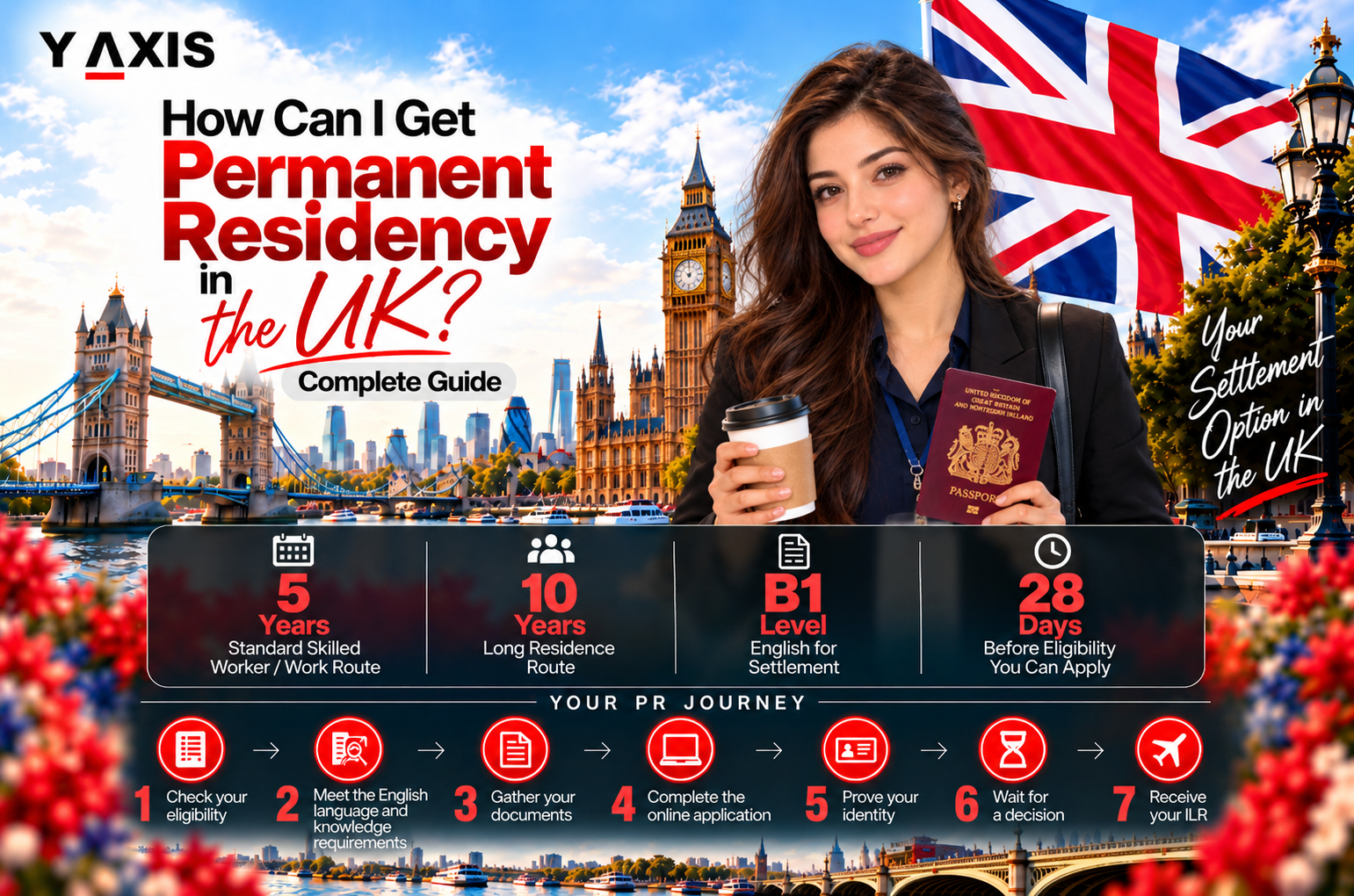
To get permanent residency in the UK, you must qualify for Indefinite Leave to Remain (ILR) by meeting the settlement requirements for your visa route. The Skilled Worker visa generally requires five years of qualifying residence, while the Innovator Founder and some Global Talent visa holders may qualify after three years. Applicants must also meet the applicable continuous residence rules, English language requirements and Life in the UK test requirements. Once approved, ILR allows you to live, work and study in the UK without time limits, giving you greater freedom and long-term stability.
*Want to apply for UK PR? Let Y-Axis guide you through the application process.
Visa Routes to UK Permanent Residency (ILR)
Several UK visa routes lead to Indefinite Leave to Remain (ILR), depending on your career, business or family circumstances. The Skilled Worker visa is for professionals with a job offer from a licensed UK sponsor, while the Global Talent visa suits recognised leaders and emerging talent. The Innovator Founder visa supports entrepreneurs with an endorsed business idea, and partner visas offer a route to settlement with a qualifying British or settled partner.
| Visa route | Qualifying period for ILR | Main eligibility criteria |
|---|---|---|
| Skilled Worker visa | 5 years | Eligible job, salary and employer sponsorship |
| Health and Care Worker visa | 5 years | Eligible healthcare or care role |
| Global Talent visa | 3 or 5 years | Eligible endorsement or prestigious award |
| Innovator Founder visa | 3 years | Endorsed business meeting settlement criteria |
| Family visa (partner) | 5 or 10 years | Qualifying relationship and residence period |
| Scale-up Worker visa | 5 years | Qualifying residence and earnings |
| UK Ancestry visa | 5 years | Eligible Commonwealth citizenship and UK ancestry |
| British National (Overseas) visa | 5 years | Eligible BN(O) status |
| International Sportsperson visa | 5 years | Eligible sporting role and endorsement |
| Long residence route | 10 years | Continuous lawful residence in the UK |
UK Permanent Residency Requirements
To qualify for UK permanent residency (ILR), you must complete the qualifying period for your visa route, meet the continuous residence rules, satisfy the English language requirement and pass the Life in the UK Test. You must also continue to meet your visa route’s conditions. The Skilled Worker visa generally requires five years of qualifying residence, while the Innovator Founder visa and some Global Talent visa holders may qualify after three years.
- Residence period: Complete 5 years on the Skilled Worker, Health and Care Worker or partner route, or 3 years on the Innovator Founder route or certain Global Talent routes.
- Absences from the UK: Generally, spend no more than 180 days outside the UK in any 12-month period.
- Route conditions: Meet the job, salary, business or relationship requirements for your visa route.
- English language: Meet the CEFR B1 level in speaking and listening, unless exempt.
- Life in the UK test: Pass the test, unless exempt.
- Immigration history: Follow your visa conditions and provide accurate information in your application.
*Need help with UK ILR requirements? Book a free consultation with Y-Axis today.
Documents Required for UK ILR
The documents required for UK permanent residency (ILR) include your valid passport or travel document, your Life in the UK test pass, English language evidence and records showing your time in the UK. Depending on your visa route, you may also need employment records, salary evidence, relationship documents or business endorsement records.
- Identity and immigration status: Valid passport or travel document, and eVisa details or share code
- Life in the UK test: Test pass reference number, unless exempt
- English language: Approved test certificate or degree evidence, unless exempt
- Residence history: Travel records showing your dates of entry and exit from the UK
- Employment and salary: Payslips, bank statements and an employer letter confirming your role and salary (work visa routes)
- Business evidence: Endorsement letter and proof of business activity and growth (Innovator Founder and Global Talent visas)
- Relationship evidence: Joint bills, tenancy or mortgage documents, and your partner’s passport and immigration status (partner visa)
How to Apply for Permanent Residency in the UK?
You can apply for UK permanent residency (Indefinite Leave to Remain or ILR) online through GOV.UK once you meet the qualifying period and settlement requirements for your visa route. You will need to complete the application form, pay the fee, submit the required documents and verify your identity.
Step 1: Check your eligibility
Confirm that you have completed the qualifying period for your visa route. You can usually apply up to 28 days before completing the required period.
Step 2: Complete the required tests
Pass the Life in the UK Test and meet the English language requirement, unless exempt.
Step 3: Submit your application and documents
Complete the online ILR application form, pay the application fee and upload your passport, residence records, test results and other required documents.
Step 4: Verify your identity
Use the UK Immigration: ID Check app or attend a biometric appointment, as instructed.
Step 5: Receive your decision
UK Visas and Immigration (UKVI) will review your application and notify you of the outcome. If approved, your ILR status will be confirmed through your eVisa.
*Want to apply for UK PR? Book a free consultation with Y-Axis today.
UK Permanent Residency Fees
The UK permanent residency (ILR) application fee is £3,226 per person. Each family member applying, including children, must pay the full fee. You do not need to pay the Immigration Health Surcharge for an ILR application.
| Fee category | Cost | Details |
|---|---|---|
| ILR application | £3,226 per person | Applies to each applicant, including dependants |
| Priority service | £500 extra | Decision within 5 working days, where available |
| Super priority service | £1,000 extra | Decision by the next working day after weekday biometrics, or within 2 working days after weekend biometrics |
| Life in the UK Test | £50 | Required unless exempt |
| English language test | Varies | Required if no exemption or accepted alternative applies |
UK Permanent Residency Processing Time
The standard processing time for UK permanent residency (ILR) is usually within 6 months of providing your fingerprints and photograph, or submitting your application if instructed to use the UK Immigration: ID Check app. Priority and super priority services may offer faster decisions, depending on availability and your visa route. Processing times can vary by application.
*Want to migrate to UK permanently? Book a free consultation with Y-Axis today.
FAQs
What is UK permanent residency (ILR)?
UK permanent residency, officially called Indefinite Leave to Remain (ILR), allows you to live, work and study in the UK without a time limit on your stay.
How many years do I need to live in the UK to get permanent residency?
You generally need 5 years of qualifying residence on the Skilled Worker and partner routes. Some Global Talent and Innovator Founder applicants can qualify after 3 years, subject to their route requirements.
How much does UK permanent residency cost?
The ILR application fee is £3,226 per person. The Life in the UK Test costs £50, while optional priority services cost extra.
Can I apply for UK permanent residency from the UAE?
No. You generally must be in the UK to apply for ILR. You can apply for a qualifying UK visa from the UAE and seek settlement after completing the required residence period.
What are the requirements for UK permanent residency?
You must complete the qualifying residence period, meet continuous residence rules, satisfy your visa route’s conditions, meet the English language requirement and pass the Life in the UK Test unless exempt.
How many days can I spend outside the UK and still qualify for ILR?
For many routes, you must not exceed 180 days outside the UK in any 12-month period. The exact rules depend on your visa category and applicable settlement requirements.
What documents are required for UK permanent residency?
You generally need a valid passport, immigration status details, residence records and evidence that you meet your visa route’s requirements. Employment, salary, business or relationship documents may also be required.
How long does UK permanent residency processing take?
Standard ILR applications usually take up to 6 months. Priority services may provide faster decisions where available.
Can I apply for British citizenship after getting ILR?
Yes. You can generally apply after holding ILR for 12 months if you meet the citizenship requirements. If you are married to a British citizen, you may be able to apply without waiting 12 months.
Can my family members get UK permanent residency with me?
Yes. Your partner and children may qualify for ILR if they meet the requirements of their dependant or family visa route. Each person must meet the applicable eligibility criteria and submit their own application.
Posted on October 23 2026
What Are the Different Types of UK Visas to Immigrate?
What Are the Different Types of UK Visas to Immigrate?
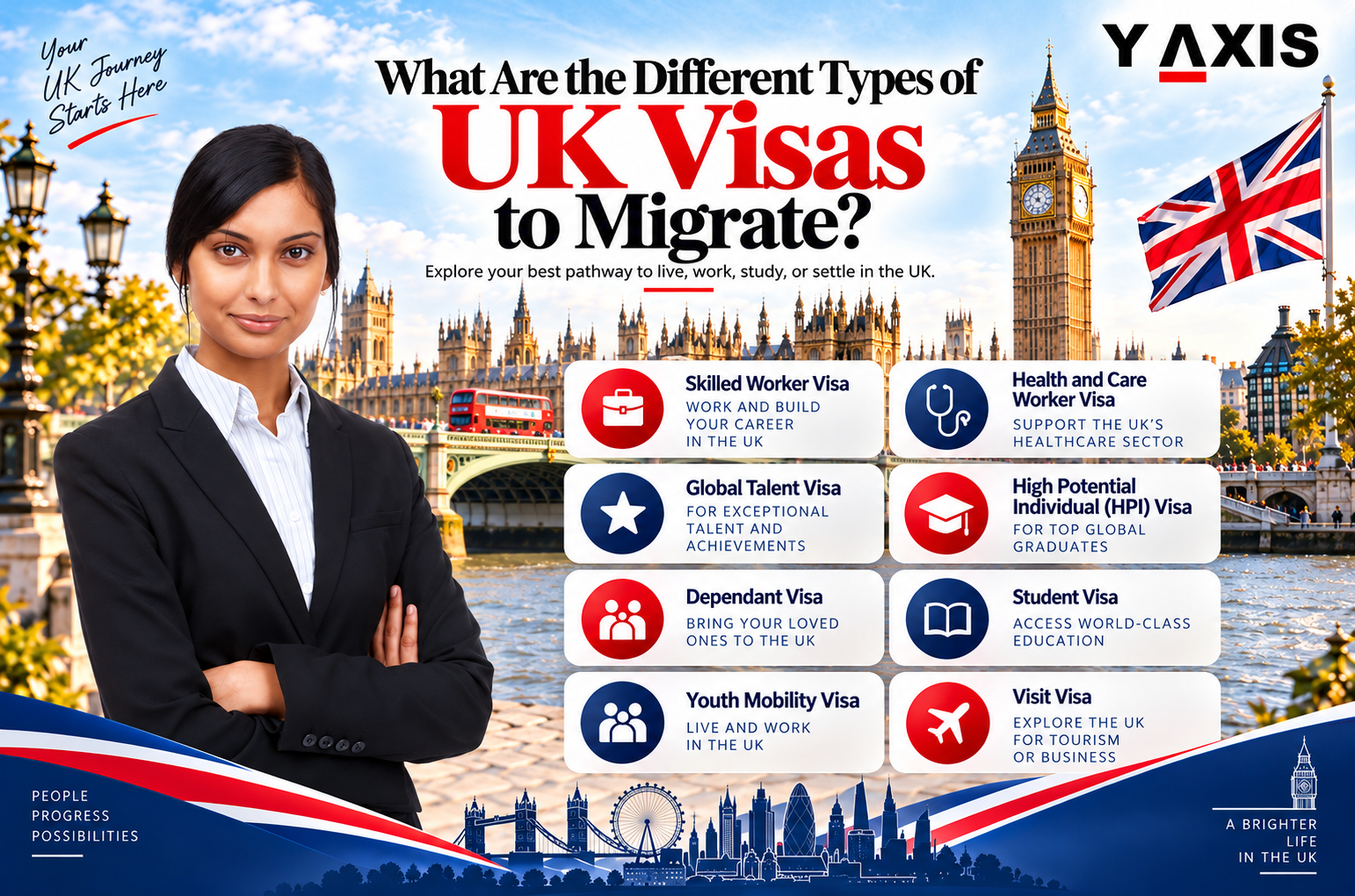
The UK offers several visa options for UAE residents who want to work, study, join family members or start a business. The main UK visa types include the Skilled Worker visa for applicants with a job offer from an approved UK employer, the Student visa for international students, the Family visa for joining a partner or qualifying relative, the Global Talent visa for recognised leaders and emerging talent, and the Innovator Founder visa for entrepreneurs with innovative business ideas. International graduates can also apply for the Graduate visa to stay in the UK after completing an eligible course. Some visa categories provide a pathway to Indefinite Leave to Remain (ILR), allowing applicants to settle permanently after meeting the eligibility requirements.
*Want to migrate to UK? Book a free consultation with Y-Axis today.
Different Types of UK Visas for Immigration
The main types of UK visas for immigration include work, study, family, talent, business and post-study visas. Popular options include the Skilled Worker visa, Student visa, Family visa, Global Talent visa, Innovator Founder visa and Graduate visa. Each visa has specific requirements, and some routes lead to Indefinite Leave to Remain (ILR), allowing applicants to settle permanently in the UK.
| UK Visa Type | Who Can Apply? | Main Purpose |
|---|---|---|
| Indefinite Leave to Remain (ILR) | People who meet the settlement requirements for their visa route | To live permanently in the UK |
| Skilled Worker visa | Applicants with a qualifying job offer from an approved UK employer | To work in the UK |
| Health and Care Worker visa | Doctors, nurses and other health and care professionals in qualifying roles | To work in eligible health and care jobs |
| Scale-up Worker visa | Applicants with a qualifying job offer from an approved scale-up business | To work for a qualifying UK business |
| Student visa | International students accepted onto eligible courses at licensed institutions | To study in the UK |
| Graduate visa | International graduates who meet the route's requirements | To stay in the UK after completing an eligible course |
| Global Talent visa | Recognised leaders and potential leaders in eligible fields | To work in research, academia, arts or digital technology |
| High Potential Individual visa | Graduates of eligible overseas universities | To live and work in the UK without a job offer |
| Innovator Founder visa | Entrepreneurs with an innovative business idea that meets the route's endorsement requirements | To establish an innovative business in the UK |
| Family visa | People joining a qualifying partner, parent or child in the UK | To live with family in the UK |
| UK Ancestry visa | Eligible Commonwealth citizens with a grandparent born in the UK | To live and work in the UK |
| Youth Mobility Scheme visa | Young adults from participating countries who meet the scheme's requirements | To live and work in the UK temporarily |
UK Visa Eligibility Requirements
UK visa eligibility depends on the visa category, and each route has its own core requirement, such as a job offer, course admission, a qualifying family relationship, an endorsement, or a residence period. Applicants living in the UAE apply online and give their biometrics at a UK visa application centre in the UAE.
- Job offer: The Skilled Worker visa requires a qualifying job offer from a Home Office-approved UK employer.
- University admission: The Student visa requires an offer for an eligible course from a licensed student sponsor.
- English language proficiency: Applicants must meet the English language requirement for their visa category.
- Financial proof: Certain categories require evidence of sufficient funds for tuition fees, living expenses, or other costs.
- Business endorsement: Innovator Founder applicants need an endorsement for their innovative business proposal.
- Professional recognition: Global Talent applicants must qualify through the relevant endorsement process or an eligible prestigious prize.
- Family relationship: Family visa applicants must meet the requirements for joining a qualifying partner, parent, or child in the UK.
- Residence requirements: Applicants seeking Indefinite Leave to Remain (ILR) must meet the residence period and other settlement conditions for their route.
*Not sure which UK visa suits you? Get free eligibility assessment from Y-Axis today.
How to Apply for a UK Visa from the UAE?
To apply for a UK visa from the UAE, choose the right visa category, meet its requirements, and apply online through GOV.UK. Depending on the route, you may also need sponsorship, supporting documents, and a biometric appointment.
Step 1: Choose the right UK visa
Pick the route that matches your plan to work, study, join family, or start a business in the UK.
Step 2: Check the requirements
Confirm what your route needs, such as job sponsorship, university admission, proof of funds, or business endorsement.
Step 3: Prepare your documents
Gather your valid passport and supporting documents, including financial proof, English language evidence, or sponsorship details, as required.
Step 4: Submit your online application
Complete the application form on GOV.UK and pay the visa fee and Immigration Health Surcharge, where applicable.
Step 5: Attend your biometric appointment
Book a slot at the UK visa application center in the UAE to provide your fingerprints and photograph and submit your documents, if required.
Step 6: Wait for the decision
UK Visas and Immigration (UKVI) assesses your application. Processing times vary by visa category and individual circumstances.
Step 7: Access your eVisa
Once approved, follow the instructions to access your eVisa and confirm your immigration status before traveling to the UK.
*Want to apply for UK Visa? Book a free consultation with Y-Axis today.
UK Visa Fees
UK visa application fees depend on the visa category and the length of stay. Applicants applying from the UAE may also need to pay the Immigration Health Surcharge (IHS), which costs £1,035 per year for most visa categories and £776 per year for students and Youth Mobility Scheme applicants. Health and Care Worker visa applicants are exempt from the IHS.
| UK visa type | Application fee | Immigration Health Surcharge (IHS) |
|---|---|---|
| Skilled Worker visa | £819–£1,865 | £1,035 per year |
| Health and Care Worker visa | £324–£628 | Exempt |
| Student visa | £558 | £776 per year |
| Graduate visa | £937 | £1,035 per year |
| Global Talent visa | £766 | £1,035 per year |
| High Potential Individual visa | £880 | £1,035 per year |
| Innovator Founder visa | £1,357 (outside the UK) | £1,035 per year |
| Family visa | £2,064 (outside the UK) | Usually £1,035 per year for adults |
| Youth Mobility Scheme visa | £340 | £776 per year |
| UK Ancestry visa | £726 | £1,035 per year |
| Scale-up visa | £937 | £1,035 per year |
UK Visa Processing Time
UK visa processing times depend on the visa category and where the application is submitted. Many work and study visa applications made from outside the UK receive a decision within 3 weeks, while family visa applications commonly take 12 weeks. Some routes also have different processing times.
| UK visa type | Outside the UK | Inside the UK |
|---|---|---|
| Skilled Worker visa | 3 weeks | 8 weeks |
| Student visa | 3 weeks | 8 weeks |
| Graduate visa | Not applicable | 8 weeks |
| Global Talent visa | 3 weeks | 8 weeks |
| Innovator Founder visa | 3 weeks | 8 weeks |
| Family visa (partner or spouse) | 12 weeks | 8 weeks |
*Planning to migrate to UK? Get expert guidance from Y-Axis professionals.
FAQs
What are the different types of UK visas for immigration?
The main UK visa types include the Skilled Worker visa, Student visa, Family visa, Global Talent visa, Innovator Founder visa, and Graduate visa. Each category serves a different purpose, from employment and education to family reunification and business.
Can I apply for a UK visa from the UAE?
Yes. You can apply online through GOV.UK from the UAE. Depending on your application, you may need to attend a UK visa application center to provide your fingerprints, photograph, and supporting documents.
Do I need a job offer to move to the UK?
The Skilled Worker visa requires a qualifying job offer from an approved UK employer. Other routes, including the Global Talent and High Potential Individual visas, do not require a conventional job offer but have their own requirements.
Which UK visa is suitable for skilled professionals?
The Skilled Worker visa suits applicants with a qualifying sponsored job offer. The Global Talent visa is another option for recognized leaders and potential leaders in eligible fields, while the High Potential Individual visa is available to graduates of qualifying overseas universities.
How much does a UK visa cost from the UAE?
The cost depends on the visa category and duration of stay. Applicants may need to pay an application fee and the Immigration Health Surcharge (IHS), unless exempt. Check the latest fees on GOV.UK before applying.
How long does it take to process a UK visa from the UAE?
Many work and Student visa applications submitted outside the UK receive a decision within 3 weeks, while Family visa applications commonly take 12 weeks. Processing times vary by category and may be longer if additional checks are required.
What English language requirements apply to UK visas?
English language requirements depend on the visa category. Applicants may need to pass an approved English test or provide qualifying evidence of their English proficiency. For example, the Skilled Worker route requires at least B2-level English for new applicants under the rules effective from 8 January 2026.
Can I bring my spouse and children to the UK?
Some work visa holders can bring their partner and children as dependants, subject to the rules for their visa category. Restrictions apply to dependants on certain routes, so check the specific visa conditions before applying.
Which UK visas can lead to permanent residency?
The Skilled Worker, Global Talent, Innovator Founder, and certain Family visa routes can lead to Indefinite Leave to Remain (ILR). Applicants must meet the residence period and other requirements applicable to their route.
What documents do I need to apply for a UK visa from the UAE?
Common documents include a valid passport and supporting evidence specific to the visa category. Depending on the route, you may also need a Certificate of Sponsorship, university admission confirmation, proof of funds, English language evidence, or documents confirming a family relationship.
Posted on October 23 2026

UK vs. Australia for Healthcare Professionals: Which Country Should You Choose?
UK vs. Australia for Healthcare Professionals: Which Country Should You Choose?
The UK and Australia are popular destinations for nurses, doctors and allied health professionals seeking overseas healthcare jobs, competitive salaries and long-term career growth. Both countries offer opportunities across public and private healthcare, but differ in salary ranges, job demand, professional registration, work visa requirements and permanent residency pathways.
Compare the UK and Australia for healthcare jobs, salaries after tax, qualification recognition, registration requirements, living costs and settlement options. Explore the UK’s NHS and private-sector opportunities alongside Australia’s healthcare job market to understand the requirements for working in each country and choose the destination that aligns with your qualifications, experience and career goals.
*Want to work abroad? Let Y-Axis help you through application process.
UK vs Australia for Healthcare Professionals: Quick Comparison
Both countries offer competitive salaries and long-term financial benefits. Australia provides 12% employer superannuation contributions, while the UK offers structured NHS pay scales and the NHS Pension Scheme. Your savings depend on your role, taxes and living costs, with London, Sydney and Melbourne generally more expensive than Manchester, Leeds, Adelaide and Perth.
| Factor | UK | Australia |
|---|---|---|
| Average Annual Healthcare Salary | £40,000–£100,000 | AUD 90,000–AUD 220,000 |
| Projected Healthcare Job Opportunities Over the Next Decade | 300,000+ | 530,000+ |
| In-Demand Healthcare Roles | Doctors, registered nurses, midwives, physiotherapists, radiographers, pharmacists and occupational therapists | Doctors, registered nurses, midwives, physiotherapists, occupational therapists and other allied health professionals |
| Major Healthcare Employment Hubs | London, Manchester, Birmingham, Leeds and Glasgow | Sydney, Melbourne, Brisbane, Perth and Adelaide |
| Work Visa Options | Health and Care Worker visa | Skills in Demand visa (subclass 482), Skilled Employer Sponsored Regional visa (subclass 494) and skilled migration visas |
| Professional Registration | General Medical Council (GMC) for doctors, Nursing and Midwifery Council (NMC) for nurses and midwives, and Health and Care Professions Council (HCPC) for many allied health professions | Australian Health Practitioner Regulation Agency (Ahpra) and the relevant National Board for regulated health professions |
| Permanent Residency and Settlement Pathways | Indefinite Leave to Remain (ILR) after meeting the applicable qualifying period and requirements | Skilled Nominated visa (subclass 190), Employer Nomination Scheme visa (subclass 186) and other permanent visa pathways |
| Estimated Monthly Living Costs | £1,500–£3,000 | AUD 2,500–AUD 4,500 |
| Family Migration Options | Bring your spouse or partner and dependent children on dependant visas | Include your spouse or partner and dependent children in a subclass 482 visa application |
UK vs Australia: Which Country Offers Better Opportunities for Healthcare Professionals?
The UK and Australia offer healthcare career opportunities across nursing, medicine and allied health, but demand varies by occupation, experience and location. The UK has a large healthcare workforce across NHS trusts and private hospitals, while Australia needs healthcare workers across metropolitan hospitals, aged care services and regional communities.
UK may suit you if you want:
- Healthcare jobs across NHS hospitals, private hospitals and specialist services
- A dedicated Health and Care Worker visa route for healthcare occupations
- Reduced visa fees and exemption from the Immigration Health Surcharge for this visa
- Structured NHS pay scales, specialist training and career progression opportunities
- Access to the NHS Pension Scheme
- Pathway to settlement through Indefinite Leave to Remain (ILR)
*Want to work in the UK? Get expert guidance from Y-Axis professionals.
Australia may suit you if you want:
- Competitive salaries across nursing, medicine and allied health.
- Employer superannuation contributions to support retirement savings.
- Salary packaging options with participating healthcare employers.
- Permanent residency pathways through visas such as subclasses 189, 190 and 186.
- Healthcare career opportunities in major cities and regional communities.
- Options to include your spouse or partner and dependent children in your visa application.
*Want to work in Australia? Get expert guidance from Y-Axis professionals.
UK vs. Australia: Salary, Living Costs and Savings for Healthcare Professionals
Healthcare professionals can earn competitive salaries in both the UK and Australia, but actual savings depend on take-home pay, taxes, housing and daily expenses. Australia offers employer superannuation contributions, while the UK provides structured NHS pay scales and access to the NHS Pension Scheme. Compare salaries for your specific role and living costs in your preferred city, as higher expenses in London, Sydney and Melbourne can reduce the savings you make from a higher salary.
| Factor | UK | Australia |
|---|---|---|
| Annual Healthcare Salary (Before Tax) | £40,000–£100,000 | AUD 90,000–AUD 220,000 |
| Monthly Gross Salary | £3,333–£8,333 | AUD 7,500–AUD 18,333 |
| Estimated Monthly Take-Home Pay | £2,650–£5,500 | AUD 5,600–AUD 12,000 |
| Monthly Rent (1-Bedroom City-Centre Apartment) | £1,100–£2,300 | AUD 1,300–AUD 3,600 |
| Monthly Grocery Costs | £250–£450 | AUD 350–AUD 600 |
| Monthly Public Transport Costs | £80–£200 | AUD 100–AUD 220 |
| Monthly Utilities, Internet and Mobile | £150–£300 | AUD 260–AUD 500 |
| Estimated Total Monthly Living Costs | £1,500–£3,200 | AUD 2,500–AUD 5,000 |
| Potential Monthly Savings | £2,160–£4,000 | AUD 600–AUD 9,500 |
| Potential Annual Savings | £25,920–£48,000 | AUD 7,200–AUD 114,000 |
| Cities with Relatively Lower Living Costs | Manchester, Leeds, Glasgow | Adelaide, Perth, Brisbane |
| Cities with Higher Living Costs | London | Sydney, Melbourne |
| Retirement Benefits | NHS Pension Scheme | Employer superannuation contributions (12%) |
*Plan Your Healthcare Career Abroad? Book a Free Consultation with Y-Axis Today.
FAQs
Which country is better for nurses, the UK or Australia?
The UK offers nursing jobs across NHS trusts and private hospitals, while Australia has opportunities in public hospitals, private healthcare, aged care and regional services. Compare salaries, registration requirements and visa pathways to find the best fit for your career goals.
Do healthcare professionals earn more in the UK or Australia?
Salaries vary by occupation, experience and location. Australia offers employer superannuation contributions, while NHS staff benefit from structured pay bands and access to the NHS Pension Scheme. Compare take-home pay and living costs to estimate potential savings.
How much income tax do healthcare professionals pay in the UK and Australia?
UK employees may pay income tax and National Insurance, while Australian tax residents pay income tax and may also pay the Medicare levy. Your tax bill depends on earnings, residency status and applicable deductions.
What work visas are available for healthcare professionals in the UK and Australia?
The UK offers the Health and Care Worker visa for qualifying occupations with an approved job offer and sponsorship. Australia offers employer-sponsored visas, such as the Skills in Demand visa (subclass 482), and skilled migration options, including subclasses 189 and 190.
What registration is required for nurses and doctors in the UK and Australia?
In the UK, nurses register with the Nursing and Midwifery Council (NMC), and doctors with the General Medical Council (GMC). In Australia, nurses and doctors must meet the relevant registration requirements through Ahpra and their respective National Boards.
Can healthcare professionals obtain permanent residency in the UK or Australia?
The UK offers settlement through Indefinite Leave to Remain (ILR), subject to the applicable qualifying period and requirements. Australia offers permanent residency pathways through visas such as subclasses 189, 190 and 186.
Which country has a lower cost of living, the UK or Australia?
Living costs depend on location and household size. London, Sydney and Melbourne can be expensive, particularly for housing. Compare rent, groceries, transport and utilities in your preferred city to estimate potential savings.
Can healthcare professionals bring their spouse and children to the UK or Australia?
Both countries offer family migration options, depending on the visa category. Check whether your spouse or partner and dependent children can accompany you and what work or study rights they receive.
Do healthcare professionals need a job offer to work in the UK or Australia?
The UK Health and Care Worker visa requires a job offer from an approved sponsor. Australia's employer-sponsored visas also require sponsorship, while points-tested visas such as subclasses 189 and 190 do not require an employer sponsor.
Does healthcare work experience in the UAE count when applying to the UK or Australia?
Yes. UAE clinical experience can support job applications and registration assessments. Prepare employment letters, detailed job descriptions, qualification records, professional licence history from DHA, DOH or MOHAP, and certificates of good standing where required.
Posted on October 21 2026
How Can I Get Permanent Residency in Germany?
How Can I Get Permanent Residency in Germany?
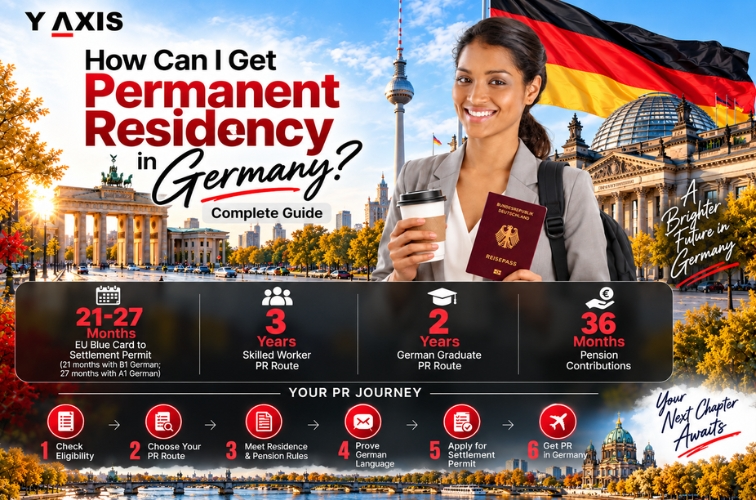
To obtain permanent residency in Germany, you must apply for a settlement permit (Niederlassungserlaubnis) after meeting the eligibility requirements for your residence permit. EU Blue Card holders can qualify after 21 months with B1-level German or 27 months with A1-level German, while skilled workers can generally apply after three years of residence in Germany. Applicants under the standard settlement permit route typically need five years of legal residence. Applicants must also meet the applicable requirements for pension contributions, sufficient income, German language proficiency and adequate accommodation. Once approved, you can live and work in Germany indefinitely and plan your long-term future with greater security.
*Want to apply for Germany PR? Let Y-Axis guide you through the application process.
Pathways to Permanent Residency in Germany
The main pathways to get permanent residency in Germany include the EU Blue Card, skilled-worker residence permits, general employment, graduation from a German university and family reunification. EU Blue Card holders can qualify for a settlement permit after 21 months with B1-level German or 27 months with A1-level German, while eligible skilled workers can generally apply after three years. Each route has its own residence period and requirements for employment, pension contributions, income and German language proficiency.
- EU Blue Card: Apply after 21 months with B1-level German or 27 months with A1-level German, subject to employment and pension contribution requirements.
- Skilled Workers: Qualify after three years with a qualifying residence permit and by meeting the applicable employment, language and pension conditions.
- General Employment: Apply through the standard route after five years of qualifying residence, subject to the required pension contributions, income and language proficiency.
- German University Graduates: Graduates working in qualified employment in Germany may qualify after two years, subject to the applicable conditions.
- Family Reunification: Eligible spouses and family members may qualify under specific residence rules.
- Self-Employment: Self-employed residents may qualify by meeting the applicable residence, financial and other requirements.
Eligibility Requirements for Germany PR
To qualify for permanent residency in Germany, applicants under the standard settlement permit route generally need five years of qualifying residence, 60 months of pension contributions, B1-level German, sufficient income and adequate accommodation. EU Blue Card holders, skilled workers and graduates of German universities may qualify sooner under specific conditions.
- Residence: Five years of qualifying residence under the standard route, with shorter periods available for certain categories.
- Income: Sufficient funds to support yourself and your dependants without relying on certain public benefits.
- Pension contributions: 60 months of statutory pension contributions under the standard route, unless different rules apply.
- German language: B1-level German under the standard route, subject to applicable exemptions.
- Integration knowledge: Knowledge of Germany’s legal and social system, usually demonstrated through the Living in Germany test or an accepted equivalent.
- Accommodation: Adequate living space for yourself and your family.
- Employment: Compliance with the employment and residence permit conditions for your category.
- Criminal record: Compliance with Germany’s public-order and security requirements.
*Need help with Germany PR requirements? Book a free consultation with Y-Axis today.
Documents Checklist for Permanent Residency in Germany
The documents required for permanent residency in Germany include a valid passport, current residence permit, proof of income, pension contribution records and German language certificate, where applicable. Applicants may also need an employment contract, health insurance, proof of accommodation and recognised qualification certificates, depending on their residence permit category.
- Valid passport: Proof of identity and nationality.
- Current residence permit: Valid German residence permit or EU Blue Card.
- Biometric photograph: Recent photograph meeting German requirements.
- Proof of income: Recent salary slips and employment contract, where applicable.
- Pension contribution record: Evidence of the required statutory pension insurance contributions.
- German language certificate: Proof of the required German proficiency level for your settlement permit route.
- Proof of accommodation: Rental agreement or other evidence of adequate housing.
- Health insurance: Proof of valid health insurance coverage.
- Qualification certificates: Recognised degree or vocational qualification for applicable skilled-worker routes.
- Civic knowledge certificate: Proof of knowledge of Germany’s legal and social system, such as the Living in Germany test certificate, where required.
- Completed application form: Settlement permit application form required by the local immigration authority.
How to Apply for Permanent Residency in Germany?
You can apply for permanent residency in Germany through the local immigration authority (Ausländerbehörde) once you meet the eligibility requirements for your residence permit category. Follow these steps to submit your application and obtain a settlement permit.
Step 1: Check your eligibility
Confirm that you meet the required residence period, employment, income, pension contribution and German language requirements for your settlement permit category.
Step 2: Prepare the required documents
Gather your valid passport, current residence permit, proof of income, pension contribution records, German language certificate and proof of accommodation, as applicable.
Step 3: Contact your local immigration office
Visit your local Ausländerbehörde website to check the application procedure, document checklist and appointment requirements.
Step 4: Submit your application
Complete the settlement permit application form and submit it with the required supporting documents according to your local immigration office's instructions.
Step 5: Attend your appointment
Present your original documents for verification and provide biometric information, such as fingerprints, if requested.
Step 6: Pay the application fee
Pay the applicable settlement permit fee according to your residence permit category and the local authority's instructions.
Step 7: Receive your settlement permit
Once approved, you will receive an electronic residence permit card (eAT) confirming your permanent residency status in Germany.
*Want to apply for Germany PR? Book a free consultation with Y-Axis today.
Germany PR Fees
The cost of permanent residency in Germany starts at €113 for a standard settlement permit. Highly qualified applicants pay €147, while self-employed applicants pay €124. You may also need to budget for German language tests, document translation and certification, depending on your route and the documents required for your application.
| Applicant Category | Application Fee |
|---|---|
| Standard settlement permit | €113 |
| Highly qualified applicants | €147 |
| Self-employed applicants | €124 |
Germany PR Processing Time
The processing time for permanent residency in Germany typically takes 6 to 8 weeks after submitting a complete application to the local immigration authority (Ausländerbehörde). Applications may take longer if documents are missing, additional checks are required or the office has a high volume of applications. After approval, issuing the electronic residence permit card (eAT) may take another 4 to 6 weeks. Preparing your documents in advance and meeting all eligibility requirements can help you move smoothly towards permanent residency in Germany.
*Want to migrate to Germany permanently? Book a free consultation with Y-Axis today.
FAQs
What are the benefits of permanent residency in Germany?
Permanent residency allows you to live and work in Germany indefinitely without renewing a temporary residence permit. You can change employers without needing a new work-related residence permit and plan your long-term career and future in Germany.
How many years do I need to live in Germany to get PR?
The standard settlement permit route generally requires five years of qualifying residence. Eligible EU Blue Card holders may qualify after 21 or 27 months, skilled workers after three years, and eligible German university graduates after two years of qualifying employment.
Can I get Germany PR after 21 months?
Yes. EU Blue Card holders can generally apply after 21 months of qualifying employment and pension contributions if they have B1-level German and meet the other settlement permit requirements.
Can I get Germany PR after 27 months?
Yes. EU Blue Card holders can generally apply after 27 months of qualifying employment and pension contributions if they have A1-level German and meet the remaining eligibility requirements.
Can I get permanent residency in Germany with a work visa?
Yes. Eligible skilled workers can generally apply after three years of holding a qualifying German residence permit. They must also meet the applicable requirements for employment, pension contributions, German language proficiency, income and accommodation.
Can I apply for Germany PR from the UAE?
No, you cannot directly apply for German permanent residency while living in the UAE. You must first move to Germany, obtain a qualifying residence permit, meet the required residence period and fulfil the applicable eligibility requirements before applying for a settlement permit.
What documents are required for Germany PR?
You generally need a valid passport, current German residence permit, biometric photograph, proof of income, pension contribution records, German language certificate and proof of accommodation. Depending on your route, you may also need an employment contract, qualification certificates and proof of knowledge of Germany's legal and social system.
How much does permanent residency in Germany cost?
The commonly cited application fees are €113 for a standard settlement permit, €147 for highly qualified applicants and €124 for self-employed applicants. Additional expenses may include language examinations, document translation and certification. Confirm the applicable fee with your local immigration office before applying.
How long does Germany PR take to process?
Processing a German permanent residency application may take approximately 6 to 8 weeks. After approval, issuing the electronic residence permit card (eAT) may take another 4 to 6 weeks. The total may therefore be around 10 to 14 weeks, excluding appointment delays or additional document checks. Actual timelines vary by immigration office.
Is Germany PR the same as German citizenship?
No. Permanent residency allows you to live and work in Germany indefinitely while retaining your existing nationality. German citizenship grants German nationality, eligibility for a German passport and additional political rights. You must submit a separate naturalisation application and meet the applicable citizenship requirements.
Posted on October 19 2026
Trending Article
Posted On October 23 2026
What Are the Different Types of Germany Visas to Immigrate?