


Posted on October 21 2026
UK vs. Australia for Healthcare Professionals: Which Country Should You Choose?

By , Editor
Updated October 21 2026
The UK and Australia are popular destinations for nurses, doctors and allied health professionals seeking overseas healthcare jobs, competitive salaries and long-term career growth. Both countries offer opportunities across public and private healthcare, but differ in salary ranges, job demand, professional registration, work visa requirements and permanent residency pathways.
Compare the UK and Australia for healthcare jobs, salaries after tax, qualification recognition, registration requirements, living costs and settlement options. Explore the UK’s NHS and private-sector opportunities alongside Australia’s healthcare job market to understand the requirements for working in each country and choose the destination that aligns with your qualifications, experience and career goals.
*Want to work abroad? Let Y-Axis help you through application process.
UK vs Australia for Healthcare Professionals: Quick Comparison
Both countries offer competitive salaries and long-term financial benefits. Australia provides 12% employer superannuation contributions, while the UK offers structured NHS pay scales and the NHS Pension Scheme. Your savings depend on your role, taxes and living costs, with London, Sydney and Melbourne generally more expensive than Manchester, Leeds, Adelaide and Perth.
| Factor | UK | Australia |
|---|---|---|
| Average Annual Healthcare Salary | £40,000–£100,000 | AUD 90,000–AUD 220,000 |
| Projected Healthcare Job Opportunities Over the Next Decade | 300,000+ | 530,000+ |
| In-Demand Healthcare Roles | Doctors, registered nurses, midwives, physiotherapists, radiographers, pharmacists and occupational therapists | Doctors, registered nurses, midwives, physiotherapists, occupational therapists and other allied health professionals |
| Major Healthcare Employment Hubs | London, Manchester, Birmingham, Leeds and Glasgow | Sydney, Melbourne, Brisbane, Perth and Adelaide |
| Work Visa Options | Health and Care Worker visa | Skills in Demand visa (subclass 482), Skilled Employer Sponsored Regional visa (subclass 494) and skilled migration visas |
| Professional Registration | General Medical Council (GMC) for doctors, Nursing and Midwifery Council (NMC) for nurses and midwives, and Health and Care Professions Council (HCPC) for many allied health professions | Australian Health Practitioner Regulation Agency (Ahpra) and the relevant National Board for regulated health professions |
| Permanent Residency and Settlement Pathways | Indefinite Leave to Remain (ILR) after meeting the applicable qualifying period and requirements | Skilled Nominated visa (subclass 190), Employer Nomination Scheme visa (subclass 186) and other permanent visa pathways |
| Estimated Monthly Living Costs | £1,500–£3,000 | AUD 2,500–AUD 4,500 |
| Family Migration Options | Bring your spouse or partner and dependent children on dependant visas | Include your spouse or partner and dependent children in a subclass 482 visa application |
UK vs Australia: Which Country Offers Better Opportunities for Healthcare Professionals?
The UK and Australia offer healthcare career opportunities across nursing, medicine and allied health, but demand varies by occupation, experience and location. The UK has a large healthcare workforce across NHS trusts and private hospitals, while Australia needs healthcare workers across metropolitan hospitals, aged care services and regional communities.
UK may suit you if you want:
- Healthcare jobs across NHS hospitals, private hospitals and specialist services
- A dedicated Health and Care Worker visa route for healthcare occupations
- Reduced visa fees and exemption from the Immigration Health Surcharge for this visa
- Structured NHS pay scales, specialist training and career progression opportunities
- Access to the NHS Pension Scheme
- Pathway to settlement through Indefinite Leave to Remain (ILR)
*Want to work in the UK? Get expert guidance from Y-Axis professionals.
Australia may suit you if you want:
- Competitive salaries across nursing, medicine and allied health.
- Employer superannuation contributions to support retirement savings.
- Salary packaging options with participating healthcare employers.
- Permanent residency pathways through visas such as subclasses 189, 190 and 186.
- Healthcare career opportunities in major cities and regional communities.
- Options to include your spouse or partner and dependent children in your visa application.
*Want to work in Australia? Get expert guidance from Y-Axis professionals.
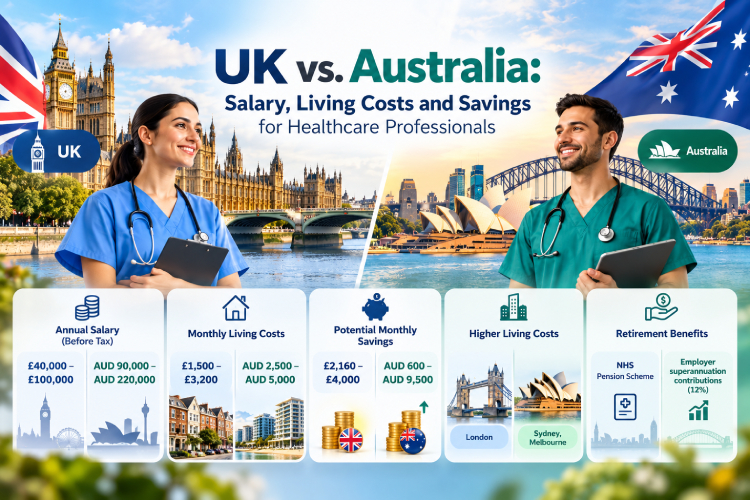
UK vs. Australia: Salary, Living Costs and Savings for Healthcare Professionals
Healthcare professionals can earn competitive salaries in both the UK and Australia, but actual savings depend on take-home pay, taxes, housing and daily expenses. Australia offers employer superannuation contributions, while the UK provides structured NHS pay scales and access to the NHS Pension Scheme. Compare salaries for your specific role and living costs in your preferred city, as higher expenses in London, Sydney and Melbourne can reduce the savings you make from a higher salary.
| Factor | UK | Australia |
|---|---|---|
| Annual Healthcare Salary (Before Tax) | £40,000–£100,000 | AUD 90,000–AUD 220,000 |
| Monthly Gross Salary | £3,333–£8,333 | AUD 7,500–AUD 18,333 |
| Estimated Monthly Take-Home Pay | £2,650–£5,500 | AUD 5,600–AUD 12,000 |
| Monthly Rent (1-Bedroom City-Centre Apartment) | £1,100–£2,300 | AUD 1,300–AUD 3,600 |
| Monthly Grocery Costs | £250–£450 | AUD 350–AUD 600 |
| Monthly Public Transport Costs | £80–£200 | AUD 100–AUD 220 |
| Monthly Utilities, Internet and Mobile | £150–£300 | AUD 260–AUD 500 |
| Estimated Total Monthly Living Costs | £1,500–£3,200 | AUD 2,500–AUD 5,000 |
| Potential Monthly Savings | £2,160–£4,000 | AUD 600–AUD 9,500 |
| Potential Annual Savings | £25,920–£48,000 | AUD 7,200–AUD 114,000 |
| Cities with Relatively Lower Living Costs | Manchester, Leeds, Glasgow | Adelaide, Perth, Brisbane |
| Cities with Higher Living Costs | London | Sydney, Melbourne |
| Retirement Benefits | NHS Pension Scheme | Employer superannuation contributions (12%) |
*Plan Your Healthcare Career Abroad? Book a Free Consultation with Y-Axis Today.
FAQs
Which country is better for nurses, the UK or Australia?
The UK offers nursing jobs across NHS trusts and private hospitals, while Australia has opportunities in public hospitals, private healthcare, aged care and regional services. Compare salaries, registration requirements and visa pathways to find the best fit for your career goals.
Do healthcare professionals earn more in the UK or Australia?
Salaries vary by occupation, experience and location. Australia offers employer superannuation contributions, while NHS staff benefit from structured pay bands and access to the NHS Pension Scheme. Compare take-home pay and living costs to estimate potential savings.
How much income tax do healthcare professionals pay in the UK and Australia?
UK employees may pay income tax and National Insurance, while Australian tax residents pay income tax and may also pay the Medicare levy. Your tax bill depends on earnings, residency status and applicable deductions.
What work visas are available for healthcare professionals in the UK and Australia?
The UK offers the Health and Care Worker visa for qualifying occupations with an approved job offer and sponsorship. Australia offers employer-sponsored visas, such as the Skills in Demand visa (subclass 482), and skilled migration options, including subclasses 189 and 190.
What registration is required for nurses and doctors in the UK and Australia?
In the UK, nurses register with the Nursing and Midwifery Council (NMC), and doctors with the General Medical Council (GMC). In Australia, nurses and doctors must meet the relevant registration requirements through Ahpra and their respective National Boards.
Can healthcare professionals obtain permanent residency in the UK or Australia?
The UK offers settlement through Indefinite Leave to Remain (ILR), subject to the applicable qualifying period and requirements. Australia offers permanent residency pathways through visas such as subclasses 189, 190 and 186.
Which country has a lower cost of living, the UK or Australia?
Living costs depend on location and household size. London, Sydney and Melbourne can be expensive, particularly for housing. Compare rent, groceries, transport and utilities in your preferred city to estimate potential savings.
Can healthcare professionals bring their spouse and children to the UK or Australia?
Both countries offer family migration options, depending on the visa category. Check whether your spouse or partner and dependent children can accompany you and what work or study rights they receive.
Do healthcare professionals need a job offer to work in the UK or Australia?
The UK Health and Care Worker visa requires a job offer from an approved sponsor. Australia's employer-sponsored visas also require sponsorship, while points-tested visas such as subclasses 189 and 190 do not require an employer sponsor.
Does healthcare work experience in the UAE count when applying to the UK or Australia?
Yes. UAE clinical experience can support job applications and registration assessments. Prepare employment letters, detailed job descriptions, qualification records, professional licence history from DHA, DOH or MOHAP, and certificates of good standing where required.
Tags:
UK vs Australia for Healthcare Professionals
UK vs Australia for Nurses
UK vs Australia for Doctors
UK vs Australia Healthcare Jobs
UK vs Australia Healthcare Salaries
UK vs Australia Work Visa
UK vs Australia Permanent Residency
NMC vs AHPRA Registration
Nursing Jobs Abroad from UAE
UK ILR vs Australia PR
Share
Y-Axis Services

Get it on your mobile
Get News alerts
Contact Y-Axis
Latest Article
Popular Post
Trending Article
Posted On October 21 2026
UK vs. Australia for Healthcare Professionals: Which Country Should You Choose?