

Posted on February 16 2026
1 Million Jobs in Australia Over the Next Decade: Job Outlook and Work Visa Options

By , Editor
Updated February 16 2026
Australia is expected to create over 1 million new and replacement jobs over the next decade, driven by large-scale retirements, population growth, and continued economic expansion. With more than 20% of the workforce expected to retire, employers need skilled workers across healthcare, IT, engineering, construction, logistics, education, and finance. This is creating strong demand for jobs in Australia, especially in occupations listed on the Australia skilled occupation list.
The Australian government is investing over AUD 1 trillion in infrastructure, housing, renewable energy, mining, and digital transformation projects. To address labour shortages, many employers are offering Australia visa sponsorship jobs and using Australia work visa programs to hire foreign workers. These roles offer competitive salaries, long-term career stability, and clear permanent residency pathways.
*Want to work in Australia? Avail Y-Axis Resume Marketing Services to find the right job faster.
Why Australia is one of the Best Countries to Work Abroad?
- Stable job market with high minimum wage of AUD 24.95 per hour
- Over 1 million jobs expected across healthcare, IT, engineering, construction, and skilled trades
- High demand for skilled professionals due to ongoing labour shortages
- Excellent work-life balance, healthcare benefits, and retirement support
- Clear pathways to permanent residency (PR) and long-term career growth
- Multiple Australia work visa options and skilled migration pathways
Job Outlook in Australia for the Next Decade
Australia has a strong and positive job outlook over the next decade, with more than 1 million job openings expected due to economic growth and workforce retirements. Many industries are expanding to meet rising demand, creating long-term employment opportunities across essential sectors.
Healthcare is projected to see the fastest growth, with over 300,000 new roles, followed by strong demand in technology, engineering, and construction. Infrastructure, housing, renewable energy, and digital transformation are also driving employment growth, while education and skilled trades continue to offer stable career opportunities.
Key job trends and opportunities in Australia over the next decade:
- Over 1 million new and replacement jobs expected across industries
- Healthcare will see the fastest growth due to an ageing population
- Strong demand for professionals in IT, engineering, and construction
- Infrastructure, housing, and clean energy projects creating new jobs
- Skilled trades and digital roles remain in high demand
Most In-Demand Jobs in Australia over the Next Decade
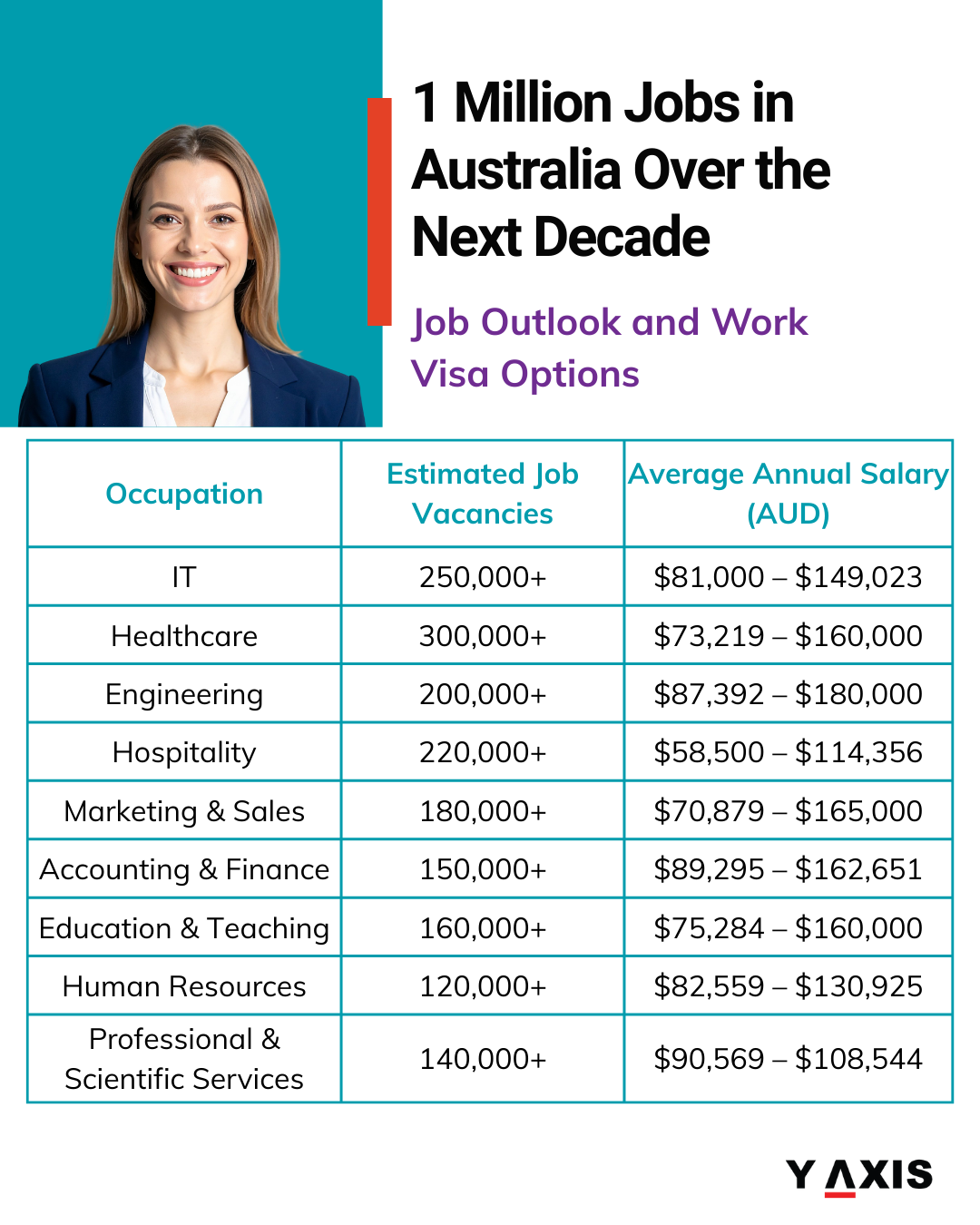
Australia is expected to create over 1 million job openings over the next decade, driven by workforce retirements, infrastructure investment, and economic growth. Healthcare alone is projected to add more than 300,000 new roles, while major infrastructure and housing projects are increasing demand for engineers, construction workers, and skilled trades. The technology sector continues to expand rapidly, creating thousands of new IT and digital jobs.
Most in-demand job opportunities in Australia over the next decade include:
|
Occupation |
Estimated Job Vacancies |
Average Annual Salary (AUD) |
|
IT |
250,000+ |
$81,000 – $149,023 |
|
Healthcare |
300,000+ |
$73,219 – $160,000 |
|
Engineering |
200,000+ |
$87,392 – $180,000 |
|
Hospitality |
220,000+ |
$58,500 – $114,356 |
|
Marketing & Sales |
180,000+ |
$70,879 – $165,000 |
|
Accounting & Finance |
150,000+ |
$89,295 – $162,651 |
|
Education & Teaching |
160,000+ |
$75,284 – $160,000 |
|
Human Resources |
120,000+ |
$82,559 – $130,925 |
|
Professional & Scientific Services |
140,000+ |
$90,569 – $108,544 |
Also Read…
Fast-Track Hiring Options in Australia for Skilled Professionals
List of Skilled Occupations Eligible for Australia Work Visa
Australia maintains a Skilled Occupation List (SOL) that includes jobs facing national labour shortages. If your occupation is on this list, you may be eligible to apply for an Australia work visa, including skilled migration and employer sponsored visas. These occupations are in high demand due to economic growth, infrastructure expansion, and workforce retirements. The Skilled Occupation List covers hundreds of roles across healthcare, IT, engineering, construction, education, and skilled trades.
|
Sector |
Occupations |
Chances of Visa Eligibility |
|
Healthcare |
Registered Nurses, General Practitioners, Physiotherapists, Medical Laboratory Scientists |
Very High |
|
Information Technology |
Software Engineers, Cybersecurity Specialists, ICT Business Analysts, Developers |
Very High |
|
Engineering |
Civil Engineers, Mechanical Engineers, Electrical Engineers, Mining Engineers |
Very High |
|
Construction and Skilled Trades |
Electricians, Plumbers, Carpenters, Construction Managers |
Very High |
|
Finance and Accounting |
Accountants, Financial Analysts, Auditors |
High |
|
Education |
Secondary School Teachers, Early Childhood Teachers, University Lecturers |
High |
|
Mining and Energy |
Mining Engineers, Geologists, Petroleum Engineers |
High |
|
Hospitality |
Chefs, Hotel Managers, Restaurant Managers |
High |
|
Professional and Scientific Services |
Project Managers, Consultants, Analysts |
High |
|
Automotive and Technical Trades |
Automotive Mechanics, Technicians |
High |
Highest Paying Jobs in Australia for Skilled Professionals
Australia offers some of the highest paying jobs in Australia across healthcare, IT, engineering, mining, and construction due to ongoing skill shortages and economic growth. Many of these roles are listed on the Australia skilled occupation list, making them eligible for Australia work visa and visa sponsorship programs. Skilled professionals working in these high demand sectors can earn between AUD 80,000 and AUD 350,000 per year, depending on their qualifications and experience.
List of Highest paying jobs in Australia include:
|
Sector |
High-Paying Job Roles |
Average Annual Salary (AUD) |
|
Healthcare |
Surgeons, General Practitioners, Medical Specialists, Anaesthetists |
$250,000 – $500,000+ |
|
Information Technology (IT) |
IT Directors, Cloud/AI Architects, Cybersecurity Specialists, Data Scientists |
$150,000 – $250,000+ |
|
Engineering |
Senior Project Engineer, Engineering Managers, Specialized Engineers |
$130,000 – $200,000+ |
|
Mining and Energy |
Mining Managers, Project Manager, Petroleum Engineers |
$180,000 – $300,000+ |
|
Finance and Accounting |
CFO (SME), Head of Risk, Investment Banker, Finance Directors |
$200,000 – $400,000+ |
|
Construction and Skilled Trades |
Project Manager, Site Manager, Project Directors, Estimators |
$150,000 – $250,000+ |
|
Legal Services |
Corporate Lawyer, General Counsel |
$180,000 – $400,000+ |
Who Can Apply for Jobs in Australia?
Australia offers job opportunities for professionals at different career stages, especially in sectors facing skill shortages. Employers are actively hiring qualified candidates who meet the required education, work experience, and Australia work visa requirements. Many of these roles are listed on the Australia Skilled Occupation List, and employers often provide visa sponsorship jobs in Australia to fill critical positions.
Graduates and Entry-Level Candidates
Graduates can apply for entry-level roles in IT support, customer service, healthcare assistance, hospitality, logistics, and administration. These roles provide valuable international work experience and career growth opportunities.
Mid-Level Professionals
Professionals with 2–8 years of experience are in strong demand across IT, engineering, healthcare, construction, finance, and education. Employers actively recruit skilled workers to fill labour shortages in these sectors.
Skilled and Senior Professionals
Highly skilled professionals and specialists are needed in healthcare, engineering, technology, and skilled trades. These roles offer high salaries, job stability, and long-term career opportunities, along with pathways to permanent residency.
Also Read…
Visa Sponsorship Jobs in Australia for Skilled Professionals
How to Get a Job in Australia from the UAE?
Australia offers strong job opportunities for skilled professionals in healthcare, IT, engineering, construction, and skilled trades. Candidates with relevant skills and qualifications can apply for jobs and Australia work visa programs.
Steps to find a job and work in Australia from the UAE:
Step 1: Check the Australia Skilled Occupation List to find jobs in high demand.
Step 2: Prepare an Australian-style resume highlighting your skills and experience.
Step 3: Apply for jobs through portals such as Seek, Indeed, LinkedIn, and company websites.
Step 4: Search for employers offering Australia visa sponsorship jobs.
Step 5: Apply for Australia work visa after receiving a job offer or meeting visa requirements.
*Want to apply for Jobs in Australia? Sign up with Y-Axis Resume Marketing Services to find the right job faster.
Best Australia Work Visa Options for Skilled Professionals
Australia offers several work visa options for skilled professionals, allowing them to work legally and build long-term careers. These visas help employers fill skill shortages and also provide pathways to permanent residency.
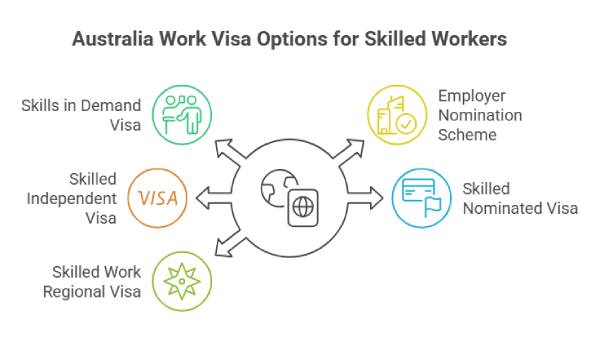
Major Australia work visa options for skilled workers include:
Skills in Demand Visa (Subclass 482): An employer sponsored visa that allows skilled professionals to work in Australia in high-demand occupations. This is one of the most common work visas and provides pathways to permanent residency.
Employer Nomination Scheme Visa (Subclass 186): A permanent visa for skilled professionals nominated by an Australian employer, allowing them to live and work permanently in Australia.
Skilled Independent Visa (Subclass 189): A permanent visa for skilled workers whose occupations are listed on the Australia Skilled Occupation List. No employer sponsorship is required.
Skilled Nominated Visa (Subclass 190): A permanent visa for skilled professionals nominated by an Australian state or territory based on labour shortages.
Skilled Work Regional Visa (Subclass 491): A temporary visa that allows skilled workers to live and work in regional Australia, with a pathway to permanent residency.
Documents Required to Work in Australia for Skilled Professionals
To work in Australia, skilled professionals must provide essential documents to support their job and Australia work visa application. These documents help verify identity, qualifications, and work experience.
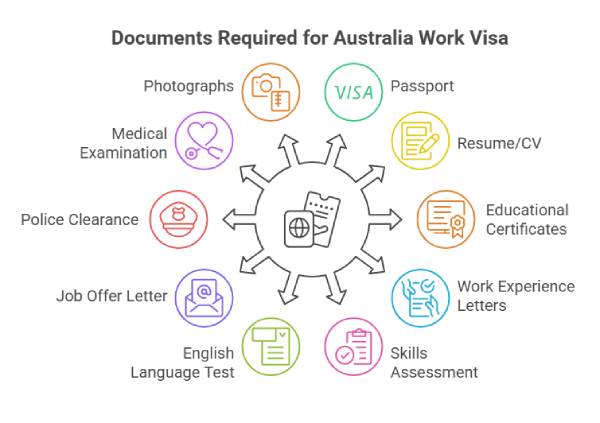
Key required documents for Australia work visa include:
- Valid passport
- Updated resume or CV
- Educational certificates and academic transcripts
- Work experience letters and employment references
- Skills assessment report (if required for your occupation)
- English language test results (IELTS, PTE, or equivalent)
- Job offer letter (for employer sponsored visas)
- Police clearance certificate
- Medical examination report
- Passport-size photographs
Step-by-Step Application Process for Australia Work Visa from Dubai
Step 1: Check your eligibility
Step 2: Complete Skills Assessment, if required
Step 3: Submit Expression of Interest (EOI) or Get Job Offer
Step 4: Gather required documents
Step 5: Submit your work visa application online through the official Australian immigration portal.
Step 6: Complete medical and background checks
Step 7: Once approved, you will receive your Australia work visa and can legally travel and work in Australia.
*Want to apply for Australia Work Visa? Get expert guidance from Y-Axis.
Australia Permanent Residency Pathways for Skilled Workers from Dubai
Skilled professionals working in Australia can apply for permanent residency (PR) through several immigration pathways. Permanent residency allows individuals to live and work in Australia permanently and access long-term career and settlement benefits.
Major permanent residency pathways include:
Employer Nomination Scheme Visa (Subclass 186): Skilled workers sponsored by an Australian employer can apply for PR after meeting work and eligibility requirements.
Skilled Independent Visa (Subclass 189): A points-based permanent visa for skilled professionals whose occupations are on the Skilled Occupation List.
Skilled Nominated Visa (Subclass 190): A permanent visa for skilled workers nominated by an Australian state or territory.
Regional PR Pathway (Subclass 191): Professionals working in regional Australia on eligible visas can apply for permanent residency after meeting residency and income requirements.
*Want to apply for Australia PR? Consult Y-Axis for expert guidance.
Top 10 Companies Offering Visa Sponsorship Jobs in Australia
Australia is home to many global and leading companies actively hiring skilled professionals across sectors such as IT, engineering, healthcare, mining, finance, and construction. Due to ongoing skill shortages, several employers offer visa sponsorship to attract qualified foreign workers. These companies provide competitive salaries, strong career growth, and long-term employment opportunities for eligible candidates.
|
Company |
Major Hiring Sectors |
Chances of Visa Sponsorship |
|
Commonwealth Bank |
IT, Cybersecurity, Finance, Data Analytics |
Medium |
|
BHP |
Mining, Engineering, Skilled Trades, Project Management |
High |
|
Rio Tinto |
Mining, Engineering, Construction, Technical Roles |
High |
|
Telstra |
IT, Telecommunications, Network Engineering |
Medium |
|
Accenture Australia |
IT, Software Development, Consulting, Cloud |
High |
|
Deloitte Australia |
Accounting, Finance, Consulting, Technology |
Medium |
|
PwC Australia |
Accounting, Advisory, Technology, Risk |
Medium |
|
IBM Australia |
Cloud Computing, IT, Cybersecurity, AI |
High |
|
Amazon Australia |
IT, Logistics, Operations, Engineering |
Medium |
|
CSL Limited |
Healthcare, Biotechnology, Research, Engineering |
Medium–High |
Best Cities in Australia with the Most Job Opportunities
Australia’s major cities offer the highest number of job opportunities, especially in IT, healthcare, engineering, construction, finance, and skilled trades. These cities have strong economies, major employers, and ongoing infrastructure and business growth.
|
City |
Major Job Sectors |
Why Consider this city? |
|
Sydney |
IT, Finance, Healthcare, Construction |
Australia’s largest job market and financial hub |
|
Melbourne |
Healthcare, IT, Education, Engineering |
Strong demand across healthcare and technology |
|
Brisbane |
Construction, Engineering, Healthcare |
Rapid population growth and infrastructure projects |
|
Perth |
Mining, Engineering, Skilled Trades |
Major mining hub with high-paying job opportunities |
|
Adelaide |
Defence, Engineering, Manufacturing |
Growing defence and technology sectors |
|
Canberra |
Government, IT, Cybersecurity |
High demand for IT and public sector professionals |
|
Gold Coast |
Healthcare, Hospitality, Construction |
Growing economy and expanding infrastructure |
Cost of Living in Australia for Skilled Professionals
The cost of living in Australia varies depending on the city, lifestyle, and accommodation choices. Major cities like Sydney and Melbourne have higher living costs, while cities like Adelaide and Perth are more affordable. Skilled professionals earning between AUD 70,000 and AUD 120,000 per year can maintain a comfortable lifestyle.
Average monthly living expenses in Australia:
|
Expense Category |
Average Cost (AUD per month) |
|
Accommodation (Rent) |
1,200 – 2,500 |
|
Food and Groceries |
400 – 800 |
|
Transportation |
150 – 300 |
|
Utilities (Electricity, Internet) |
150 – 250 |
|
Health Insurance |
100 – 200 |
|
Miscellaneous Expenses |
300 – 600 |
Tips to Improve Your Chances of Getting a Job in Australia
- Apply for jobs in high-demand sectors such as healthcare, IT, engineering, and construction
- Prepare a professional Australian-style resume and cover letter
- Gain relevant work experience and improve your technical skills
- Complete skills assessment and meet Australia work visa requirements
- Apply to multiple employers to increase your chances of selection
FAQs
What is the job outlook in Australia over the next decade?
Australia has a strong job outlook, with over 1 million job openings expected due to workforce retirements and economic growth. Industries such as healthcare, IT, engineering, and construction will see the highest demand. Many of these roles are listed on the Australia Skilled Occupation List, making them eligible for Australia work visa programs. Skilled professionals can access visa sponsorship jobs in Australia and benefit from long-term career opportunities and stable employment.
What are the most in-demand jobs in Australia?
The most in-demand jobs in Australia include registered nurses, software engineers, civil engineers, electricians, aged care workers, and teachers. These roles are listed on the Australia Skilled Occupation List and qualify for Australia work visa programs. Healthcare and technology sectors have the fastest growth due to population increase and digital transformation. Skilled workers in these fields can find visa sponsorship jobs in Australia with competitive salaries and long-term career growth.
Can foreign workers apply for jobs in Australia?
Yes, foreign workers can apply for jobs in Australia if they meet qualification and Australia work visa requirements. Employers actively hire skilled professionals in healthcare, IT, engineering, and construction. Many companies offer visa sponsorship jobs in Australia to fill skill shortages. Candidates with occupations on the Australia Skilled Occupation List have better employment chances. Applying through job portals and employer websites improves opportunities to work legally and build a career in Australia.
What is the Australia Skilled Occupation List?
The Australia Skilled Occupation List includes jobs facing labour shortages and eligible for Australia work visa programs. It covers occupations such as engineers, nurses, IT professionals, and skilled trades workers. This list helps employers hire foreign workers for high demand jobs in Australia. If your occupation is on the list, your chances of visa approval and employment increase. Skilled professionals should check this list before applying for jobs in Australia.
What visa options are available to work in Australia?
Australia offers several work visa options, including the Skills in Demand Visa, Skilled Independent Visa (Subclass 189), and Employer Nomination Scheme Visa (Subclass 186). These visas allow skilled professionals to work legally and may provide permanent residency pathways. Employer sponsored visas are common for visa sponsorship jobs in Australia. Choosing the right Australia work visa depends on your occupation, qualifications, and job offer from an Australian employer.
What is the Skills in Demand Visa in Australia?
The Skills in Demand Visa is an employer sponsored Australia work visa designed to help employers hire skilled foreign workers in high demand occupations. It allows professionals to work legally and offers pathways to permanent residency Australia. Employers use this visa to fill shortages in healthcare, IT, engineering, and construction. Skilled professionals with relevant qualifications can apply for visa sponsorship jobs in Australia through this program.
How can I find visa sponsorship jobs in Australia?
You can find visa sponsorship jobs in Australia through job portals such as Seek, Indeed, and LinkedIn. Focus on occupations listed on the Australia Skilled Occupation List, as these roles are more likely to offer sponsorship. Apply directly to companies facing labour shortages in healthcare, IT, and engineering. Preparing a strong resume and applying to multiple employers improves your chances of securing Australia work visa and employment.
What is the average salary for jobs in Australia?
The average salary for jobs in Australia ranges between AUD 70,000 and AUD 120,000 per year, depending on occupation and experience. High demand jobs in Australia, such as engineers, IT professionals, and healthcare workers, earn higher salaries. Senior professionals may earn over AUD 150,000 annually. Competitive salaries and strong employment demand make Australia attractive for skilled professionals seeking Australia work visa and career growth opportunities.
Is Australia good for skilled professionals?
Australia is one of the best countries for skilled professionals due to strong job demand, high salaries, and permanent residency pathways. Employers actively hire foreign workers in healthcare, IT, engineering, and construction. Skilled professionals can apply for Australia work visa programs and visa sponsorship jobs. Australia also offers excellent work-life balance, career growth, and quality of life, making it a top destination for global talent.
What documents are required for Australia work visa?
Documents required for Australia work visa include a valid passport, resume, educational certificates, work experience letters, and English test results such as IELTS or PTE. Skills assessment, medical examination, and police clearance certificates may also be required. Employer sponsored visa applicants need a job offer letter. These documents help verify eligibility and improve approval chances for visa sponsorship jobs in Australia.
Can I get permanent residency after working in Australia?
Yes, skilled professionals can apply for permanent residency Australia through visas such as Subclass 189, 190, and 186. These visas allow foreign workers to live and work permanently. Occupations listed on the Australia Skilled Occupation List have higher PR approval chances. Permanent residency provides long-term job security, career growth, and settlement benefits for skilled professionals working in Australia.
Which industries have the most jobs in Australia?
Healthcare, IT, engineering, construction, and education have the most jobs in Australia. These sectors face ongoing skill shortages and actively hire skilled professionals. Many of these roles are eligible for Australia work visa programs and visa sponsorship jobs. Skilled workers in these industries have strong employment opportunities, competitive salaries, and permanent residency pathways.
What is the minimum wage in Australia?
Australia’s national minimum wage is AUD 24.95 per hour, one of the highest globally. Skilled professionals earn significantly higher salaries depending on their occupation and experience. High minimum wages and strong job demand make Australia attractive for foreign workers. Skilled professionals working in visa sponsorship jobs in Australia benefit from competitive earnings and career growth opportunities.
How long does Australia work visa processing take?
Australia work visa processing usually takes between 1 and 6 months, depending on visa type and application completeness. Employer sponsored visas may be processed faster if employers urgently need skilled workers. Providing accurate documents and meeting eligibility requirements helps speed up approval. Processing times vary based on demand and visa category.
Is IELTS required for Australia work visa?
Yes, IELTS or other English tests such as PTE are required for most Australia work visa applications. English proficiency helps employers and immigration authorities assess communication skills. Meeting minimum score requirements improves visa approval chances. Skilled professionals applying for jobs in Australia should prepare for English tests in advance.
What is the easiest way to get a job in Australia?
The easiest way to get jobs in Australia is to apply for occupations listed on the Australia Skilled Occupation List. Focus on high demand sectors such as healthcare, IT, and engineering. Apply through job portals and target visa sponsorship employers. Meeting Australia work visa requirements increases employment chances.
Which cities have the most jobs in Australia?
Sydney, Melbourne, Brisbane, Perth, and Adelaide offer the most jobs in Australia. These cities have strong economies and major employers across healthcare, IT, engineering, and finance. Skilled professionals can find visa sponsorship jobs and career growth opportunities in these locations.
Can fresh graduates get jobs in Australia?
Yes, fresh graduates can find entry-level jobs in Australia, especially in IT, healthcare, hospitality, and administration. These roles help build experience and improve future employment opportunities. Graduates may also qualify for Australia work visa programs if their occupation is in demand.
Is Australia work visa easy to get?
Australia work visa approval depends on occupation demand, qualifications, and eligibility. Skilled professionals listed on the Australia Skilled Occupation List have higher approval chances. Employer sponsored visas improve success rates.
Why is Australia hiring foreign workers?
Australia hires foreign workers to fill skill shortages caused by workforce retirements and economic growth. Skilled professionals are needed across healthcare, IT, engineering, and construction. Visa sponsorship jobs help employers meet labour demands.
Tags:
Jobs in Australia
Australia Work Visa
Australia Visa Sponsorship Jobs
Australia Jobs for Foreigners
Jobs in Australia with Visa Sponsorship
Employer Sponsored Visa Australia
Australia Skilled Occupation List
High Demand Jobs in Australia
Australia
Share
Y-Axis Services

Get it on your mobile
Get News alerts
Contact Y-Axis
Latest Article
Popular Post
Trending Article

Posted On March 31 2026
Which is the best option to move abroad: Study or Work?