

Posted on July 23 2026
Top 10 Countries for Doctors to Work Abroad: Salary, Demand & PR Opportunities Compared

By , Editor & Director
Updated July 23 2026
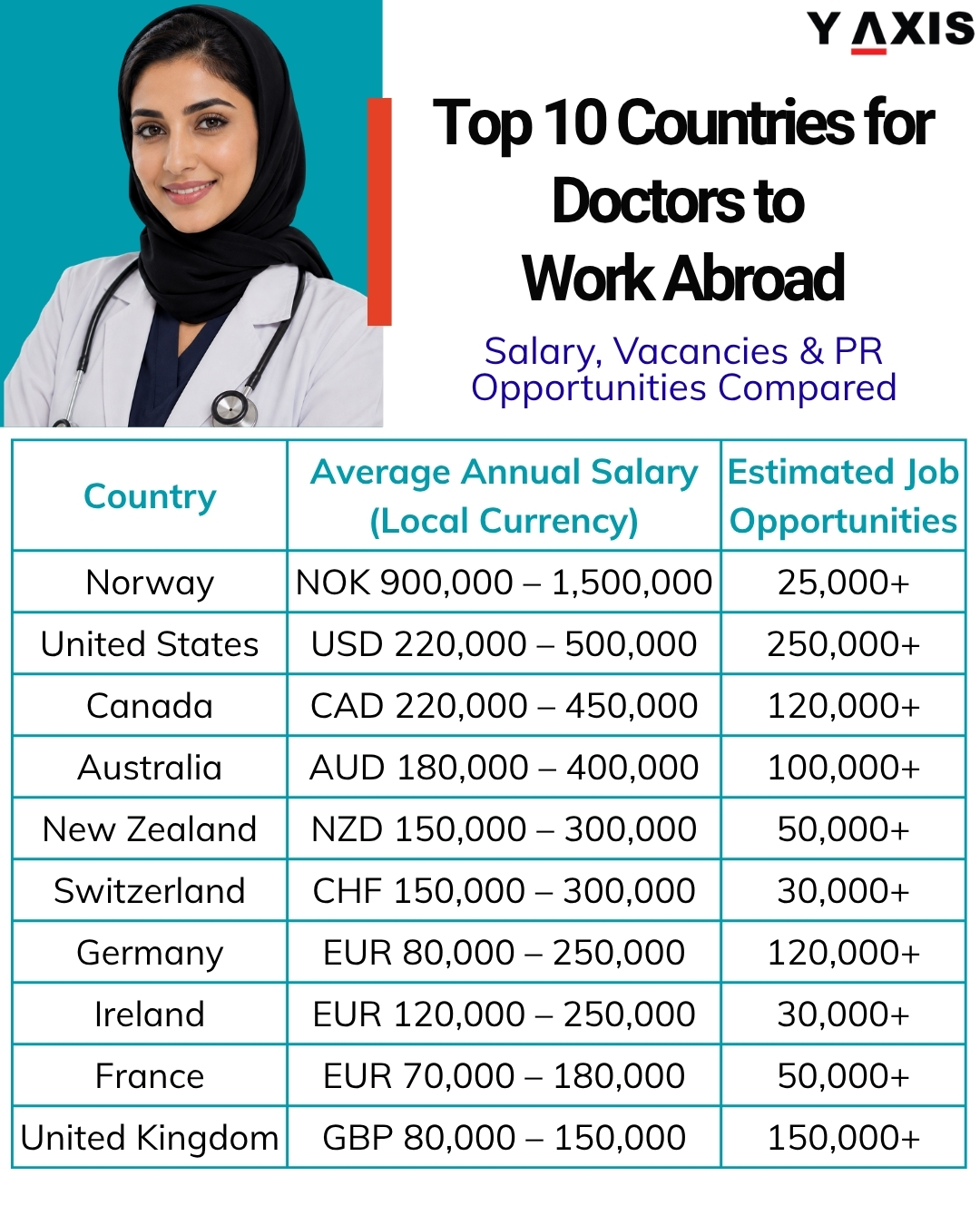
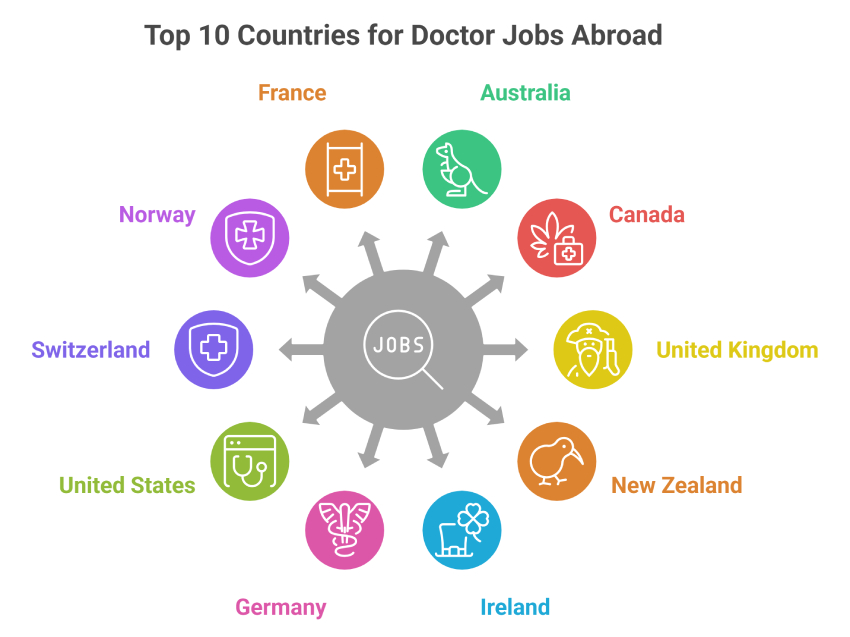
The best countries for doctors to work abroad are Australia, Canada, New Zealand, the UK, Ireland, Germany, the USA, Switzerland, Norway, and France. These countries offer competitive salaries, strong demand across medical specialties, opportunities for foreign-trained doctors, and permanent residence pathways.
Demand for doctors remains high due to ageing populations, growing healthcare needs, and ongoing labour shortages. The World Health Organization projects a global shortage of 11 million health workers by 2030. Demand for doctors remains strong across hospitals, primary care, and specialist medical services.
*Want to work abroad? Sign up with Y-Axis Resume Marketing Services to find right job faster.
Why Is the Demand for Doctors Increasing Globally?
The global demand for doctors is driven by shortages, population growth, rising chronic diseases, and an ageing medical workforce. Shortages are particularly high in primary care, specialist medicine, and rural healthcare.
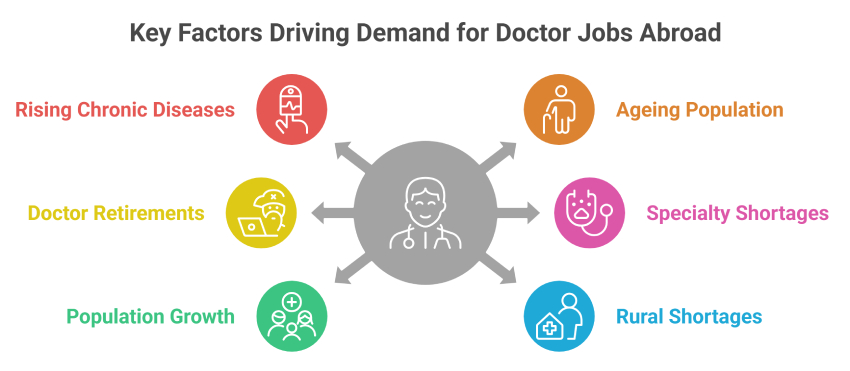
- Rising chronic diseases are increasing demand for doctors.
- 1 in 6 people globally will be aged 60 or older, increasing medical needs by 2030.
- Doctor retirements are creating new medical vacancies.
- Shortages are increasing demand across key medical specialties.
- Population growth is increasing the need for medical services.
- Rural areas continue to face significant doctor shortages.
How to Choose the Best Country for Doctor Jobs Abroad?
The best country for doctor jobs abroad depends on salaries, demand for your medical specialty, licensing requirements, work visa options, and permanent residence pathways. Cost of living and working conditions are also important when comparing countries for doctor jobs abroad.
- Compare doctor salaries against taxes and living costs.
- Check job vacancies for your medical specialty.
- Check whether your medical degree is recognised for registration.
- Review licensing exams, language tests, and clinical experience requirements.
- Compare work visa and permanent residence pathways.
- Consider working hours, leave, healthcare benefits, and career progression.
Top 10 Countries for Doctors to Work Abroad
Doctors have strong job opportunities in countries such as Australia, Canada, the UK, Germany, and New Zealand, with annual salaries ranging from around AED 200,000 to over AED 1 million. General practitioners, surgeons, psychiatrists, radiologists, and anaesthesiologists are among the roles in demand. More than 600,000 foreign-trained physicians work across OECD countries, indicating continued demand for overseas-trained doctors.
|
Country |
Average Annual Salary |
Estimated Doctor |
|
Australia |
AUD 180,000 – 400,000 |
100,000+ |
|
Canada |
CAD 220,000 – 450,000 |
120,000+ |
|
United Kingdom |
GBP 80,000 – 150,000 |
150,000+ |
|
New Zealand |
NZD 150,000 – 300,000 |
50,000+ |
|
Ireland |
EUR 120,000 – 250,000 |
30,000+ |
|
Germany |
EUR 80,000 – 250,000 |
120,000+ |
|
United States |
USD 220,000 – 500,000 |
250,000+ |
|
Switzerland |
CHF 150,000 – 300,000 |
30,000+ |
|
Norway |
NOK 900,000 – 1,500,000 |
25,000+ |
|
France |
EUR 70,000 – 180,000 |
50,000+ |
*Want to work abroad? Sign up with Y-Axis Resume Marketing Services to find right job faster.
Best Countries for Doctors to Work and Settle Abroad
Australia, Canada, New Zealand, the UK, Germany, and Ireland are among the best countries for doctors to work and settle abroad. Strong demand across medical specialties, competitive salaries, established routes for overseas-trained doctors, and pathways to permanent residence make these destinations suitable for long-term medical careers.
Doctor Jobs in Australia
Australia is a popular choice for doctors seeking overseas careers, with strong opportunities in regional healthcare, public hospitals, and specialist medical services. General practitioners, psychiatrists, emergency medicine doctors, anaesthetists, radiologists, and other specialists are needed across different healthcare settings. Regional and rural areas provide opportunities for doctors who want to work beyond major cities. Overseas-trained doctors can follow Medical Board of Australia and Ahpra registration pathways before practising. Employer-sponsored visas and skilled migration programs also support long-term settlement options. With demand for medical expertise, structured registration routes, and migration pathways, Australia remains one of the top destinations for doctors planning to work abroad.
|
Factor |
Details |
|
Doctor Job Market & Job Vacancies for the Next Decade |
Australia has steady demand for doctors, with over 100,000 job vacancies expected over the next decade across hospitals, regional healthcare services, and aged care facilities. |
|
Investment in Healthcare Sector |
Australia is making record healthcare investments, with funding rising to $140 billion and $537 billion committed over four years. This investment supports demand for doctors across Medicare, public hospitals, digital health, medical research, and aged care services. |
|
In-Demand Doctor Roles & Skills |
Key roles include general practitioners (GPs), specialist doctors, and hospital doctors. Important skills include clinical care, diagnostics, patient management, and rehabilitation. |
|
Work Visa Options for Doctors |
Doctors can explore visa options including the Skills in Demand Visa (Subclass 482), Skilled Independent (189), Skilled Nominated (190), Employer Nomination Scheme (186), and Skilled Work Regional (491). |
|
Fast-Track Hiring Options |
Employer-sponsored visas and state or territory nomination pathways support recruitment for priority healthcare occupations, including doctors. |
|
PR / Long-Term Residence Opportunities |
Doctors can access points-based PR pathways (189/190), employer-sponsored PR (186), and regional pathways (491 → PR) for long-term residence in Australia. |
|
Licensing & Registration Requirements |
Doctors must complete mandatory registration with the Australian Health Practitioner Regulation Agency (AHPRA) before practising as a doctor in Australia. |
|
Language Requirements |
Doctors need to demonstrate English language proficiency, typically through IELTS or an equivalent approved language test. |
|
Eligibility for Dependents |
Spouses and dependent children can accompany the primary applicant under applicable visa conditions. |
|
Benefits for Family Members |
Family members may access benefits including spouse work rights, access to public education, and Medicare access, subject to visa conditions. |
*Want to Work in Australia? Let Y-Axis guide you through application process.
Doctor Jobs in Canada
Canada is a leading destination for doctors seeking overseas careers, with opportunities across family medicine, hospitals, emergency care, and specialist healthcare. Family physicians are highly needed in many provinces, while specialists and hospital doctors are also recruited through provincial healthcare networks. Rural and remote communities provide additional opportunities through physician recruitment programs. Overseas-trained doctors must complete province-specific licensing requirements before practising. Canada also provides immigration pathways such as Express Entry and Provincial Nominee Programs for doctors planning permanent residence. With ongoing healthcare demand, provincial recruitment opportunities, and structured immigration options, Canada remains one of the preferred countries for doctors looking to work and settle abroad.
|
Factor |
Details |
|
Doctor Job Market & Job Vacancies for the Next Decade |
Canada continues to experience strong demand for doctors, with over 120,000 job vacancies expected over the next decade across hospitals, long-term care facilities, and community healthcare services nationwide. |
|
Investment in Healthcare Sector |
Canada is investing up to $14.3 million to address healthcare labour shortages and nearly $200 billion over 10 years to strengthen the healthcare system. These investments support demand for doctors across hospitals, primary care, and community health services. |
|
In-Demand Doctor Roles & Skills |
Key roles include general practitioners, specialist doctors, and hospital doctors. Important skills include clinical care, diagnostics, and patient management. |
|
Work Visa Options for Doctors |
Doctors can explore employer-specific work permits, Express Entry-linked work permits, and Provincial Nominee Programs (PNPs) to work in Canada. |
|
Fast-Track Hiring Options |
Category-based Express Entry draws, provincial healthcare recruitment streams, and priority processing options support recruitment for in-demand healthcare occupations, including doctors. |
|
PR / Long-Term Residence Opportunities |
Doctors can apply for permanent residence through Express Entry and Provincial Nominee Programs, with healthcare occupations often receiving priority consideration. |
|
Licensing & Registration Requirements |
Doctors must complete mandatory registration with provincial regulatory bodies, such as the College of Physicians and Surgeons in the province where they plan to practise. |
|
Language Requirements |
Doctors must demonstrate English or French language proficiency through approved language tests. |
|
Eligibility for Dependents |
Spouses and dependent children can accompany the primary applicant under applicable immigration rules. |
|
Benefits for Family Members |
Family members may access benefits including spouse work rights, public healthcare, and public education for children. |
*Want to Work in Canada? Let Y-Axis guide you through application process.
Doctor Jobs in the United Kingdom
The United Kingdom is a major destination for doctors due to opportunities within the National Health Service (NHS) and other healthcare organisations. Doctors are recruited across general practice, emergency medicine, psychiatry, surgery, internal medicine, and specialist fields to support healthcare services. Overseas-trained doctors can register with the General Medical Council (GMC) and apply for medical roles across England, Scotland, Wales, and Northern Ireland. The NHS continues to welcome international doctors through established recruitment routes. With an English-speaking medical environment, structured registration process, and Skilled Worker visa pathway, the UK remains a popular choice for doctors seeking overseas employment.
|
Factor |
Details |
|
Doctor Job Market & Job Vacancies for the Next Decade |
The UK is projected to see continued recruitment demand for doctors, with over 150,000 job vacancies expected over the next decade across the NHS and private healthcare sector. |
|
Investment in Healthcare Sector |
The UK invests over £200 billion annually in the NHS, supporting hospitals, community healthcare services, workforce expansion, and digital health initiatives that continue to drive demand for doctors across the country. |
|
In-Demand Doctor Roles & Skills |
Key roles include general practitioners (GPs), specialist doctors, and hospital doctors. Important skills include clinical care, diagnostics, patient management, and healthcare service delivery. |
|
Work Visa Options for Doctors |
Doctors can explore visa options including the Skilled Worker Visa, Health and Care Worker Visa, Global Talent Visa, Scale-Up Visa, and UK employer-sponsored work visas. |
|
Fast-Track Hiring Options |
The Health and Care Worker Visa provides priority processing and reduced visa fees for eligible healthcare workers, including doctors. |
|
PR / Long-Term Residence Opportunities |
Doctors can apply for Indefinite Leave to Remain (ILR) after completing the required residence period in the UK. |
|
Licensing & Registration Requirements |
Doctors must complete mandatory registration with the General Medical Council (GMC) before practising as a doctor in the UK. |
|
Language Requirements |
Doctors must demonstrate English language proficiency through approved tests such as IELTS or recognised UK qualifications. |
|
Eligibility for Dependents |
Spouses and dependent children can accompany the primary applicant under applicable visa conditions. |
|
Benefits for Family Members |
Family members may access benefits including spouse work rights, access to public education, and NHS healthcare, subject to visa conditions. |
* Want to Work in the UK? Let Y-Axis guide you through the steps.
Doctor Jobs in New Zealand
New Zealand is a preferred destination for doctors interested in community healthcare, regional medical practice, and hospital-based roles. The country requires doctors across general practice, emergency medicine, psychiatry, and specialist healthcare services to support communities nationwide. Regional healthcare centres provide opportunities for doctors who want to work outside major cities and contribute to local medical services. Overseas-trained doctors can apply through Medical Council of New Zealand registration pathways before practising. New Zealand’s focus on accessible healthcare, patient-focused medical services, and skilled residence options makes it a suitable choice for doctors planning international careers and long-term settlement.
|
Factor |
Details |
|
Doctor Job Market & Job Vacancies for the Next Decade |
New Zealand continues to have strong employment opportunities for doctors, with over 50,000 job vacancies expected over the next decade across hospitals, primary care services, mental health services, and aged care facilities. |
|
Investment in Healthcare Sector |
New Zealand is increasing healthcare investment, with over $5.5 billion in funding increases for digital health, hospital infrastructure, and workforce development. A further $14 billion is required for hospital upgrades over the next decade, alongside growing investment in AI and integrated care systems. |
|
In-Demand Doctor Roles & Skills |
Key roles include general practitioners (GPs), specialist doctors, and hospital doctors. Important skills include clinical care, diagnostics, and patient management. |
|
Work Visa Options for Doctors |
Doctors can explore visa options including the Accredited Employer Work Visa (AEWV), employer-sponsored work visas, and sector-specific recruitment pathways. |
|
Fast-Track Hiring Options |
Green List roles provide priority processing and fast-track residence options for eligible healthcare occupations, including doctors. |
|
PR / Long-Term Residence Opportunities |
Doctors can access residence pathways through the Green List and Skilled Migrant Category for long-term settlement in New Zealand. |
|
Licensing & Registration Requirements |
Doctors must complete mandatory registration with the Medical Council of New Zealand before practising as a doctor. |
|
Language Requirements |
Doctors must demonstrate English language proficiency through approved tests or recognised qualifications required for medical practice. |
|
Eligibility for Dependents |
Spouses and dependent children can accompany the primary applicant under applicable visa conditions. |
|
Benefits for Family Members |
Family members may access benefits including spouse work rights, public education, and public healthcare services, subject to visa conditions. |
Doctor Jobs in Ireland
Ireland is becoming an important destination for doctors due to recruitment opportunities across public hospitals, specialist departments, and healthcare organisations. Doctors are needed in general medicine, emergency care, psychiatry, anaesthesia, and other specialties through healthcare employers, including the Health Service Executive (HSE). Overseas-trained doctors can register with the Medical Council of Ireland before beginning medical practice. Ireland’s English-speaking healthcare environment makes it easier for many international doctors to continue their careers. Employment-based immigration routes and residence options also support long-term plans. With healthcare recruitment opportunities and access to the European medical sector, Ireland offers strong prospects for doctors seeking jobs abroad.
|
Factor |
Details |
|
Doctor Job Market & Job Vacancies for the Next Decade |
Ireland is expected to see continued demand for doctors, with over 30,000 job vacancies projected over the next decade across hospitals, primary care services, and aged care facilities. |
|
Investment in Healthcare Sector |
Ireland is making its largest-ever healthcare investment, with €9.25 billion under the National Development Plan and a record €27.4 billion health budget. This funding supports digital health, new hospital capacity, community care, and healthcare workforce expansion, strengthening demand for doctors across the country. |
|
In-Demand Doctor Roles & Skills |
Key roles include general practitioners (GPs), specialist doctors, and hospital doctors. Important skills include clinical care, diagnostics, and patient management. |
|
Work Visa Options for Doctors |
Doctors can explore visa options including the Critical Skills Employment Permit, General Employment Permit, and employer-sponsored work permits for employment in Ireland. |
|
Fast-Track Hiring Options |
The Critical Skills Employment Permit supports priority healthcare occupations, including doctors, through a streamlined employment route for eligible roles. |
|
PR / Long-Term Residence Opportunities |
Doctors can apply for Stamp 4 (long-term residence) after completing the required residence and employment period in Ireland. |
|
Licensing & Registration Requirements |
Doctors must complete mandatory registration with the Medical Council of Ireland before practising medicine in Ireland. |
|
Language Requirements |
Doctors need to demonstrate English language proficiency through approved tests or recognised qualifications for medical practice. |
|
Eligibility for Dependents |
Spouses and dependent children can accompany the primary applicant under applicable immigration conditions. |
|
Benefits for Family Members |
Family members may access benefits including spouse work rights, public education, and public healthcare services, subject to visa conditions. |
Doctor Jobs in Germany
Germany has growing demand for doctors as hospitals, clinics, and healthcare facilities seek medical staff across different regions. General practitioners, internal medicine doctors, surgeons, and specialists are needed to support healthcare services, particularly in areas with increasing medical workforce requirements. Smaller cities and rural regions provide opportunities for doctors who want to work outside major urban centres. Overseas-trained doctors can practise after completing recognition of their medical qualifications and meeting language requirements. With advanced healthcare facilities, stable employment opportunities, and long-term residence pathways, Germany remains one of Europe’s leading destinations for doctors seeking international medical careers.
|
Factor |
Details |
|
Doctor Job Market & Job Vacancies for the Next Decade |
Germany is experiencing increasing demand for doctors, with over 120,000 job vacancies expected over the next decade across hospitals, elderly care services, and specialised medical facilities. |
|
Investment in Healthcare Sector |
Germany’s healthcare spending exceeds €538 billion, supported by a €50 billion Hospital Transformation Fund to modernise hospitals by 2030. Investments in digital health, AI, telemedicine, and healthcare workforce expansion are strengthening the need for doctors across the country. |
|
In-Demand Doctor Roles & Skills |
Germany has demand for general practitioners (GPs), specialist doctors, and hospital doctors. Key skills include clinical care, diagnostics, patient management, and specialised medical treatments. |
|
Work Visa Options for Doctors |
Doctors can apply through visa routes including the EU Blue Card, Skilled Worker Visa, and employer-sponsored work visas for medical employment in Germany. |
|
Fast-Track Hiring Options |
The Accelerated Skilled Worker Procedure (ASPV) enables faster visa processing and qualification checks for healthcare occupations, including doctors. |
|
PR / Long-Term Residence Opportunities |
Doctors can obtain permanent residence after meeting the required residence period and fulfilling German language requirements. |
|
Licensing & Registration Requirements |
Doctors must complete qualification recognition (Anerkennung) and obtain approval from the State Medical Association (Ärztekammer) before practising medicine in Germany. |
|
Language Requirements |
Doctors need German language proficiency, generally at B1–B2 level, depending on the role and medical practice requirements. |
|
Eligibility for Dependents |
Spouses and dependent children can accompany the primary applicant under applicable immigration rules. |
|
Benefits for Family Members |
Family members may receive benefits including spouse work rights, access to public education, and comprehensive public healthcare coverage. |
*Want to Work in Germany? Let Y-Axis guide you through application process.
Doctor Jobs in the United States
The United States is a top destination for doctors due to opportunities across hospitals, specialised medical centres, healthcare networks, and research institutions. Doctors are needed in primary care, surgery, psychiatry, emergency medicine, and various specialist fields. International medical graduates can pursue practice through the US licensing pathway and meet state-specific requirements before working as doctors. The country provides access to advanced medical technology, specialised healthcare facilities, and diverse clinical environments. Employment-based immigration routes also support long-term career planning. With one of the world’s largest healthcare sectors and extensive medical specialisation opportunities, the US continues to attract doctors from around the world.
|
Factor |
Details |
|
Doctor Job Market & Job Vacancies for the Next Decade |
The United States continues to offer one of the largest healthcare employment markets for doctors, with over 250,000 job vacancies projected over the next decade across hospitals, clinics, and specialised healthcare facilities. |
|
Investment in Healthcare Sector |
Healthcare investment in the US is expanding toward 2030, with total healthcare spending expected to exceed $5 trillion by the early 2030s. Growth in AI, digital healthcare, value-based care, preventive medicine, telehealth, remote monitoring, and data-driven healthcare models is creating further demand for doctors. |
|
In-Demand Doctor Roles & Skills |
The US healthcare system has demand for general physicians, specialist doctors, surgeons, and hospital doctors. Doctors need strong expertise in clinical care, diagnosis, patient management, and specialised treatments. |
|
Work Visa Options for Doctors |
International doctors can access pathways such as the H-1B Visa, H-1C Visa (limited), O-1 Visa, and employer-sponsored work visas to practise medicine in the US. |
|
Fast-Track Hiring Options |
H-1B and EB-3 sponsorship pathways help healthcare employers recruit doctors for shortage occupations. |
|
PR / Long-Term Residence Opportunities |
Doctors may obtain permanent residence through employment-based Green Card routes under EB-2 and EB-3 categories. |
|
Licensing & Registration Requirements |
Doctors must obtain state-level medical licences and complete professional certification requirements before providing medical services in the US. |
|
Language Requirements |
Doctors must meet English language proficiency requirements to communicate with patients and deliver medical care in the United States. |
|
Eligibility for Dependents |
The primary applicant can include spouses and dependent children under applicable visa categories. |
|
Benefits for Family Members |
Dependents may receive visa benefits, including spouse work rights depending on the visa category and approval conditions. |
*Want to Work in the USA? Let Y-Axis guide you through application process.
Doctor Jobs in Switzerland
Switzerland is a sought-after destination for doctors looking to work in a high-quality healthcare environment with opportunities across hospitals, private clinics, and specialist facilities. Doctors are needed in general medicine, internal medicine, surgery, and specialised healthcare services. Overseas-trained doctors must complete recognition procedures and meet language requirements before practising in the country. Switzerland provides opportunities within advanced medical facilities and a well-developed healthcare network. With a stable professional environment, strong healthcare standards, and European career opportunities, Switzerland remains an attractive option for doctors seeking international medical careers and long-term professional growth.
|
Factor |
Details |
|
Doctor Job Market & Job Vacancies for the Next Decade |
Switzerland continues to have demand for doctors, with over 30,000 job opportunities expected over the next decade across hospitals, specialist clinics, medical practices, and healthcare services. |
|
Investment in Healthcare Sector |
Switzerland’s healthcare expenditure is projected to reach CHF 109.6 billion by 2027. The Health2030 Strategy supports ongoing investment in digital healthcare, medical technologies, health data, and healthcare system development through 2030, strengthening the country’s healthcare infrastructure. |
|
In-Demand Doctor Roles & Skills |
Switzerland has opportunities for general practitioners (GPs), specialist doctors, and hospital doctors. Key skills include clinical care, diagnostics, patient management, and specialised treatments. |
|
Work Visa Options for Doctors |
Doctors can explore work permit options including the L Permit, B Permit, and employer-sponsored Swiss work permits for employment in Switzerland. |
|
Fast-Track Hiring Options |
Employer-led recruitment and cantonal work permit processing support the hiring of doctors for healthcare positions across Switzerland. |
|
PR / Long-Term Residence Opportunities |
The C Permit (settlement permit) provides permanent residence after completing the required period of residence in Switzerland. |
|
Licensing & Registration Requirements |
Doctors must complete medical qualification recognition or registration through MEBEKO and obtain entry in the MedReg register before practising medicine in Switzerland. |
|
Language Requirements |
Doctors need proficiency in German, French, or Italian, depending on the canton and the language used in medical practice. |
|
Eligibility for Dependents |
Spouses and dependent children can accompany the primary applicant through family reunification provisions. |
|
Benefits for Family Members |
Family members can access benefits including education and healthcare services, while spouse work rights depend on the applicable residence permit. |
*Want to Work in Switzerland? Let Y-Axis guide you through application process.
Doctor Jobs in Norway
Norway is an attractive option for doctors seeking opportunities in public healthcare, hospitals, and community medical services. Doctors are needed across general practice, specialist care, and regional healthcare centres to support medical services throughout the country. Areas outside major cities provide opportunities for doctors who want to work in community-focused healthcare roles. Overseas-trained doctors can apply through authorisation pathways managed by Norwegian health authorities before practising. Norway’s focus on accessible medical care, quality healthcare services, and skilled worker residence options makes it a suitable destination for doctors looking for stable careers abroad.
|
Factor |
Details |
|
Doctor Job Market & Job Vacancies for the Next Decade |
Norway has continued demand for doctors, especially in hospitals, general practice, specialist healthcare services, and rural healthcare regions. Over 25,000 job opportunities are expected over the next decade across these healthcare areas. |
|
Investment in Healthcare Sector |
Norway is investing NOK 500 billion in healthcare services over the next 10 years. The investment focuses on hospital development, digital health systems, healthcare technology, and improving medical services, supporting long-term demand for doctors. |
|
In-Demand Doctor Roles & Skills |
Doctor roles in demand include general practitioners (GPs), specialist doctors, and hospital doctors. Key skills include patient diagnosis, clinical treatment, medical decision-making, and patient management. |
|
Work Visa Options for Doctors |
Doctors can work in Norway through the Skilled Worker Residence Permit and employer-sponsored work permits after securing employment with a Norwegian healthcare organisation. |
|
Fast-Track Hiring Options |
Norway supports doctor recruitment through employer-led hiring processes and healthcare recruitment programmes to address shortages in hospitals and medical services. |
|
PR / Long-Term Residence Opportunities |
Doctors can apply for permanent residence in Norway after meeting the required residence period, employment conditions, and Norwegian language requirements. |
|
Licensing & Registration Requirements |
Doctors must obtain medical authorisation from the Norwegian Directorate of Health (Helsedirektoratet) before providing medical services in Norway. |
|
Language Requirements |
Doctors need Norwegian language proficiency to communicate with patients, work with healthcare teams, and practise medicine in Norway. |
|
Eligibility for Dependents |
Spouses and dependent children can accompany the primary applicant through family immigration routes. |
|
Benefits for Family Members |
Family members can access Norway’s education and healthcare systems, while spouse work rights depend on the applicable residence permit conditions. |
Doctor Jobs in France
France provides doctor job opportunities across public hospitals, private clinics, and regional healthcare centres. General practitioners, hospital doctors, and specialists are needed to support medical services across different parts of the country. Regional areas offer opportunities for doctors who want to work in communities with growing healthcare needs. Overseas-trained doctors can pursue medical practice after completing recognition and authorisation procedures. France’s established healthcare system, diverse medical roles, and European location make it a suitable option for doctors seeking international careers. Employment-based residence options also support foreign doctors planning long-term professional opportunities in the French healthcare sector.
|
Factor |
Details |
|
Doctor Job Market & Job Vacancies for the Next Decade |
France is facing a growing need for doctors, with over 50,000 job vacancies projected over the next decade due to shortages in general medicine, hospitals, specialist care, and rural healthcare regions affected by medical deserts. |
|
Investment in Healthcare Sector |
France is modernising its healthcare system through the €54 billion France 2030 investment plan, focusing on hospital transformation, digital health, medical innovation, healthcare technology, and improving access to medical services across regions. |
|
In-Demand Doctor Roles & Skills |
France has demand for general practitioners (GPs), hospital doctors, surgeons, and specialist doctors, particularly in areas with limited healthcare access. Key skills include clinical diagnosis, patient management, emergency care, and specialised medical treatment. |
|
Work Visa Options for Doctors |
Overseas doctors can explore pathways such as the Talent Passport, salaried employee visa, and employer-sponsored work permits depending on their qualifications and employment offer in France. |
|
Fast-Track Hiring Options |
Healthcare institutions use direct recruitment and regional hiring initiatives to attract doctors to hospitals and areas experiencing shortages of medical professionals. |
|
PR / Long-Term Residence Opportunities |
Doctors living and working in France may apply for long-term residence permits after meeting the required residence period and immigration conditions. |
|
Licensing & Registration Requirements |
Doctors must complete qualification recognition procedures and obtain registration with the French Medical Council (Conseil National de l’Ordre des Médecins) before practising medicine in France. |
|
Language Requirements |
Doctors must demonstrate French language proficiency to communicate with patients, complete medical duties, and integrate into the French healthcare system. |
|
Eligibility for Dependents |
Spouses and dependent children may join the primary applicant through applicable family residence arrangements. |
|
Benefits for Family Members |
Family members can access France’s education and healthcare services, while spouse work rights depend on the applicable residence status. |
Job Outlook for Doctors over the Next 10 Years
The demand for doctors is expected to grow steadily over the next decade as healthcare needs increase due to ageing populations, rising chronic diseases, and shortages of qualified medical professionals. Career opportunities are expected to expand across general practice, specialist medicine, hospitals, rural healthcare, aged care, and preventive care. Many healthcare markets are actively seeking internationally trained doctors to fill workforce gaps and improve access to medical services.
Doctors with recognised qualifications, clinical experience, and required medical registrations will have strong opportunities to build their careers abroad. The outlook remains positive for physicians who can meet licensing, language, and professional requirements in their chosen destination.
*Want to work abroad? Sign up with Y-Axis Resume Marketing Services to find right job faster.
FAQs
Which countries are best for doctors to work abroad?
Countries such as Australia, Canada, the UK, Germany, the US, Ireland, New Zealand, Switzerland, France, and Norway are among the top destinations for doctors seeking overseas careers. These countries have demand for general practitioners, specialist doctors, surgeons, and hospital doctors due to healthcare workforce requirements. They also offer structured medical registration processes, work visa pathways, and long-term residence options for international doctors.
Which country offers the highest salary for doctors?
The US generally offers the highest earning potential for doctors, with average physician salaries ranging from around USD 220,000 to USD 350,000 per year, depending on speciality and experience. Specialist doctors and surgeons can earn significantly more. Switzerland, Australia, Canada, and Germany also offer strong salaries, with doctors earning approximately USD 100,000 to USD 300,000 annually depending on role and location.
What is the average doctor salary abroad?
Doctor salaries vary by country and speciality. General practitioners may earn around USD 80,000 to USD 200,000 per year, while specialist doctors can earn USD 150,000 to USD 400,000 or more in countries with higher healthcare demand. Actual salaries depend on speciality, experience, licensing, location, and employment sector.
Which countries have the highest demand for doctors?
Countries including Australia, Canada, the UK, Germany, Ireland, New Zealand, and the US have strong demand for doctors. Opportunities are available across hospitals, primary healthcare centres, specialist clinics, rural healthcare services, and aged care facilities. Demand is particularly high for general practitioners, emergency doctors, surgeons, and specialists due to growing healthcare needs and medical workforce requirements.
Which countries offer permanent residency options for doctors?
Countries such as Australia, Canada, New Zealand, Germany, and Ireland offer long-term residence pathways for doctors. Australia provides skilled migration routes such as Subclass 189, 190, and 491, while Canada offers pathways through Express Entry and Provincial Nominee Programs. Doctors may also access employer-sponsored residence options in countries where healthcare employers actively recruit international doctors.
How can doctors from the UAE find overseas job opportunities?
Doctors working in the UAE can explore overseas opportunities by completing the required medical registration process, preparing professional documents, and applying through hospitals, healthcare employers, and international recruitment channels. The process usually involves qualification verification, licensing exams, language requirements, job applications, and obtaining the appropriate work visa for the destination country.
What are the requirements to work as a doctor abroad?
Doctors generally need a recognised medical degree, professional registration, clinical experience, language proficiency, and approval from the destination country’s medical regulator. Requirements differ by country. For example, doctors may need AMC assessments for Australia, USMLE for the US, UKMLA routes for the UK, MCCQE pathways for Canada, or qualification recognition procedures in Germany.
Which countries recognise UAE medical licences or experience?
Most countries do not directly transfer UAE medical licences, but clinical experience gained in the UAE can support overseas job applications. Countries such as Australia, Canada, the UK, Germany, Ireland, and New Zealand assess international medical experience during recruitment and registration. Doctors must still complete the required licensing and registration procedures before practising independently.
What medical licensing exams are required for doctors abroad?
Doctors must complete destination-specific licensing assessments before practising overseas. Examples include USMLE for the United States, AMC exams for Australia, UKMLA pathway for the UK, MCCQE pathway for Canada, and medical knowledge or language assessments in countries such as Germany. The required process depends on the doctor’s qualification, speciality, and chosen destination.
Is IELTS or OET required for doctors to work overseas?
Many countries require doctors to prove English language proficiency through tests such as IELTS or OET before medical registration. The requirement depends on the destination country and medical authority. Countries such as the UK, Australia, Canada, Ireland, and New Zealand commonly accept approved English language tests for international doctors applying for registration.
How long does it take to become a registered doctor abroad?
The registration timeline varies by country and depends on qualification assessment, licensing exams, document verification, and language requirements. Some pathways may take several months, while others can take longer if additional examinations or supervised practice are required. Doctors with complete documentation and recognised qualifications may experience a smoother registration process.
Which countries are best for specialist doctors?
Countries such as the US, Switzerland, Australia, Canada, Germany, and the UK offer strong opportunities for specialist doctors. These healthcare systems have demand for specialists across areas such as cardiology, oncology, surgery, emergency medicine, and other advanced medical fields. Career opportunities depend on speciality demand, registration requirements, salary expectations, and professional recognition.
Which countries are best for general practitioners (GPs)?
Australia, Canada, the UK, Ireland, and New Zealand have strong demand for general practitioners due to increasing primary healthcare needs. GPs can find opportunities in community clinics, hospitals, and regional healthcare services. These countries provide established pathways for international doctors through medical registration, employer sponsorship, and skilled migration routes.
What work visas are available for doctors abroad?
Doctors can access different visa options depending on the destination country. Examples include Australia’s Skilled Independent Visa (Subclass 189), Skilled Nominated Visa (Subclass 190), and employer-sponsored visas; the UK Health and Care Worker Visa; Canada’s work permits and immigration pathways; and Germany’s Skilled Worker Visa. Visa eligibility depends on registration, employment, and immigration requirements.
Can doctors relocate abroad with their families?
Yes, many countries allow doctors to include spouses and dependent children in their visa applications. Family benefits may include spouse work rights, access to education, and healthcare services. The available benefits depend on the visa category and destination country. Countries such as Australia, Canada, the UK, and New Zealand provide family options through their migration pathways.
What benefits do doctors get when working abroad?
Doctors working abroad may receive benefits including competitive salaries, career advancement opportunities, professional development, healthcare coverage, pension benefits, and improved work-life balance. Benefits vary by country and employer. Some destinations also provide long-term residence pathways, family migration options, and opportunities to specialise within advanced healthcare systems.
What documents are required for doctors to work overseas?
Doctors usually need documents such as medical degree certificates, professional registration certificates, employment experience letters, identity documents, language test results, licensing exam results, and professional references. Additional documents may include credential verification reports, certificates of good standing, and medical registration approvals depending on the destination country.
How much work experience is required to work as a doctor abroad?
Work experience requirements vary by country, speciality, and employer. Some countries accept newly qualified doctors after completing medical registration requirements, while others prefer doctors with clinical experience. Hospitals and healthcare employers often look for experience in areas such as general medicine, emergency care, surgery, and specialist departments.
Which countries offer the best work-life balance for doctors?
Countries such as Australia, New Zealand, Switzerland, Norway, and Ireland are known for offering strong healthcare systems and quality of life. Work-life balance depends on speciality, location, working hours, and healthcare employer. Doctors working in regional healthcare areas may also benefit from additional incentives and lifestyle advantages.
How do doctors choose the right country to work abroad?
Doctors should compare countries based on salary, medical licensing process, job demand, visa options, PR pathways, language requirements, family benefits, and career growth opportunities. A specialist doctor may prioritise salary and advanced healthcare facilities, while a GP may focus on demand, registration ease, and long-term settlement options.
Tags:
Doctor Jobs Abroad
Doctors Working Abroad
International Doctor Jobs
Foreign Doctor Jobs
Doctor Salaries Abroad
Doctor Demand Abroad
Highest Paying Countries for Doctors
Doctor Work Visas
PR Opportunities for Doctors
Doctor Licensing Abroad
Share
Y-Axis Services

Get it on your mobile
Get News alerts
Contact Y-Axis
Latest Article
Popular Post
Trending Article
Posted On July 23 2026
Top 10 Countries for Doctors to Work Abroad: Salary, Demand & PR Opportunities Compared