

Posted on December 29 2025
What are the most in-demand jobs in Europe for the next 10 years?

By , Editor
Updated January 24 2026
The most in-demand jobs in Europe for the next 10 years will be in information technology, healthcare, engineering, renewable energy, construction and skilled trades, logistics, and advanced manufacturing. High-demand roles include software developers, data and AI specialists, cybersecurity experts, doctors and nurses, renewable energy engineers, construction managers, supply chain professionals, and skilled technicians.
Europe currently has over 5 million job vacancies, and this number is expected to rise 20 million by 2035 due to an ageing population, low birth rates, and rapid digital transformation. The European Union plans to invest €1.8 trillion in infrastructure, clean energy transition, digitalisation, housing, and industrial innovation, accelerating hiring across multiple sectors.
With strong labour laws, competitive salaries, and a healthy work–life balance, Europe continues to be a top destination for professionals building long-term global careers.
*Want to work in Europe? Let Y-Axis guide you through application process.
Most In-Demand Sectors with Job Opportunities in Europe for the Next 10 Years
Europe’s job market is expected to see sustained growth across key sectors facing long-term labour shortages. Demand is being driven by demographic changes, digital transformation, clean energy goals, and large-scale investment in infrastructure, housing, and industrial innovation. These trends are creating steady job opportunities across both technical and professional roles through the next decade.
List of most in-demand sectors with job opportunities in Europe:
|
Sector |
In-Demand Job Roles |
|
Information Technology (IT) |
Software Developers, Data Analysts, Cybersecurity Specialists, Cloud Engineers, AI & Machine Learning Experts |
|
Healthcare & Nursing |
Doctors, Registered Nurses, Elderly Care Nurses, Mental Health Professionals, Physiotherapists, Medical Laboratory Specialists |
|
Engineering |
Civil Engineers, Mechanical Engineers, Electrical Engineers, Industrial Engineers, Project Managers |
|
Renewable Energy & Sustainability |
Renewable Energy Engineers, Sustainability Managers, Environmental Engineers, Energy Efficiency Specialists |
|
Construction & Skilled Trades |
Construction Managers, Electricians, Plumbers, HVAC Technicians, Welders, Skilled Technicians |
|
Logistics & Supply Chain |
Supply Chain Managers, Logistics Coordinators, Warehouse Automation Specialists |
|
Advanced Manufacturing |
Automation Engineers, Robotics Technicians, Quality Control Specialists |
Top 7 European Countries with Job Opportunities for Skilled Professionals
Europe offers strong job opportunities across multiple countries due to ongoing labour shortages and long-term investment in key sectors. Countries such as Germany, France, the Netherlands, Ireland, Sweden, Spain, and Portugal are expected to see the highest hiring demand over the next 10 years, particularly in technology, healthcare, engineering, renewable energy, and construction.
List of top 7 European Countries with High Job Demand:
|
Country |
In-Demand Sectors |
Job Vacancies (Approx.) |
|
Germany |
IT, Engineering, Healthcare, Manufacturing, Renewable Energy |
1.8 million |
|
France |
Healthcare, Construction, Digital Technology, Green Energy |
350,000 |
|
Netherlands |
IT, Logistics, Engineering, Finance |
400,000 |
|
Ireland |
IT, Pharmaceuticals, Finance, Business Services |
120,000 |
|
Sweden |
Clean Energy, Engineering, IT, Advanced Manufacturing |
150,000 |
|
Spain |
Renewable Energy, Healthcare, Construction, Tourism |
130,000 |
|
Portugal |
IT & Digital Services, Healthcare, Tourism, Skilled Trades |
80,000 |
In-Demand Skills with Job Opportunities in Europe
Employers across Europe are increasingly hiring based on skills rather than job titles. Professionals with strong technical expertise, industry-specific knowledge, and adaptable soft skills have better chances of securing long-term job opportunities across high-demand sectors.
List of top in-demand Skills Employers Look for in Europe:
|
Occupation |
In-Demand Skills |
|
Information Technology |
AI & Machine Learning, Cybersecurity, Cloud Computing, Data Analytics |
|
Renewable Energy & Sustainability |
Renewable Energy Systems, Environmental Compliance, Energy Efficiency, Sustainable Design |
|
Healthcare |
Patient Care, Diagnostics, Medical Technology, Mental Health Support |
|
Engineering & Technical |
Automation, Robotics, Electrical Systems, Maintenance & Quality Control |
|
Business & Management |
Strategic Planning, Financial Management, HR Analytics |
|
Creative & Digital |
Digital Marketing, Content Strategy, UX/UI Design |
|
Soft Skills |
Communication, Problem-Solving, Teamwork, Adaptability |
How to Get Job in Europe for Skilled Professionals?
Getting a job in Europe requires a structured and skills-focused approach. Employers prioritise candidates who meet current labour shortages and industry standards, especially in technology, healthcare, engineering, renewable energy, and skilled trades.
Step 1: Identify in-demand roles aligned with your skills and experience
Step 2: Check European qualification recognition and licensing requirements
Step 3: Upskill to meet industry and digital standards
Step 4: Prepare a Europe-standard, skills-focused CV
Step 5: Apply through trusted job portals and employer career pages
Step 6: Secure a job offer and complete the required work authorisation
Step 7: Plan relocation and settlement arrangements
*Want to apply for jobs in Europe? Get expert guidance from Y-Axis professionals.
High Paying Careers in the Europe for Skilled Professionals
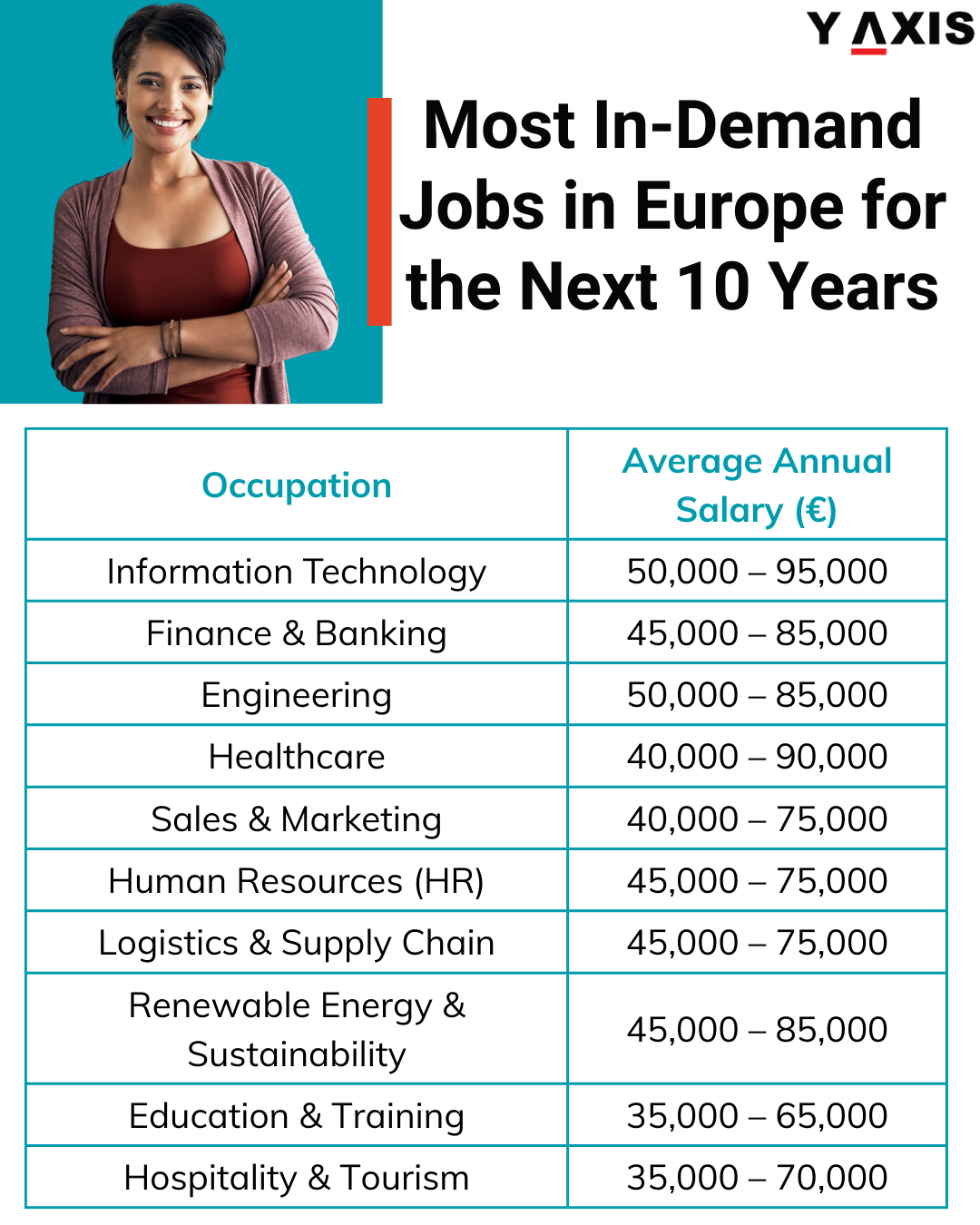
High-paying jobs in Europe are mainly found in sectors facing long-term skill shortages and strong investment. While salaries vary by country and experience, these occupations consistently offer attractive pay and stable career prospects across Europe.
List of high paying job opportunities in Europe:
|
Occupation |
Average Annual Salary (€) |
Job Outlook |
|
Information Technology |
50,000 – 95,000 |
Very High |
|
Finance & Banking |
45,000 – 85,000 |
High |
|
Engineering |
50,000 – 85,000 |
High |
|
Healthcare |
40,000 – 90,000 |
Very High |
|
Sales & Marketing |
40,000 – 75,000 |
Moderate |
|
Human Resources (HR) |
45,000 – 75,000 |
Moderate |
|
Logistics & Supply Chain |
45,000 – 75,000 |
High |
|
Renewable Energy & Sustainability |
45,000 – 85,000 |
High |
|
Education & Training |
35,000 – 65,000 |
Moderate |
|
Hospitality & Tourism |
35,000 – 70,000 |
Moderate |
Benefits of Working in Europe for Skilled Professionals
Europe offers long-term career stability for skilled professionals through strong labour protections, competitive salaries, and a balanced work culture. Many European countries actively support workforce mobility while investing in innovation, sustainability, and public services.
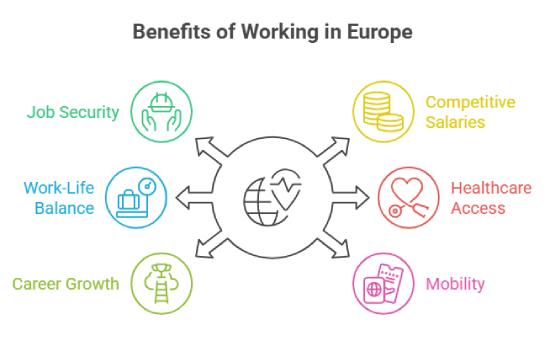
Key benefits for skilled professionals include:
- Strong labour laws and job security
- Competitive salaries and employee benefits
- Healthy work–life balance with generous paid leave
- Access to public healthcare and social security systems
- Career growth with global employers and innovative industries
- Opportunity to work across multiple European countries
Job Outlook in Europe for the Next 10 Years
Europe’s job outlook over the next decade remains strong due to persistent labour shortages and large-scale investment across key industries. The region already faces more than 5 million unfilled jobs, and this gap is expected to grow significantly by 2035 as populations age, birth rates decline, and digital transformation accelerates.
Demand will remain high across information technology, healthcare, engineering, renewable energy, construction, logistics, and advanced manufacturing. Continued investment in infrastructure, clean energy, digitalisation, housing, and industrial innovation will support long-term hiring, offering stable career opportunities for skilled professionals across Europe.
FAQs
What are the most in-demand jobs in Europe for the next 10 years?
The most in-demand jobs in Europe for the next 10 years will be in information technology, healthcare, engineering, renewable energy, construction and skilled trades, logistics, and advanced manufacturing. High-demand roles include software developers, data and AI specialists, cybersecurity experts, doctors and nurses, renewable energy engineers, construction managers, supply chain professionals, and skilled technicians. These jobs are driven by long-term skill shortages, ageing populations, and rapid economic transformation across Europe.
Why is job demand increasing in Europe over the next decade?
Job demand in Europe is increasing due to ageing populations, low birth rates, and a growing gap between available skills and labour market needs. Many workers are retiring faster than new talent enters the workforce. At the same time, large-scale investment by the European Union in infrastructure, clean energy, digitalisation, housing, and industrial innovation is accelerating hiring and creating millions of new job opportunities across key sectors.
Which sectors will create the most job opportunities in Europe?
The sectors expected to create the most job opportunities in Europe include IT and digital services, healthcare and social care, engineering, renewable energy, construction, logistics and supply chain, and advanced manufacturing. These sectors are expanding due to labour shortages, technological upgrades, sustainability targets, and infrastructure development. Employers across Europe continue to report difficulty filling roles, ensuring steady hiring demand through the next decade.
Are IT and technology jobs in high demand across Europe?
Yes, IT and technology jobs are in high demand across Europe and are expected to remain so for the next 10 years. Employers are actively hiring software developers, data analysts, AI and machine learning specialists, cloud engineers, and cybersecurity professionals. Digital transformation across industries, increased automation, and growing cyber risks are driving continuous demand, making technology roles among the most stable and future-proof careers in Europe.
What healthcare jobs will be most in demand in Europe?
Healthcare jobs will remain among the most in-demand roles in Europe over the next decade. Doctors, registered nurses, elderly care professionals, mental health specialists, physiotherapists, and medical laboratory technicians are especially sought after. Ageing populations and increased healthcare needs are placing pressure on healthcare systems. As a result, employers continue to recruit healthcare professionals to fill critical staffing shortages across hospitals and care facilities.
How important is renewable energy for Europe’s future job market?
Renewable energy is one of the fastest-growing employment sectors in Europe. Demand is increasing for renewable energy engineers, sustainability managers, environmental engineers, and energy efficiency specialists. Europe’s commitment to clean energy, climate targets, and carbon reduction is driving large-scale investment in solar, wind, electric vehicles, and green infrastructure. These initiatives are creating long-term job opportunities and making renewable energy careers highly stable.
Which European countries have the highest job demand?
European countries with the highest job demand include Germany, France, the Netherlands, Ireland, Sweden, Spain, and Portugal. These countries face labour shortages across technology, healthcare, engineering, renewable energy, construction, and logistics. Strong economic activity, ageing workforces, and continued public and private investment are driving consistent hiring. As a result, these countries offer some of the best long-term job opportunities in Europe.
What skills are required to get high-demand jobs in Europe?
High-demand jobs in Europe require a mix of technical, professional, and soft skills. Key skills include data analytics, AI and machine learning, cybersecurity, cloud computing, automation, renewable energy systems, healthcare expertise, and engineering knowledge. Employers also value communication, adaptability, teamwork, and problem-solving abilities. Professionals who continuously upgrade their skills are more competitive in Europe’s evolving job market.
How can skilled professionals prepare for job opportunities in Europe?
Skilled professionals can prepare for job opportunities in Europe by targeting in-demand sectors and upgrading relevant skills. This includes gaining recognised certifications, improving digital and language skills, and preparing a Europe-standard CV. Applying through trusted job portals and employer websites improves visibility. Understanding qualification recognition and work authorisation requirements early also helps align profiles with employer expectations.
What is the long-term job outlook in Europe for skilled professionals?
The long-term job outlook in Europe remains positive for skilled professionals. Labour shortages are expected to increase through 2035 as populations age and digital transformation accelerates. Strong demand across IT, healthcare, engineering, renewable energy, construction, logistics, and advanced manufacturing will continue to support hiring. Professionals with future-ready skills can expect stable employment and long-term career growth across Europe.
Tags:
Europe jobs
in-demand jobs
Europe job market
future careers
skilled professionals
high demand jobs
work in Europe
Share
Y-Axis Services

Get it on your mobile
Get News alerts
Contact Y-Axis
Latest Article
Popular Post
Trending Article

Posted On March 11 2026
Top 10 Countries Offering IT Jobs with Visa Sponsorship