

Posted on February 13 2026
3 Million Jobs in Germany Over the Next Decade: Job Outlook and Work Visa Options

By , Editor & Director
Updated February 13 2026
Germany is set to create around 3 million new and replacement jobs over the next decade, driven by large-scale retirements, steady industry growth, technological advancement, and rising investment in green energy and infrastructure. To meet this demand, German employers are increasingly hiring foreign graduates, freshers, and skilled professionals.
The government plans to invest over €1 trillion in infrastructure, industry, digital systems, defence, and renewable energy and has simplified immigration processes to speed up international hiring. Fast-track routes such as the Accelerated Skilled Worker Procedure and the Opportunity Card are helping address labour shortages and driving strong demand across IT, engineering, healthcare, manufacturing, logistics, automotive, renewable energy, and research, positioning Germany as a top European destination for long-term careers.
*Want to work in Germany? Avail Y-Axis Resume Marketing Services to find the right job faster.
Why Germany is one of the Best Countries for Jobs Abroad?
- Europe’s strongest and most stable economy
- Competitive salaries with strong labour protections
- Simplified immigration rules and fast-track hiring routes
- Healthy work–life balance with regulated working hours
- Access to public healthcare and social security benefits
- Job opportunities in global companies, manufacturing leaders, and R&D hubs
- Clear pathways to permanent residence and long-term settlement
Job Outlook in Germany over the Next Decade
Germany’s labour market is stable and set for long-term growth over the next decade, the country is expected to generate around 3 million new and replacement jobs, largely due to mass retirements, economic expansion, and continued investment in technology and infrastructure. As a significant portion of the workforce exits the labour market, employers are facing persistent skill shortages across both professional and technical roles.
To address these gaps, Germany is actively recruiting foreign talent and simplifying immigration processes. Government-backed initiatives and fast-track visa options are making it easier for international professionals to enter the workforce and secure long-term employment.
Key job market trends through 2035 include:
- Around 3 million job openings across multiple industries
- Large-scale retirements creating sustained labour shortages
- Strong demand in IT, engineering, healthcare, manufacturing, and logistics
- Increased reliance on foreign professionals to meet workforce needs
- Faster hiring through simplified work visa and permit processes
- Stable employment prospects supported by long-term public and private investment
Most In-Demand Jobs in Germany over the Next Decade
Germany’s labour shortages are expected to continue well into the next decade as retirements increase and economic demand expands. This has led to consistently high demand for skilled and semi-skilled professionals across both technical and service-based roles. Employers are actively hiring international workers to fill positions that cannot be met by the domestic workforce alone.
Job opportunities are especially strong in sectors that support Germany’s industrial base, digital transformation, and public services. Many of these roles also offer work visa sponsorship and long-term career stability.
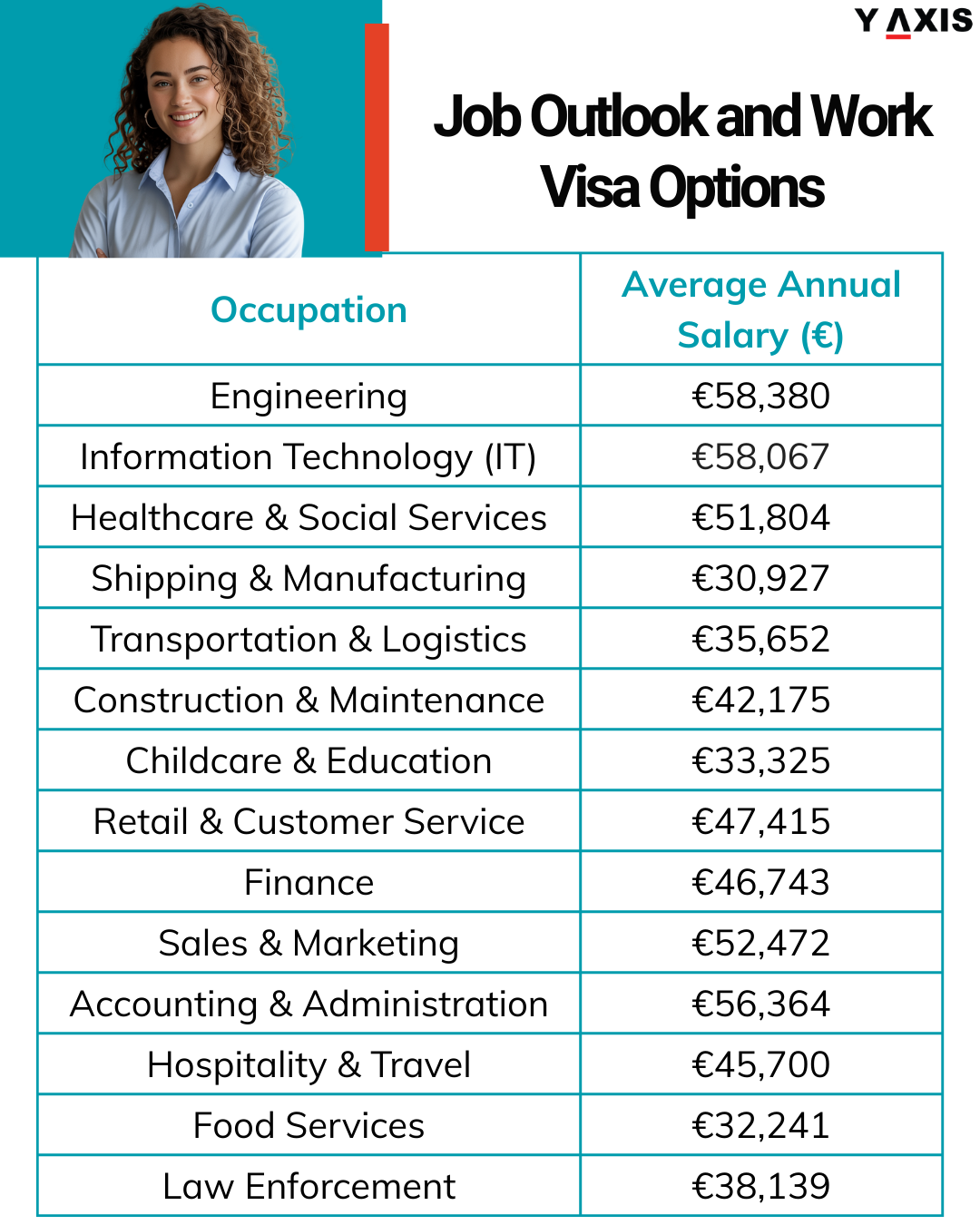
Some of the most in-demand jobs in Germany over the next decade:
|
Occupation |
Estimated Job Vacancies |
Average Annual Salary (€) |
|
Engineering |
700,000+ |
€58,380 |
|
Information Technology (IT) |
650,000+ |
€58,067 |
|
Healthcare & Social Services |
500,000+ |
€51,804 |
|
Shipping & Manufacturing |
600,000+ |
€30,927 |
|
Transportation & Logistics |
400,000+ |
€35,652 |
|
Construction & Maintenance |
500,000+ |
€42,175 |
|
Childcare & Education |
450,000+ |
€33,325 |
|
Retail & Customer Service |
550,000+ |
€47,415 |
|
Finance |
350,000+ |
€46,743 |
|
Sales & Marketing |
300,000+ |
€52,472 |
|
Accounting & Administration |
320,000+ |
€56,364 |
|
Hospitality & Travel |
380,000+ |
€45,700 |
|
Food Services |
350,000+ |
€32,241 |
|
Law Enforcement & Public Safety |
200,000+ |
€38,139 |
Also Read…
Fast-track Hiring options in Germany for Skilled Professionals
In-Demand Sectors and Job Roles in Germany for Foreign Professionals
Germany has ongoing skill shortages across key industries, making it easier for foreign professionals with the right qualifications and experience to find job opportunities. The strongest demand is in sectors such as renewable energy, IT, engineering, healthcare, construction, and logistics, where employers actively hire international talent.
|
Sector |
In-Demand Job Roles |
|
Information Technology |
Software developers, data scientists, cybersecurity specialists, cloud engineers, AI professionals, ERP consultants |
|
Engineering & Advanced Manufacturing |
Mechanical, electrical, automotive, industrial, and mechatronics engineers |
|
Healthcare & Life Sciences |
Doctors, nurses, elderly care workers, medical technicians, physiotherapists |
|
Renewable Energy & Sustainability |
Renewable energy engineers, wind & solar technicians, energy systems engineers, battery specialists, grid planners |
|
Construction & Skilled Trades |
Civil engineers, electricians, plumbers, HVAC technicians, welders, construction supervisors |
|
Logistics, Transport & Supply Chain |
Logistics managers, supply chain analysts, warehouse supervisors, freight coordinators, professional drivers |
|
Finance, Accounting & Business Services |
Accountants, auditors, financial analysts, tax consultants, compliance professionals |
|
Tourism & Hospitality |
Hotel managers, chefs, cooks, restaurant supervisors, hospitality service staff |
|
Education & Research |
University lecturers, research scientists, STEM teachers, academic researchers |
|
Sales, Marketing & Customer Support |
Sales managers, digital marketing specialists, business development managers, multilingual customer support staff |
Who Can Apply for Jobs in Germany as a Foreign Professional?
Germany welcomes foreign professionals at different career stages as long as they meet basic qualification and skill requirements. Due to ongoing labour shortages, employers are increasingly open to hiring foreign nationals, including fresh graduates and experienced professionals, across multiple sectors.
Freshers and Graduates
Germany offers entry-level and trainee roles for recent graduates, particularly in IT, engineering, logistics, healthcare, and business services. Candidates can use job-search visas such as the Opportunity Card to explore employment without a prior job offer. Once hired, employers commonly support work visa applications.
*Want to apply for German Opportunity Card? Let Y-Axis help you through the process.
Mid-Level Professionals
Professionals with relevant work experience are in high demand across IT, engineering, manufacturing, finance, and healthcare. Many employers sponsor work visas for skilled roles, offering long-term employment and career stability.
Senior and Specialist Professionals
Experienced specialists and leadership professionals are eligible for advanced roles and benefit from faster visa processing. Options such as the EU Blue Card provide quicker pathways to permanent residence and long-term settlement.
Step-by-Step Process to Apply for Jobs in Germany for Foreign Professionals
Step 1: Identify in-demand roles that match your qualifications, skills, and experience
Step 2: Search and apply through German job portals, company career pages, and professional networks
Step 3: Prepare a German-style CV that match job requirements
Step 4: Write a role-specific cover letter highlighting relevant experience and skills
Step 5: Attend online interviews and complete technical or skill assessments if required
Step 6: Secure a job offer and apply for the appropriate work visa
*Looking for Jobs in Germany? Sign up with Y-Axis Resume Marketing Services to find the right job faster.
Germany Work Visa Options for Foreign Professionals
Germany offers multiple work visa pathways to attract international talent and address long-term labour shortages. The right visa depends on your qualifications, work experience, and whether you already have a job offer.
 Some of the main pathways for working in Germany for foreign professionals include:
EU Blue Card
The EU Blue Card is designed for highly skilled professionals with a recognised university degree and a qualifying job offer. It offers higher salary thresholds, faster access to permanent residence, and long-term career stability, making it ideal for professionals planning to settle in Germany.
Skilled Worker Visa
This visa is suitable for professionals with recognised academic or vocational qualifications who have secured a job offer from a German employer. It covers a wide range of roles across IT, engineering, healthcare, manufacturing, logistics, and renewable energy.
Opportunity Card (Chancenkarte)
The Opportunity Card allows eligible candidates to enter Germany without a job offer to search for employment under a points-based system. It is suitable for graduates and skilled professionals who meet criteria such as qualifications, experience, age, and language skills.
Accelerated Skilled Worker Procedure
This employer-led option enables faster visa processing and quicker onboarding, helping skilled professionals start work in Germany sooner.
Can I Work in Germany Without a Job Offer?
Yes, you can move to Germany and work without having a job offer in advance by using the Opportunity Card (Chancenkarte). It allows skilled professionals to live in Germany for up to one year while looking for a full-time job. During this time, you’re allowed to work part-time (up to 20 hours a week) or take short trial jobs, which help you, earn income and gain local experience. Once you find a suitable job, you can switch to a regular work permit or EU Blue Card and start working full time.
Top Companies Hiring Foreign Professionals in Germany
Germany is home to many global companies that actively hire international professionals to address skill shortages. These employers operate across technology, engineering, manufacturing, healthcare, finance, and research, and many support work visa sponsorship. International hiring is most common for roles requiring specialised skills, technical expertise, or global experience, with large employers often offering relocation and immigration support.
Some of the leading companies hiring foreign professionals in Germany include:
|
Company |
Sector |
Chances of Visa Sponsorship |
|
SAP |
IT, Software, Cloud, AI, Data |
High |
|
Siemens |
Engineering, Automation, Energy, IT |
High |
|
BMW Group |
Automotive, Manufacturing, R&D, IT |
Medium–High |
|
Volkswagen Group |
Automotive, EV, Manufacturing, Software |
Medium–High |
|
Bosch |
Engineering, Electronics, AI, Automation |
High |
|
Deutsche Telekom |
IT, Cybersecurity, Telecom, Cloud |
High |
|
BASF |
Chemicals, Engineering, Sustainability, R&D |
Medium |
|
Deloitte Germany |
Consulting, Finance, IT, Analytics |
High |
|
Amazon Germany |
Logistics, Operations, IT, Cloud |
High |
|
Google Germany |
Software, AI, Data, Product |
Medium |
Also Read…
Visa Sponsorship Jobs in Germany for Skilled Professionals
Best Cities in Germany for Job Opportunities
Germany’s job growth is concentrated in major cities that act as hubs for industry, innovation, and international business. These cities offer stronger hiring activity, better access to global employers, and higher chances of work visa sponsorship for foreign professionals.
|
City |
Key Sectors |
Why Consider this City? |
|
Berlin |
IT, startups, fintech, media, research |
Europe’s startup hub with many English-speaking roles |
|
Munich |
Engineering, automotive, IT, aerospace, R&D |
Highest salaries and strong presence of global firms |
|
Frankfurt |
Finance, banking, consulting, IT |
Financial centre of Europe with strong corporate hiring |
|
Hamburg |
Logistics, shipping, aviation, engineering |
Major port city with trade and supply chain jobs |
|
Stuttgart |
Automotive, manufacturing, mechanical engineering |
Core hub of Germany’s automotive industry |
|
Cologne |
Media, IT, healthcare, logistics |
Large and diverse job market |
|
Düsseldorf |
Consulting, telecom, finance, corporate services |
Expat-friendly city with strong business presence |
|
Leipzig |
Manufacturing, logistics, renewable energy |
Fast-growing city with lower living costs |
How to Apply for a German Work Permit from Abroad?
To apply for a German work permit from abroad, you must first secure a job offer from a German employer and meet the eligibility requirements. Applications are submitted through the German embassy or consulate and vary depending on whether you apply for a Skilled Worker Visa or EU Blue Card.
Step by Step Process to apply for German Work Visa from Abroad:
Step 1: Check your eligibility
Step 2: Secure a job offer from a German employer
Step 3: Get your qualifications recognised, if required for your profession
Step 4: Collect required documents, including passport, CV, job contract, and proof of qualifications
Step 5: Apply for the relevant work visa, such as the EU Blue Card, Skilled Worker Visa, or Opportunity Card
Step 6: Book and attend a visa appointment at the German embassy or consulate
Step 7: Receive visa approval and make travel arrangements
Step 8: Register locally after arrival in Germany and begin employment
Tips to Improve Your Chances of Getting a Job in Germany
- Get your qualifications recognised before applying, especially for regulated professions
- Use a German-style CV and tailor your cover letter to each role and employer
- Focus on in-demand sectors such as IT, engineering, healthcare, manufacturing, and logistics
- Apply through official job portals, company career pages, and LinkedIn
- Learn basic German language skills to improve hiring chances and career growth
- Use fast-track visa options once a job offer is secured
FAQs
How many jobs will be available in Germany over the next decade?
Germany is expected to create around 3 million new and replacement jobs over the next decade due to mass retirements, economic expansion, and large-scale investment in infrastructure, digitalisation, and green energy. Labour shortages across IT, engineering, healthcare, manufacturing, and logistics are driving strong demand for foreign professionals, graduates, and skilled workers, making Germany one of the top destinations for jobs abroad.
Why is Germany creating 3 million jobs over the next 10 years?
Germany’s job growth is driven by an ageing workforce, steady industrial growth, and rising investment in technology, renewable energy, and infrastructure. Large-scale retirements are creating millions of replacement jobs, while sectors such as IT, healthcare, engineering, and manufacturing continue to expand. To fill these gaps, Germany is actively hiring foreign professionals and simplifying work visa and immigration processes.
What is the job outlook in Germany for foreign professionals?
The job outlook in Germany for foreign professionals is very strong over the next decade. With persistent labour shortages, employers are increasingly relying on international talent to fill skilled and semi-skilled roles. High demand exists in IT, engineering, healthcare, logistics, construction, and renewable energy. Simplified visa pathways and long-term employment prospects make Germany attractive for overseas workers.
Which sectors will have the highest job demand in Germany?
Germany’s highest job demand will be in information technology, engineering, healthcare, manufacturing, logistics, construction, and renewable energy. Digital transformation and automation are boosting IT roles, while ageing demographics are increasing healthcare demand. Infrastructure and sustainability projects are creating jobs in construction and green energy, offering strong opportunities for foreign professionals seeking work visa sponsorship.
What are the most in-demand jobs in Germany for foreigners?
The most in-demand jobs in Germany for foreigners include software developers, engineers, healthcare workers, data scientists, logistics professionals, electricians, and renewable energy specialists. Germany faces long-term skill shortages in both technical and service-based roles, encouraging employers to hire international workers. Many of these jobs offer competitive salaries, visa sponsorship, and pathways to permanent residence.
Can freshers and international graduates get jobs in Germany?
Yes, freshers and international graduates can get jobs in Germany, especially in IT, engineering, logistics, healthcare, and business services. Germany offers entry-level roles, trainee programs, and graduate schemes. The Opportunity Card allows graduates to search for jobs without a prior offer. Once hired, employers commonly support work visa applications for long-term employment.
Is Germany hiring foreign skilled workers without experience?
Germany is hiring foreign workers with limited experience, particularly in shortage occupations and entry-level roles. While experienced professionals are preferred, graduates with recognised qualifications, technical skills, or internships are also in demand. Sectors such as IT, engineering, logistics, and healthcare offer opportunities for early-career professionals, supported by job-search visas and employer-sponsored work permits.
What is the average salary in Germany for foreign professionals?
The average salary in Germany for foreign professionals ranges between €45,000 and €60,000 per year, depending on the industry and experience. IT and engineering roles often offer higher salaries, while healthcare and technical jobs provide stable income and benefits. Germany’s structured pay scales, labour protections, and social security benefits make it attractive for long-term career growth.
What work visa options are available for Germany?
Germany offers several work visa options for foreign professionals, including the EU Blue Card, Skilled Worker Visa, Opportunity Card, and the Accelerated Skilled Worker Procedure. Each visa suits different qualification levels and employment situations. These pathways make it easier for skilled workers, graduates, and experienced professionals to work and settle in Germany long term.
What is the EU Blue Card Germany and who can apply?
The EU Blue Card Germany is designed for highly skilled professionals with a recognised university degree and a qualifying job offer. It offers higher salary thresholds, faster permanent residence, and family reunification benefits. The EU Blue Card is popular among IT specialists, engineers, doctors, and researchers planning long-term careers in Germany.
What is the Germany Skilled Worker Visa?
The Germany Skilled Worker Visa allows foreign professionals with recognised academic or vocational qualifications to work in Germany. Applicants must have a valid job offer from a German employer. This visa covers roles across IT, engineering, healthcare, manufacturing, logistics, and renewable energy and offers a pathway to permanent residence after meeting eligibility requirements.
What is the Opportunity Card (Chancenkarte) in Germany?
The Opportunity Card is a points-based visa that allows skilled professionals to move to Germany without a job offer and search for employment for up to one year. It permits part-time work during the job search period. Once a suitable job is secured, candidates can switch to a Skilled Worker Visa or EU Blue Card.
Can I work in Germany without a job offer?
Yes, you can work in Germany without a job offer by applying for the Opportunity Card. This visa allows skilled professionals to live in Germany while searching for employment. During this period, part-time work and trial jobs are permitted. After securing a full-time job, you can transition to a regular work permit or EU Blue Card.
How do I apply for jobs in Germany from abroad?
To apply for jobs in Germany from abroad, identify in-demand roles that match your qualifications and apply through job portals, company websites, and LinkedIn. Prepare a German-style CV and tailored cover letter. Attend online interviews and assessments. Once you receive a job offer, apply for the appropriate German work visa.
How long does it take to get a German work visa?
German work visa processing times usually range from 8 to 12 weeks, depending on the visa type and country of application. The Accelerated Skilled Worker Procedure can significantly reduce processing time. Submitting complete documents, recognised qualifications, and employer support helps avoid delays and speeds up approval.
Which companies in Germany hire foreign professionals?
Many global and German companies actively hire foreign professionals due to skill shortages. Employers in IT, engineering, automotive, healthcare, consulting, and logistics frequently sponsor work visas. Large multinational firms and manufacturing leaders often offer relocation support, long-term contracts, and career growth opportunities for international employees.
Which cities in Germany offer the best job opportunities?
Cities such as Berlin, Munich, Frankfurt, Hamburg, Stuttgart, Cologne, Düsseldorf, and Leipzig offer the best job opportunities in Germany. These cities are major hubs for IT, finance, engineering, manufacturing, logistics, and research. They provide higher salaries, better visa sponsorship prospects, and expat-friendly work environments.
Is German language required to work in Germany?
German language skills are not mandatory for all jobs, especially in IT, engineering, research, and multinational companies where English is widely used. However, learning basic German improves job prospects, workplace integration, and long-term career growth. Regulated professions like healthcare often require German language proficiency.
Can working in Germany lead to permanent residence?
Yes, working in Germany can lead to permanent residence. Foreign professionals on work visas such as the EU Blue Card or Skilled Worker Visa can apply for permanent residence after meeting employment and residency requirements. Stable income, social security contributions, and basic German language skills improve eligibility for long-term settlement.
How can foreign professionals increase their chances of getting a job in Germany?
Foreign professionals can increase their chances by targeting in-demand sectors, preparing a German-style CV, and tailoring applications for each role. Getting qualifications recognised, learning basic German, and applying through official job portals and company websites are essential. Using fast-track visa options also improves hiring success.
Tags:
jobs in Germany
Germany job opportunities
Germany job market
work in Germany
Share
Y-Axis Services
Get it on your mobile
Get News alerts
Contact Y-Axis
Latest Article
Popular Post
Trending Article
Posted On July 23 2026
Top 10 Countries for Doctors to Work Abroad: Salary, Demand & PR Opportunities Compared